Translate

segunda-feira, 25 de junho de 2018

O Fantástico Sr. Anderson: ranqueando a filmografia do diretor mais excêntrico de todos os tempos (Bilíngue) [ATUALIZADO]


E não se esqueçam de curtir a página do blog no Facebook:
(And don't forget to like the blog's Facebook page:)

E aí, galerinha de cinéfilos! Aqui quem fala é o João Pedro! Como vocês bem sabem, eu sou muito fã dos filmes do diretor Wes Anderson. Os filmes dele são caracterizados por ter elencos de primeira linha, direções de fotografia de tirar o fôlego, design de produção em tons pastel, trilhas sonoras nostálgicas, passo acelerado, e por te dar uma vontade de ver os seus filmes de novo, porque todos são ótimos. E para celebrar o lançamento do seu novo filme, Ilha dos Cachorros, que estreará dia 19 de julho, irei fazer um ranking dos filmes desse excêntrico diretor, e irei atualizá-lo quando eu ver seu novo filme. Irei incluir aqui, dentre os curtas dele, apenas Hotel Chevalier, que serve como um prólogo para Viagem à Darjeeling. Então, vamos lá!
(What's up, film buffs! João Pedro here! As you well know, I am a huge fan of Wes Anderson's films. His movies are characterized by its A-list casts, breathtaking cinematography, pastel-colored production design, nostalgia-filled soundtracks, fast pace, and by giving you a huge will to watch them again, because they are all great. And to celebrate the release of his new film, Isle Of Dogs, I will rank the filmography of this eccentric director, and will update it when I see his new film. I will include here, among his short films, only Hotel Chevalier, which serves as a prologue to The Darjeeling Limited. So, let's go!)


10 – VIAGEM À DARJEELING (2007) (THE DARJEELING LIMITED)
Como eu falei acima, todos os filmes do Wes são bons. Viagem à Darjeeling talvez seja o mais estranho que ele já fez. Mas o filme possui muitos pontos fortes: Adrien Brody, Owen Wilson e Jason Schwartzman estão muito bem como três irmãos em conflito que não se encontram há muito tempo, é bem restrito à um ambiente, sendo que a maioria do filme se passa em um trem, a trilha sonora é fantástica, contando com uma das canções mais icônicas dentro dos filmes do Wes (“Strangers”, da banda The Kinks), a fotografia e o design de produção são excelentes. Mas devemos levar em conta que o Wes já tinha lançado sucessos como Os Excêntricos Tenenbaums e Três é Demais antes de Viagem à Darjeeling. O filme é bom, mas não chega aos pés dos filmes pelos quais o Wes foi indicado ao Oscar (Tenenbaums, Moonrise Kingdom, O Fantástico Sr. Raposo e O Grande Hotel Budapeste), por isso coloco esse em décimo lugar.
(As said above, all of Wes' films are great. The Darjeeling Limited may be his weirdest one yet. Although it has several strengths: Adrien Brody, Owen Wilson and Jason Schwartzman are very good as a conflicting trio of brothers that haven't seen each other in a long time, it is very restricted to one setting, as most of it is set in a train, the soundtrack is fantastic, with one of the most iconic song in Wes Anderson films (“Strangers”, by The Kinks), the cinematography and production design are excellent. But we should notice that Wes had already released hits like The Royal Tenenbaums and Rushmore before The Darjeeling Limited. It is good, but it doesn't reach the levels of the films which Wes was Oscar-nominated for (Tenenbaums, Moonrise Kingdom, Fantastic Mr Fox and The Grand Budapest Hotel), that's why I put this one in tenth place.)


9 – PURA ADRENALINA (1996) (BOTTLE ROCKET)
Muitos diretores fazem um tremendo sucesso com seus primeiros filmes: Quentin Tarantino, Hayao Miyazaki, Guillermo del Toro, e por aí vai. O Wes também obteve sucesso com seu primeiro filme, feito em 1996, com seus colegas de faculdade, Owen e Luke Wilson. Feito como um curta primeiramente, digamos que o Wes aqui ainda não tinha se tornado o Wes do Moonrise Kingdom. Era um Wes mais jovem, nas palavras de Dignan, interpretado por Owen Wilson, mais inocente. Feito com apenas 7 milhões de orçamento, o que é bom para um filme independente, Wes já começou grandes parcerias com seu primeiro filme, incluindo com o diretor de fotografia Robert Yeoman, que trabalhou em todos os seus filmes live-action até agora. O roteiro é deveras simples, não possuía aquele passo acelerado presente em Moonrise, Hotel Budapeste e Sr. Raposo, mas mostrava que Wes Anderson era um diretor cuja obra valia a pena acompanhar. O filme possui falas memoráveis (“'Cause I'm fucking innocent.”), um elenco pequeno, mas primoroso, composto pelos irmãos Wilson e James Caan, e um trabalho de câmera muito bem feito. Novamente digo, o filme é bom, mas como disse um pouco acima, o Wes ainda não era o Wes de seus filmes mais recentes, então por isso, nono lugar.
(A lot of directors make a huge success with their first films: Quentin Tarantino, Hayao Miyazaki, Guillermo del Toro, and so it goes. Wes also obtained success with his first film, made in 1996, with his friends from college, Owen and Luke Wilson. Primarily made as a short film, let's say Wes wasn't the Moonrise Kingdom Wes here. He was younger and, in the words of Dignan, portrayed by Owen Wilson, innocent. Made with only 7 million as budget, which is good for an indie, Wes already begun grand partnerships with his first flick, including DoP Robert Yeoman, who worked on all of his live-action films so far. The script is rather simple, it didn't possess that fast pace that Moonrise, Grand Budapest or Mr. Fox had, but it showed that Wes Anderson was a director whose work was worth following. It has memorable lines (“'Cause I'm fucking innocent.”), a small, but promising cast, composed by the Wilson brothers and James Caan, and a well-done camerawork. Saying it again, it's a good movie, but as said above, Wes still wasn't the Wes from his recent films, and because of that, ninth place.)


8 – A VIDA MARINHA COM STEVE ZISSOU (2004) (THE LIFE AQUATIC WITH STEVE ZISSOU)
Talvez o mais subestimado da filmografia de Wes Anderson, esse filme, que conta a história de um explorador que faz documentários sobre suas expedições e que deseja vingança contra uma criatura misteriosa que matou seu melhor amigo, foi o mais detonado pela crítica que o Wes já fez. Contando com um elenco fantástico (Bill Murray, Anjelica Huston, Cate Blanchett, Owen Wilson, Willem Dafoe, Jeff Goldblum, e por aí vai), esse é um outro filme com uma história meio esquisita. O que me fez impulsionar esse filme para o oitavo lugar consiste em 4 coisas:
  1. O Wes já estava amadurecido, tendo feito Três é Demais e Os Excêntricos Tenenbaums;
  2. Tem uma carga emocional maior do que os dois filmes citados acima;
  3. As criaturas aquáticas criadas para o filme, como o tubarão-jaguar, foram desenhadas por ninguém menos do que Henry Selick, responsável por O Estranho Mundo de Jack e Coraline;
  4. Tem uma trilha sonora composta apenas por músicas do enigmático David Bowie, traduzidas para o PORTUGUÊS pelo Seu Jorge, que também atua no filme.
É um Moonrise Kingdom ou um Grande Hotel Budapeste? Não. Mas é inegável o fato que Steve Zissou se tornou um dos personagens mais icônicos da carreira do diretor, ficando, nesse ranking, em oitavo lugar.
(Perhaps the most underrated one in Wes's filmography, this film, which tells the story of an explorer who makes documentaries on his expeditions and who wishes to avenge his best friend, who was killed by a mysterious creature, received the least amount of positive reviews in Wes's career.
With a fantastic cast (Bill Murray, Anjelica Huston, Cate Blanchett, Owen Wilson, Willem Dafoe, Jeff Goldblum, etc.), this is another film with a kind of weird story.
What made me boost this film into eighth place consists in 4 things:
  1. Wes has already matured, having in his filmography hits like Rushmore and The Royal Tenenbaums;
  2. It has a bigger emotional charge than the two films above;
  3. The aquatic creatures made for the film, like the jaguar shark, were designed by none other than Henry Selick, director of The Nightmare Before Christmas and Coraline;
  4. Its soundtrack is composed, in its entirety, by songs from the enigmatic David Bowie, translated for PORTUGUESE by Seu Jorge, who is an actor in the film as well.
Is it like Moonrise Kingdom or Grand Budapest Hotel? No. But it's undeniable that Steve Zissou is one of the most iconic characters in the director's career, placing the film, in this particular ranking, in eighth place.)


7 – HOTEL CHEVALIER (2007)
Como disse na introdução, esse é o único curta que avaliarei do Wes, pelo fato de Hotel Chevalier ser um prólogo de Viagem à Darjeeling. Esse curta de 13 minutos acompanha a estadia de um dos irmãos Whitman, Jack (Jason Schwartzman) em um hotel na França, cujo nome leva o do curta. Do nada, surge Rhett (Natalie Portman), uma ex-namorada de Jack, disposta a retomar o relacionamento. Eu simplesmente adorei esse curta, inclusive, gostei mais dele do que Viagem à Darjeeling. Não é tão cheio quanto o filme que o segue, é curto, preciso, romântico, bem escrito, bem atuado e bem dirigido. Schwartzman e Portman estão ótimos, e o curta é uma boa pedida se aparecerem algumas referências sobre a ex e sobre o hotel em “Darjeeling”. Ele tem uma fantástica direção de arte, com o amarelo dominando o cenário, e possui como trilha sonora uma música que fica na sua cabeça muito tempo depois de assistir ao curta (Where Did You Go To (My Lovely?), de Peter Sardsedt), que inclusive, está na trilha de “Darjeeling”. Contando que tanto Hotel Chevalier quanto Darjeeling são os últimos filmes antes do que eu chamo da “Trilogia de Ouro de Wes Anderson” (O Fantástico Sr Raposo, Moonrise Kingdom, e O Grande Hotel Budapeste), mas não chegam a ser melhores do que os top 5, coloco o curta em sétimo lugar.
(As said in the introduction, this is the only short film of Wes's I'll consider, as Hotel Chevalier is a prologue to The Darjeeling Limited. This 13-minute short film follows the stay of one of the Whitman brothers, Jack (Jason Schwartzman) in a hotel in France, named after the short film. Out of nowhere, Rhett (Natalie Portman), Jack's ex-girlfriend, comes in, willing to continue their relationship. I simply loved this short film, even more than I did with The Darjeeling Limited. It isn't as overstuffed as “Darjeeling”, it's short, concise, romantic, well-written, well-acted, and well-directed. Schwartzman and Portman are great together, and the short is a nice call if there are some references to the ex and the hotel in “Darjeeling”. It has an amazing art direction, with yellow dominating the set, and has, as soundtrack, a song that sticks in your head long after you've seen the short (Where Did You Go To (My Lovely?), by Peter Sardsedt), which is also in the “Darjeeling” soundtrack. Counting that Chevalier and Darjeeling were the last films before what I call the “Wes Anderson's Golden Trilogy” (Fantastic Mr. Fox, Moonrise Kingdom and The Grand Budapest Hotel), but aren't as good as the top 5, I put the short in seventh place.)


6 – OS EXCÊNTRICOS TENENBAUMS (2001) (THE ROYAL TENENBAUMS)
Chegamos ao favorito dos fãs. Sendo o primeiro filme do Wes indicado ao Oscar (Melhor Roteiro Original), Tenenbaums foi um marco na carreira do diretor. Tendo um elenco mais que estelar (Gene Hackman, Anjelica Huston, Ben Stiller, Gwyneth Paltrow, Luke Wilson, Owen Wilson, Danny Glover, Bill Murray, e por aí vai), uma trilha sonora icônica (“Hey Jude”, “Needle in the Hay”, e “Me and Julio Down By The Schoolyard”), e um roteiro pra lá de excêntrico, Tenembaums é uma obra-prima das comédias dos anos 2000, e ainda sendo o terceiro filme do Wes, três anos depois do filme que o lançou ao sucesso indie, “Três é Demais”. Tem falas memoráveis, atuações que provavelmente são algumas das melhores que os atores já fizeram, um trabalho de câmera impecável, com enquadramentos perfeitos, e um desenvolvimento rápido. O roteiro de Wes e Owen Wilson consegue misturar comédia e drama perfeitamente, com momentos que você ri alto, e também possui momentos que você chega a chorar. Sendo um dos 100 melhores filmes do século XXI, de acordo com a BBC, Os Excêntricos Tenenbaums é imperdível e inesquecível, e totalmente recomendo para aqueles que desejam uma comédia diferente.
(We're here with the fan favorite. Being Wes's first Oscar-nominated film (Best Original Screenplay), Tenenbaums was a landmark in the director's career. With a more than stellar cast (Gene Hackman, Anjelica Huston, Ben Stiller, Gwyneth Paltrow, Luke Wilson, Owen Wilson, Danny Glover, Bill Murray, and it goes further), an iconic soundtrack (“Hey Jude”, “Needle in the Hay” and “Me and Julio Down By The Schoolyard”), and one hell of an eccentric script, Tenenbaums is a masterpiece of 2000s comedy, and still being Wes's third film, three years after the film which launched him into indie success, “Rushmore”. It has memorable lines, performances which may be the actors' best ones yet, an impeccable camera work, with perfect framing, and a fast-paced development. The script written by Wes and Owen Wilson can mix comedy with drama perfectly, with laugh-out-loud moments, but also with I'm-going-to-cry moments. Being one of the 100 greatest films in the 21st century, according to the BBC, The Royal Tenenbaums is an unforgettable must-see, and I totally recommend it to the ones who seek a different kind of comedy.)


5 – TRÊS É DEMAIS (1998) (RUSHMORE)
Foi aqui que Wes estava começando a se tornar o Wes que conhecemos agora. Rushmore começou duas parcerias atemporais com Wes: Bill Murray e Jason Schwartzman, que, de um jeito ou outro, estão presentes nos filmes seguintes dele. O filme é uma comédia de amadurecimento sobre um dramaturgo jovem, Max Fischer (Schwartzman), que estuda em uma escola prestigiada, onde ele se apaixona por uma professora do primário (Olivia Williams), que involuntariamente, também vira alvo das cantadas de Herman Blume (Murray), um homem de negócios. Começa então, um jogo de gato e rato entre Fischer e Blume pelo coração da professora. Max Fischer talvez seja o melhor personagem que o Wes já criou, não sei se é porque eu e ele temos idades similares, mas dos personagens do Wes, a minha identificação fica com uma junção de Max com Sam Shakusky, de Moonrise Kingdom. O filme é deveras tragicômico, ele meio que faz o que Tenenbaums fez tão bem, mistura comédia com um pouquinho de drama, momentos de ira, melancolia, afinal, o normal para um adolescente como Max. As atuações aqui estão fantásticas: Jason Schwartzman (em seu papel de estreia) arrasa como Max, enfrentando todos os clichês de um adolescente com hormônios à flor da pele, mas dando uma leve reviravolta nos eventos; Olivia Williams e Bill Murray também dão um show, tendo papéis melancólicos, onde você meio que sente o que o personagem está sentindo naquele momento. O elenco coadjuvante também tem tempo de mostrar o que tem, com destaque para Brian Cox, Mason Gamble e Seymour Cassel. Estreando algumas das marcas registradas de Wes Anderson, Três é Demais é um dos melhores e mais diferentes filmes sobre amadurecimento que já vi, mas ainda não chega aos pés da Trilogia de Ouro, então, quinto lugar.
(It was here that Wes was starting to become the Wes we know now. Rushmore started two timeless partnerships with Wes: Bill Murray and Jason Schwartzman, who, one way or another, are present in his following films. The film is a coming of age comedy about a young playwright, Max Fischer (Schwartzman), who studies in a prestigious school, where he falls in love with a first grade teacher (Olivia Williams), who, in an involuntary manner, also becomes a target to the wooing of Herman Blume (Murray), a businessman. That starts a cat and mouse game between Fischer and Blume for the teacher's heart. Max Fischer may be the best character Wes has ever created, I don't know if it's because we have similar ages, but of all of his characters, my identification is a junction between Max and Moonrise Kingdom's Sam Shakusky. The film is slightly tragicomic, it kinda does what Tenenbaums did so well, mixing comedy with a little bit of drama, moments of anger, melancholy, after all, the usual for an adolescent like Max. The performances here are fantastic: Jason Schwartzman (in his debut role) crushes it as Max, facing all the clichés a teen with raging hormones has to, but with a slight twist to it; Olivia Williams and Bill Murray also bring unforgettable performances, with melancholic roles, where you kinda feel what the character is feeling at that scene. The supporting cast also has time to show what they got, especially Brian Cox, Mason Gamble and Seymour Cassel. Debuting some of the trademarks of Wes Anderson, Rushmore is one of the best and most different coming of age films I've ever seen, but still not as good as the Golden Trilogy, so, fifth place.)


4 – O GRANDE HOTEL BUDAPESTE (2014) (THE GRAND BUDAPEST HOTEL)
Chegamos a um dos mais recentes filmes do Wes, já fazendo parte da sua Trilogia de Ouro. Vencedor de 4 Oscars, e indicado a 9, incluindo Melhor Filme, O Grande Hotel Budapeste é, provavelmente, o melhor exemplo de direção de arte que eu já vi. Como é um filme com camadas, vamos por partes:
  1. Técnica: o trabalho de fotografia aqui é maravilhoso, e deveria ter levado o Oscar, digo o mesmo da direção de arte, que ganhou o Oscar com seus tons em pastel. É impressionante o uso do formato da tela para significar passagem de tempo (4x3 para passado, e 16x9 para presente), representando a melhor parceria do Wes com o diretor de fotografia Robert Yeoman. As maquetes do hotel são muito bem feitas, o interior tem uma decoração impecável, que até me deu vontade de me mudar pra lá (até eu descobrir que diferentes cômodos foram filmados em diferentes locações), e os doces da confeitaria Mendl's me deram aquele desejo que essa confeitaria existisse na vida real.
  2. Atuações: Agora o Wes atingiu o pico de “elenco estelar”. Ralph Fiennes, Tilda Swinton, Saoirse Ronan, Adrien Brody, Jeff Goldblum, Willem Dafoe, Léa Seydoux, Bill Murray, Jason Schwartzman, Edward Norton, Owen Wilson, Jude Law, Harvey Keitel, F. Murray Abraham, Mathieu Amalric, Tom Wilkinson e o estreante Tony Revolori dão um tremendo show nas atuações, com destaque para o Ralph Fiennes, que tem um papel que deveria ter sido indicado ao Oscar como o pomposo M. Gustave H. Se você não se sentiu atraído pela história ou pelos aspectos técnicos, você definitivamente iria ficar assistindo pelo elenco. Quem não iria?
  3. Roteiro e direção: Até o momento, esse foi o único filme que indicou o Wes ao top 3: Melhor Filme, Direção e Roteiro. E, sinceramente, ele deveria ter levado os 3, por ter uma história original pra contar (Birdman parece ter sido um roteiro adaptado da vida do Michael Keaton), por dirigir sua equipe de uma maneira maravilhosa, praticamente impecável, e por criar um filme que definitivamente, será discutido nos tempos que estão por vir.
Sei que pode causar um pouco de polêmica, mas essa é a MINHA OPINIÃO, e cada um tem a sua. Terminando a Trilogia de Ouro, e abrindo portas para Ilha dos Cachorros, O Grande Hotel Budapeste é uma obra-prima técnica e narrativa perfeitamente construída, e representa Wes Anderson em sua melhor forma.
(We're now in one of Wes's most recent films, already being a part of his Golden Trilogy. A 4-Oscar winner, and nominated for 9, including Best Picture, The Grand Budapest Hotel is, probably, the greatest example of art direction I've ever seen. As it's a film with layers, let's analyze it by parts:
  1. Technical: the cinematography work here is wonderful, and should've taken the Oscar, same said about the art direction, which took the Oscar home with its pastel-coloured palette. It's impressive how the format of the screen is used to represent time passing by (4x3 for past, 16x9 for present), representing the best partnership between Wes and director of photography Robert Yeoman. The scale models of the hotel are really well made, the interior is well decorated, and I truly wanted to move to the hotel (until I found out that different rooms were filmed in different locations), and the sweets in the Mendl's bakery made me wish that it really existed.
  2. Acting: Now, Wes has reached the pinnacle of “stellar cast”. Ralph Fiennes, Tilda Swinton, Saoirse Ronan, Adrien Brody, Jeff Goldblum, Willem Dafoe, Léa Seydoux, Bill Murray, Jason Schwartzman, Edward Norton, Owen Wilson, Jude Law, Harvey Keitel, F. Murray Abraham, Mathieu Amalric, Tom Wilkinson and debut actor Tony Revolori give one hell of a show, especially Ralph Fiennes, in a role that should've been Oscar-nominated, as the flamboyant M. Gustave H. If you didn't feel attracted by the story or the technical aspects, you definitely would've sit through just for the cast. Who wouldn't?
  3. Writing and directing: Right now, Grand Budapest is the only movie that nominated Wes for the Top 3: Best Picture, Director and Screenplay. And, honestly, he should've taken all 3, for having an original story to tell (Birdman looks like an adapted screenplay based on Michael Keaton's life), for directing his team in a wonderful, practically flawless way, and for creating a film that definitely, will be discussed in times to come.
I know it will cause some controversy, but this is MY OPINION, and everyone has their own.
Closing the Golden Trilogy, and opening the doors for Isle of Dogs, The Grand Budapest Hotel is a perfectly built narrative and technical masterpiece, and it represents Wes Anderson in his best form.)


3 - ILHA DOS CACHORROS (2018) (ISLE OF DOGS)

http://nocinemacomjoaopedro.blogspot.com/2018/07/ilha-dos-cachorros-como-wes-anderson.html


2 – O FANTÁSTICO SR. RAPOSO (2009) (FANTASTIC MR. FOX)
Começando a Trilogia, temos o filme que é, até o momento, o único que não é original. O Fantástico Sr. Raposo é baseado no livro de Roald Dahl, responsável por Matilda e A Fantástica Fábrica de Chocolate, e conta a história de uma raposa, que, para sustentar sua família, rouba suprimentos e alimentos de um trio de fazendeiros. O que ele não esperava é que os fazendeiros iriam se voltar contra ele. Sendo o primeiro filme de animação do Wes, e o stop-motion não poderia ser uma escolha melhor, aqui foi onde a marca registrada do passo rápido mais se consolidou, pois o filme possui apenas 1h26min de duração, e como meu pai diz, é preciso de várias assistidas para entender o filme por inteiro, ou ver o filme em uma velocidade menor do que o normal, porque passa bem mais rápido do que os filmes live-action do Wes. No elenco, temos pessoas que já estão familiarizadas com o Wes (Jason Schwartzman e Bill Murray, o próprio Wes faz um personagem no filme), com a verdadeira realeza de Hollywood, com George Clooney e Meryl Streep como o Sr. e Sra. Raposo, e eles mandam muito bem. O roteiro é uma maravilha à parte. Sabemos que não é original, mas o Wes trabalha muito bem o material fonte, dando uma nova cara a ele. O filme começa uma nova parceria com o Wes: o compositor Alexandre Desplat, que, inclusive, venceu o Oscar de Melhor Trilha Original por O Grande Hotel Budapeste, fez as trilhas dos filmes da Trilogia e do vindouro Ilha dos Cachorros. Temos aqui um novo diretor de fotografia também, Tristan Oliver, que faz um trabalho lindo demais com o visual do filme, rendendo vários frames dignos de serem papéis de parede, e eu mal posso esperar pra ver o trabalho dele em Ilha dos Cachorros.
Pode-se dizer que o filme é uma das criações mais poéticas do Wes, como o filme é uma análise do comportamento dos animais, particularmente os selvagens, e o filme poderia ter sido feito com personagens humanos e ainda ter dado um efeito, pois seria uma análise de o quão longe um homem iria pra sustentar sua família. O filme possui uma das cenas mais poéticas do cinema que já vi, fica bem pertinho do final, e acho que se você ver, você vai saber qual.
Sendo, provavelmente, um dos melhores filmes de animação que eu já vi, se não o melhor, O Fantástico Sr. Raposo é um filme tecnicamente perfeito, narrativamente cativante e, de fato, fantástico, e totalmente disposto a ser assistido repetidas vezes.
(Starting off the Trilogy, we have the film which is, at the moment, the only one which isn't original. Fantastic Mr. Fox is based on the book written by Roald Dahl, responsible for Matilda and Charlie and The Chocolate Factory, and tells the story of a fox who, in order to sustain his family, steals supplies and food from a trio of farmers. What he didn't expect is that the farmers were going to turn on him. As Wes's first animated film, and stop-motion couldn't be a better choice, it was here that the fast pace trademark was consolidated, as the film is only 1 hour and 26 minutes long, and as my dad says, you need to watch it several times to get it by whole, or watch it in a slower speed than usual, because it goes a lot faster than Wes's live-action films. In the cast, we have people who are already familiar with Wes's work (Jason Schwartzman and Bill Murray, Wes himself voices a character), with real Hollywood royalty, with George Clooney and Meryl Streep as Mr. and Mrs. Fox, and they crush it. The script is a particular wonder. We know it's not original, but Wes works with the book really well, giving it a new identity. The film starts off a new partnership: composer Alexandre Desplat, who won the Oscar for Best Original Score for The Grand Budapest Hotel, scored all of the Trilogy and Isle of Dogs. We have a new director of photography as well, Tristan Oliver, who does a marvelous work with the movie's visuals, and I can't wait to see his work on Isle of Dogs.
It can be said that the film is one of Wes's more poetic works, as it analyzes the behavior of animals, especially wild ones, and it could be easily made with human characters, and still have some effect, as it would be an analysis on how far a man would go to sustain his family. It has one of the most poetic scenes in cinema history for me, it's pretty close to the ending, and I think you'll notice if you watch.
Being, probably, one of the best animated films I've ever seen, if not the best, Fantastic Mr. Fox is a technically perfect, narratively captivating, and, indeed, fantastic film, totally willing to be watched several times.)


1 – MOONRISE KINGDOM (2012)
Vocês esperavam outra coisa? Eu não. (Risos) Quem me conhece sabe que eu AMO Moonrise Kingdom, e considero ele como não só o melhor filme do Wes, mas também como o melhor filme de todos os tempos. Pode ser difícil de entender para vocês, mas por isso, vamos analisar o filme por camadas, me imaginando com 12 anos, na primeira vez que eu assisti:
  1. Identificação com personagens principais: Eu disse no “Três é Demais” que minha identificação com um personagem do Wes incluiria o escoteiro Sam Shakusky. Por quê? Pra começar, nós tinhamos a mesma idade. Isso foi primordial pra identificação. Somos românticos, aventureiros, dispostos a fazer qualquer coisa para que tenhamos o amor verdadeiro que tanto merecemos (mas no caso do Sam, ele foi um pouquinho longe demais... kkkkkkk). E agora, temos outra coisa em comum: ambos temos óculos. Pode parecer meio estúpido, mas sim, isso foi um dos motivos.
  2. A história: Caso você não saiba, Moonrise Kingdom se passa na década de 1960 e conta a história de dois adolescentes de 12 anos, Sam Shakusky e Suzy Bishop, apaixonados, que fogem de seus respectivos lares para não sofrer as angústias que os adultos passam. O roteiro, inclusive foi indicado ao Oscar, e a história realmente me atraiu quando estava sentado na sala de cinema, vendo o filme, com seus momentos felizes, engraçados, agridoces, tristes, e aquele final super-ultra-mega maravilhoso, cuja trilha sonora vai ficar tocando na minha cabeça toda vez que eu pensar nele (Benjamin Britten é TOP!!).
  3. O elenco: Outro elenco massa em filmes do Wes. Bill Murray, Edward Norton, Frances McDormand, Jason Schwartzman, Tilda Swinton, Bruce Willis, e por aí vai. Mas quem rouba a cena é o elenco mirim, encabeçado por Jared Gilman e Kara Hayward, e pelo futuro indicado a Melhor Ator Coadjuvante Lucas Hedges. Por isso, esse é o filme do Wes com o qual eu mais me identifico, pois se concentra mais no elenco infantil do que no adulto, e eu, tanto com 12 quanto com 18 anos, adorei isso.
  4. As locações: No meu ponto de vista, cada locação de Moonrise Kingdom (o farol de Nova Penzance, a igreja onde é ambientada a peça, o próprio Reino do Nascer da Lua, o acampamento Ivanhoe, o Fort Lebanon) renderia um cartão-postal, e eu teria o enorme prazer de comprar cada um deles. Outra coisa maravilhosa sobre os filmes do Wes é que tudo que ele faz parece com a realidade, especialmente Tenenbaums, Três é Demais e Moonrise Kingdom.
Resumindo, Moonrise Kingdom é, pra mim, até agora, o melhor filme que o Wes Anderson já fez, e mesmo com Ilha dos Cachorros chegando, acho difícil tirar ele da primeira posição (Risos).
(Did you guys expect something else? Not me. (LOL) Who knows me knows how much I LOVE Moonrise Kingdom, and I consider it to be not only Wes Anderson's greatest film, but also the greatest film of all time. It might be hard to understand for you guys, but, let's analyze the film by layers, picturing a 12-year-old me, when I first watched it:
  1. Identification with main characters: As I said in “Rushmore”, my identification with a Wes character would include scout Sam Shakusky. Why? For starters, we had the same age. This was a main thing for me to identify with him. We're both romantic, adventurous, willing to do anything to get the true love we deserve (but in Sam's case, he went a little too far... hahahahahaha). And now, we have another thing in common: we both have glasses. It may seem stupid, but yeah, that was one of the reasons.
  2. The story: In case you don't know, Moonrise Kingdom is set in the 60s and tells the story of two 12-year-olds, Sam Shakusky and Suzy Bishop, in love, who run away from their respective homes to avoid suffering the anguishes of adult life. The script was even Oscar-nominated, and the story really attracted me, as I sat down, and watched its happy, funny, bittersweet moments and that super-mega-power terrific ending, and the soundtrack of it will keep playing in my head everytime I think about the ending. (Benjamin Britten, you're the BOSS!)
  3. The cast: Another superb cast in Wes's films. Bill Murray, Edward Norton, Frances McDormand, Jason Schwartzman, Tilda Swinton, Bruce Willis, and it goes further. But who really steals the show is the younger cast, headed by Jared Gilman, Kara Hayward and future Best Supporting Actor nominee Lucas Hedges. That's why this is the Wes Anderson movie I most identify with, because it cares more about its youngsters than its elders, and I, being 12 or 18, loved that.
  4. The locations: In my point of view, every location in Moonrise Kingdom (the New Penzance lighthouse, the church where the play is set, Moonrise Kingdom itself, Camp Ivanhoe, Fort Lebanon) would be worthy of a postcard, and I would gladly buy every single one of them. Another wonderful thing about Wes's films is that everything he does looks so astonishingly real, especially Tenenbaums, Rushmore and Moonrise Kingdom.
In a nutshell, Moonrise Kingdom is, for me, so far, the best movie Wes Anderson ever made, and, even with Isle of Dogs on its way, I think it's hard to take it out of the first place. (LOL).)


Bom, é isso, pessoal! Espero que vocês tenham gostado de saber um pouco mais sobre os filmes desse diretor que eu tanto admiro!! Se vocês gostam de Wes Anderson, criei uma página no Facebook dedicada à apreciar o trabalho dele, o nome é O Excêntrico Mundo de Wes Anderson e o link é esse: https://www.facebook.com/oexcentricomundodewes/

Até a próxima,
João Pedro

(Well, that's it, guys! I hope you loved to know more about the filmography of this director I admire! If you like Wes Anderson, I created a page on Facebook dedicated to appreciate his work! Here's the link: https://www.facebook.com/oexcentricomundodewes/

See you next time,
João Pedro)

quinta-feira, 24 de maio de 2018

IMO: "IT: A Coisa": uma obra-prima aberta à interpretações [SPOILERS] (Bilíngue)


E não se esqueça de curtir a página do blog no Facebook:
(And don't forget to like the blog's Facebook page:)

E aí, galerinha de cinéfilos! Aqui quem fala é o João Pedro, me desculpem pela demora! Acho que a maioria de vocês já viu, ou pelo menos, ouviu falar de “It: A Coisa”. Sim, aquele filme onde um palhaço metamorfo aterroriza um grupo de adolescentes. Provavelmente, foi uma das melhores adaptações de Stephen King que eu já vi, e o melhor “filme de terror” também. Então, começando esse novo bloco no meu blog, vamos às razões de porque “It: A Coisa” é o melhor “filme de terror” de todos os tempos! Só avisando, esse post será cheio de SPOILERS, então se você nunca viu “It”, veja o filme antes e depois leia esse post. Se não, leia por sua própria conta e risco!
(What's up, film buffs! JP here, apologizing for the delay! I think that most of you have already seen or heard about “It”. Yes, that movie where the shape-shifting clown terrifies a bunch of teens. It is probably one of the best Stephen King adaptations I've ever seen, and also the best “horror film”. So, starting this brand-new block on the blog, let's go to the reasons of why “It” is the best “horror film” of all time! Just a slight warning: this post is going to be filled with SPOILERS, so if you have never seen “It”, watch the movie first and then read this post. If not, read at your own risk!)

Vamos começar com uma declaração polêmica: “IT: A COISA” NÃO É UM FILME DE TERROR! Por isso coloquei as aspas na introdução. Por incrível que pareça, o filme, na verdade, é um drama de amadurecimento com elementos de terror, que se concentra em desenvolver a amizade e camaradagem dos protagonistas, assim como seus demônios interiores, do que mostrar um palhaço assassino comedor de crianças. Claro, o filme tem seus momentos assustadores, como a infame cena de abertura do bueiro, mas mesmo com o Pennywise, o filme não deixa de ser uma versão de “Conta Comigo” (outra brilhante adaptação de Stephen King) com elementos do gênero de terror. Tanto que todas as cenas assustadoras exibidas nos trailers são, praticamente, a quantidade de terror que o filme passa em suas duas horas e quinze minutos de duração. Então, resumindo, mesmo se o marketing promovia “It: A Coisa” como um filme de terror, o filme é um drama sobre amadurecimento.
(Let's start with a controversial declaration: “IT” IS NOT A HORROR FILM! That's why I put the quotations in the intro. As hard as it may seem, the film is, actually, a coming-of-age drama with elements from the horror genre, which focuses on developing the friendship and camaraderie of the main characters, and their inner demons, than showing a kid-eating killer clown. Sure, the film has its scary scenes, like the infamous opening sewer scene, but even with Pennywise, the film never ceases to be a horror-spiced version of “Stand By Me” (another brilliant King adaptation). Also, all the scary scenes shown in the trailers are, basically, the exact quantity of horror that the movie transmits in its 2-hour-and-15-minute running time. So, in a nutshell, even if the marketing campaign promoted “It” as a horror film, it is a coming-of-age drama.)


E é por isso que esse filme é tão brilhante. Sendo um drama sobre amadurecimento, acima de tudo, ele se importa com os personagens antes de assustá-los com o Pennywise. A escolha do diretor certo foi primordial nessa questão. E o Andy Muschietti, que fez uma coisa parecida (importar antes de assustar) no seu filme de estreia “Mama”, comandou a adaptação com maestria, transmitindo exatamente a mesma coisa que fez de “Mama” um sucesso. Uma forma de captar isso é que demora bastante para o Pennywise aparecer da cena do bueiro para a morte de Patrick Hockstetter, o que dá tempo para desenvolver os terrores reais dos protagonistas, principalmente o bullying agressivo que eles sofrem pelas mãos de Henry Bowers e sua gangue e Gretta e seu grupo, que atormentam Beverly no início do filme.
(And that's why this movie is so brilliant. Being, above all things, a coming-of-age drama, it cares about the characters before scaring them with Pennywise. The right director was a primordial choice in this question. And Andy Muschietti, who did something similar (caring before scaring) in his debut movie “Mama”, headlined the adaptation wonderfully, transmitting exactly the same material that made “Mama” a hit. A way to notice that is that it takes long for Pennywise to appear from the sewer scene to Patrick Hockstetter's death, long enough to develop the real horrors that the main characters face, mainly the agressive bullying they suffer by the hands of Henry Bowers and his gang and Gretta and her group, who torment Beverly in the beginning of the film.)


Já que estamos falando de terrores reais, vamos para outra declaração polêmica: As cenas que causam mais angústia são aquelas onde os personagens estão sendo atormentados por coisas ou pessoas reais, não onde eles são atormentados pelo Pennywise. Se alguém falar pra mim que não se sentiu preocupado com o Ben quando o Henry CORTOU UM “H” GIGANTE NA BARRIGA DELE, ou morreu de medo do Henry quando ele ASSASSINOU O PAI DELE A SANGUE-FRIO, ou quando o pai da Beverly quase a ESTUPROU, eu simplesmente falarei “Vocês estão mentindo.”.
Claro, o Pennywise tem suas encarnações que assustam bem mais do que o palhaço (o Leproso, e a Mulher da Pintura), mas sério, o Pennywise não assusta ou causa angústia alguma no espectador perto dos perigos do mundo real que os personagens enfrentaram no filme. De novo, essa é minha opinião, e estou vendo o filme como um drama sobre amadurecimento. Você pode concordar, ou discordar comigo, sem nenhum problema.
(Talking about real horrors, let's go to another controversial declaration: The scenes that cause more anguish to the viewer are those where the characters are being tormented by real things or people, not where they're tormented by Pennywise. If anyone says to me that they didn't feel worried for Ben when Henry CARVED A GIGANTIC “H” ON HIS BELLY, or got scared to hell of Henry when he MURDERED HIS FATHER IN COLD BLOOD, or when Beverly's dad almost RAPED her, I will simply say “You are lying.”. Sure, Pennywise has its incarnations which brings even more chills than the clown (the Leper, and the Woman in the Painting), but really, Pennywise doesn't scare or cause any anguish in the viewer near the real-world dangers that the characters faced in the film. Again, this is my opinion, watching the movie as a coming-of-age drama. You can agree or disagree with me, no problem.)


Eu não sei se fui só eu que percebi, mas o Pennywise fica menos assustador a cada vez que ele aparece. Mas acho que isso tem uma razão para acontecer. “It: A Coisa” é uma história de superação dos medos de uma pessoa, e fala sobre a importância da coragem e a força da amizade verdadeira. Então, a cada medida que o Pennywise aparece no filme, os protagonistas estão cada vez mais perto de superar seus medos, tanto que no final, eles metem a porrada no Pennywise sem piedade, mesmo com ele incorporando os maiores medos que eles tinham (Bill = medo de o Georgie estar morto; Mike = medo de viver com a culpa de não ter salvado seus pais; Richie = medo de palhaços; Stan = medo da mulher da pintura; Eddie = medo de doenças; Beverly = medo do pai dela; Ben = medo de múmias e do passado de Derry), ou seja, eles não têm mais medo do que aterrorizava eles no começo do filme. Se isso for verdade, foi uma jogada brilhante dos roteiristas e dos diretores de fotografia!
(I don't know if I was the only one who noticed this, but Pennywise gets less scary each time he appears. But I think that has a reason to happen. “It” is a story about overcoming one's fears, and talks about the importance of bravery and the strength of true friendship. So, each time Pennywise appears to the Losers in the film, they are one step closer to overcoming their fears, because in the end, they beat the crap out of Pennywise, with him shape-shifting into their biggest fears at the time (Bill = scared of Georgie being dead; Mike = scared of living with the guilt of not saving his parents; Richie = scared of clowns; Stan = scared of the woman in the painting; Eddie = scared of diseases; Beverly = scared of her dad; Ben = scared of mummies and Derry's past), meaning, they aren't scared of what terrified them at the beginning of the film anymore. If that's true, it was a brilliant move by the screenwriters and directors of photography!)


E, para finalizar essa análise-teoria da conspiração, percebi quando (re)vi o filme ontem, que, se olharmos pelo ponto de vista de Bill, podemos ver que ele pode estar enfrentando as 5 etapas do luto de Elisabeth Kubler-Ross, mesmo que não seja na ordem cronológica no filme. Elas são:
  1. Negação (Bill, até atirar em um Pennywise fantasiado de Georgie, sempre negou que seu irmãozinho estava morto, chegando até a construir um equipamento feito de tubos de hamster para explicar o percurso de Georgie pelo esgoto)
  2. Raiva (Ao ouvir Richie dizer que Georgie estava morto, Bill dá um soco na cara dele, ainda acreditando que ele estava apenas desaparecido)
  3. Barganha (O que chegaria mais perto disso seria quando o Bill encontra o “Georgie” tanto no porão quanto no esgoto, quando o “Georgie” tenta convencer o Bill que ele realmente é o irmãozinho desaparecido)
  4. Depressão (Uma representação dessa parte seria o discurso do Bill para levar os outros à entrar na casa da rua Neibolt, para encontrar seu irmão supostamente desaparecido; outra parte seria quando o Bill estava sozinho na cozinha, comendo cereal e olhando em direção à uma fotografia de Georgie)
  5. Aceitação (Depois do embate final contra o Palhaço Dançarino, Bill encontra a capa de chuva que Georgie vestia quando encontrou Pennywise no bueiro, e, sendo confortado pelos seus amigos, chora, aceitando que seu irmão morreu.)
Pois é, seria isso, eu acho. Então, da próxima vez que você ver “It: A Coisa”, uma obra-prima aberta a interpretações, como vocês podem ver (risos), tente ver sob esses pontos de vista. É simplesmente revigorante como um filme feito para as massas possa ter vários significados ocultos. E é por isso que eu adoro “It: A Coisa”!

Abraços quentinhos para todos vocês,
João Pedro

(And, to close this analysis-conspiracy theory, I noticed when (re)watching the film last night that, if we look through Bill's point of view, we can see that he might have been facing Elisabeth Kubler-Ross' 5 stages of grief throughout the film, even if it's not in chronological order. And they are:
  1. Denial (Bill, until he shot Pennywise disguised as Georgie, always denied that his little brother was dead, getting to the point of building an equipment made of hamster tubes to describe Georgie's journey through the sewers)
  2. Anger (By hearing Richie say that Georgie was dead, Bill punches him in the face, still believing that he was just missing)
  3. Bargain (What would come the closest to that would be Bill's encounters with “Georgie” both in the basement and in the sewers, when “Georgie” tries to convince Bill that he's really his missing brother)
  4. Depression (A representation of this part would be Bill's speech to lead the others to enter the house on Neibolt St. with him, in order to find his missing brother; other part would be when Bill was sitting alone in the kitchen, eating cereal and looking towards a picture of Georgie)
  5. Acceptance (After the final showdown against the Dancing Clown, Bill finds the raincoat Georgie was wearing when he found Pennywise in the sewers, and, being conforted by his friends, he cries, accepting that his brother is gone.)
Yeah, that would be it, I guess. So, the next time you see “It”, a masterpiece open to interpretations, as you can see (LOL), try to see it under these points of view. It's simply reinvigorating how a movie made to the big public can have several hidden meanings. And that's why I love “It”!!

Warm hugs for all of you,
João Pedro)


sexta-feira, 13 de abril de 2018

Resenha-crítica "O Iluminado", de Stanley Kubrick (Bilíngue)


E não se esqueçam de curtir a página do blog no Facebook:
(And don't forget to like the blog's Facebook page:)

Português:
“O Iluminado” (The Shining) é um filme estadunidense de 1980 do gênero suspense-terror dirigido por Stanley Kubrick e estrelado por Jack Nicholson, Shelley Duvall, Danny Lloyd, Scatman Crothers, Joe Turkel, Barry Nelson, Philip Stone, Lisa Burns e Louise Burns. O filme é baseado no romance de mesmo nome escrito por Stephen King.

O filme gira em torno de Jack Torrance (Nicholson), que arruma um trabalho como zelador em um hotel nas montanhas do Colorado, onde, uma vez, um ex-zelador (Stone) assassinou sua família inteira, na esperança de curar seu bloqueio de escritor. Ele se muda para lá com sua esposa Wendy (Duvall), e o filho Danny (Lloyd), que é atormentado por premonições. Depois de se mudarem pra lá, Danny começa a ter visões cada vez mais perturbadoras, e Jack, além de não conseguir escrever, aprende os segredos sombrios do hotel, e começa a demonstrar os primeiros sintomas da “febre de cabana”, o que foi o mesmo que aconteceu com o ex-zelador.

Sinceramente, antes desse filme, eu nunca tinha visto um filme de Stanley Kubrick. E eu nunca me senti realmente interessado à vê-lo inteiro. Sabe aqueles filmes de terror bem antigos que causavam medo antes, mas são considerados toscos agora? Esse foi meu primeiro pensamento sobre “O Iluminado”. Mas, graças a Steven Spielberg, e sua mais recente (e nostálgica) obra-prima, “Jogador Número 1”, eu finalmente tive a vontade de sentar e ver o filme. E, meus amigos, que filme! Pode não ser uma adaptação fiel ao livro de Stephen King, como o próprio odiou o filme, mas “O Iluminado” tem razão para ter se tornado um clássico do gênero. Vamos começar com as atuações: Jack Nicholson é um dos melhores atores vivos, na minha opinião; nunca vi uma atuação ruim dele e Jack Torrance não é uma exceção, ele encarna toda a psicopatia do personagem com maestria, e eu tenho uma leve impressão que esse papel o inspirou a aceitar o papel de Coringa, no “Batman”, de 1989. Shelley Duvall parece entregar mais do que uma atuação, considerando que a relação entre ela e Stanley Kubrick foi bem turbulenta no set, parece mais que ela entregou uma experiência ao vivo, como se as falas e ações dela não estivessem no roteiro, e eu falo isso como um baita elogio. Danny Lloyd faz muito bem como um menino meio problemático, como o Samuel de “The Babadook”, e Scatman Crothers também está muito bom como um chef que, sinceramente, parece ser importante em apenas uma cena, mas é uma cena bem explicativa sobre o que acontece com Danny. Agora, vamos para o visual. O jogo de câmera é maravilhoso, é muito bem feito e perfeitamente simétrico, como se o Kubrick soubesse como causar intriga e medo com a câmera. Tem momentos em que a câmera é aérea, que é sob o ponto de vista de um personagem, que ela acompanha o personagem em uma determinada cena, e funciona em cada uma dessas situações. Digo o mesmo pelos sets, com cores atrativas, e frames dignos de serem wallpapers. O hotel Overlook é uma maravilha a parte, pois, além de ser um lugar bem chique, é um lugar bem fechado, bem claustrofóbico, o que inicia a loucura do protagonista. E o fato do filme ser ambientado em um lugar mais fechado dá um tom bem atmosférico para o filme, como “Rua Cloverfield, 10”.
Também há várias interpretações metafóricas do filme, mas deixarei isso para a resenha do brilhante documentário “Room 237”... (Risos)
Brilhante, atmosférico e assustador, “O Iluminado” é um dos vários clássicos de Stanley Kubrick, e ainda continua causando calafrios, mesmo com 38 anos de idade.
Amei esse filme!!! Recomendo fortemente para todos os fãs do gênero e do diretor!!

Nota: 9,5 de 10!!

Elenco: Jack Nicholson, Shelley Duvall, Danny Lloyd, Scatman Crothers, Joe Turkel, Barry Nelson, Philip Stone, Lisa Burns e Louise Burns.
Direção: Stanley Kubrick.
Duração: 146 min (versão americana), 119 min (versão europeia).
Distribuição: Warner Bros. Pictures.


English:
“The Shining” is a 1980 American horror-thriller film directed by Stanley Kubrick. It stars Jack Nicholson, Shelley Duvall, Danny Lloyd, Scatman Crothers, Joe Turkel, Barry Nelson, Philip Stone, Lisa Burns and Louise Burns. It is based on the novel of the same name written by Stephen King.

The film tells the story of Jack Torrance (Nicholson), who gets a job as a caretaker at a hotel in the Colorado mountains, where, once, a former caretaker (Stone) murdered his entire family, hoping to recover from writer's block. He moves from his home to the hotel with his wife, Wendy (Duvall), and his son, Danny (Lloyd), who is tormented by premonitions. After moving, Danny starts to have darker and darker premonitions, and Jack, besides not writing a thing, learns about the hotel's dark secrets, and starts to demonstrate symptoms of cabin fever, just like the former caretaker.

Sincerely, before this film, I had never seen a Stanley Kubrick film. And I never felt interested in watching it as a whole. You guys know those really old horror movies that frightened people at the time of release, but now are considered cheesy? That was my first thought about “The Shining”. But, thanks to Steven Spielberg and his most recent (and nostalgic) masterpiece, “Ready Player One”, I finally wanted to see the whole film. And, my friends, what a movie! It might not be a faithful adaptation of Stephen King's novel, as King himself hated the film, but “The Shining” has reasons to have become a classic in its genre. Let's start with the acting: Jack Nicholson is one of the greatest living actors, in my opinion; I've never seen one bad performance he's done, and Jack Torrance is no exception, he incarnates all the psychopathy of the character like a master, and I have a slight impression that this role gave him the role of the Joker in 1989's “Batman”. Shelley Duvall seems like she gave more than a performance, as her relationship with Kubrick on set was turbulent, it looks like she gave a live experience, as if her actions and lines weren't scripted, and I mean that as one hell of a compliment. Danny Lloyd did really nice as a problematic kid, like Samuel from “The Babadook”, and Scatman Crothers is also really good as a chef who, sincerely, seems like he's important in just one scene, but it's a very explaining scene about what's happening to Danny. Now, let's talk about the visuals. The camera work is marvelous, really well done and perfectly symmetrical, as if Kubrick knew how to cause intrigue and fear with it. It has moments with air shots, point of view shots, character-accompanying shots, and it works in every one of these situations. I say the same about the sets, with attractive colors and in frames worthy of becoming wallpapers. The Overlook hotel is a masterpiece in its own, because, besides being a really fancy place, it's also a restricted, claustrophobic space, which boosts the protagonist's madness. And the fact that the film's set in a restricted place builds an atmosphere in it, like in “10 Cloverfield Lane”.
There's also several metaphorical interpretations of “The Shining”, but I'll leave that for the review of the brilliant documentary “Room 237”... (LOL)
Brilliant, atmospheric, and terrifying, “The Shining” is one of Stanley Kubrick's many classics, and it still gives chills, even at age 38.
I loved it!! I strongly recommend it to the genre's fans and Kubrick fans!!

I give it a 9,5 out of 10!!

Cast: Jack Nicholson, Shelley Duvall, Danny Lloyd, Scatman Crothers, Joe Turkel, Barry Nelson, Philip Stone, Lisa Burns and Louise Burns.
Directed by: Stanley Kubrick.
Running time: 146 minutes (American cut), 119 minutes (European cut).
Distribution: Warner Bros. Pictures.


domingo, 1 de abril de 2018

"Cry Baby": Melanie Martinez e sua fábula sonoramente (e cinematograficamente) explícita (Bilíngue)


E não se esqueçam de curtir a página do blog no Facebook:
(And don't forget to like the blog's Facebook page:)

E aí, galerinha de cinéfilos! Aqui quem fala é o João Pedro. Acredito que à medida que o tempo passa, muitos musicistas e bandas usam o cinema como maneira de promoção de seus trabalhos. Beyoncé fez um curta de Lemonade, Arcade Fire e Imagine Dragons irão fazer curtas extensos sobre suas novas músicas, e alguns fazem uma história cinematográfica que é baseada nas canções do álbum. Melanie Martinez, ex-competidora do The Voice, usa o cinema como, além de promover seus trabalhos, um método de contar histórias. É isso o que ela faz em relação ao seu álbum de estreia, “Cry Baby”, lançado em 2015. Fui apresentado ao trabalho dessa jovem e promissora musicista por meio da escola, e fiquei impressionado com tanto as letras quanto os clipes super bem feitos (os quais ela mesma roteirizou e dirigiu). Então, peço que me acompanhem em uma viagem pelo mundo explicitamente sombrio e desventurado de “Cry Baby”, faixa por faixa. Vamos lá!
(What's up, film buffs! João Pedro here. I believe that as time goes by, many bands and singers use filmmaking as a way to promote their work. Beyoncé made a Lemonade short film, Arcade Fire and Imagine Dragons will make long short films on their new songs, and some make a cinematic story based on songs from their albums. Melanie Martinez, a former The Voice contestant, uses filmmaking as, besides to promote her work, a method to tell stories. That is what she does with her debut album, “Cry Baby”, released in 2015. I was introduced to this young and promising song artist's work through school, and I was impressed with her songwriting and her well produced music videos (which she wrote and directed herself). So, I ask for you to be my guest on a journey through the unfortunate, explicitely dark world of “Cry Baby”, track by track. Let's go!)


“Cry Baby” (Bebê Chorona, em tradução livre) tem 13 faixas, e talvez algumas faixas se conectem umas às outras. Todas possuem nomes tradicionalmente infantis (em tradução livre, “Casa de Boneca”, “Mamadeira”, “Leite e Biscoitos”, “Peguei, Tá com Você”, entre outros), mas mantenha em sua mente que o trabalho de Martinez não só lida com temas sérios, como abuso, loucura, sequestro, traição, vícios em drogas e até estupro, mas também possui canções com palavrões bem pesados. Farei aqui uma análise da história do álbum como uma história contínua, como se as 13 faixas fossem completamente conectadas, o que elas são. Vamos começar!
(“Cry Baby” has 13 tracks, and maybe some of them connect to each other in a way. All of them have traditionally childish titles (“Dollhouse”, “Sippy Cup”, “Milk and Cookies”, “Tag, You're It”, among others), but keep it in your mind that Martinez's work deals with serious themes like abuse, madness, kidnapping, betrayal, drug addictions and even rape, and also has songs with really heavy profanities. I will make here an analysis of the album's story as a continuous story, as if the 13 tracks were completely connected, which they are. Let's begin!)


Nas primeiras 3 faixas, “Cry Baby”, “Dollhouse” e “Sippy Cup” (“Bebê Chorona”,”Casa de Boneca” e “Mamadeira”, em tradução livre), somos apresentados à protagonista da história, Cry Baby (interpretada nos videoclipes pela própria Martinez) e à sua família. Já sabemos de cara na primeira estrofe de “Cry Baby”, cujo instrumental inicial é uma mistura de choros e risos de bebê, que a protagonista é uma pessoa bem emocional, já que ela “substitui o cérebro com o coração” e “leva as coisas pelo lado pessoal”, o que faz ela desmoronar. A família dela, apresentada em “Dollhouse”, é bem desestruturada e disfuncional: a mãe possui um vício enorme em álcool e cigarros, o filho fuma maconha e o pai trai a esposa constantemente, mas assim, eles tentam levar as pessoas a acreditar que é uma família perfeita, manipulando-a como se fosse uma casa de boneca. Assim como diz no refrão:
“Foto, foto, sorria para a foto
Pose com o seu irmão, você não vai ser uma boa irmã?
Todo mundo pensa que nós somos perfeitos
Por favor, não deixe eles verem o que há atrás da cortina
C-A-S-A-D-E-B-O-N-E-C-A, eu vejo coisas que mais ninguém vê”
E se “Dollhouse” é sobre esconder o que há atras da cortina, “Sippy Cup” é sobre as confusões que acontecem nesse lugar, mas ainda assim a família tenta mascará-los. O verso que explicita isso é “Syrup is still syrup in a sippy cup” (Xarope ainda é xarope em uma mamadeira). O xarope em questão seria o álcool, no qual a mãe de Cry Baby é viciada, ou seja, mesmo que ela tente amenizar e pensar que aquilo não é tão problemático, colocando o líquido em um copinho de crianças, ainda é álcool. No clipe, vemos a mãe desmaiada no chão da cozinha (que é inclusive mencionada na faixa anterior), enquanto o pai chega com uma amante, e então a raiva dela, fundida ao vício do álcool, a leva a assassinar os dois à facadas, enquanto Cry Baby assiste a tudo. A mãe então, envenena Cry Baby, tirando sua inocência e fazendo-a esquecer de tudo o que houve.
(On the first 3 tracks, “Cry Baby”, “Dollhouse” and “Sippy Cup”, we are introduced to the protagonist of Martinez's story, Cry Baby (played in the music videos by Martinez herself) and her family. We already learn in the first lines of “Cry Baby”, whose instrumentals are a mix of babies laughing and crying, that the protagonist is a very emotional person, as she “replaces her brain with her heart” and “takes things so hard”, which makes her fall apart. Her family, introduced in “Dollhouse”, is highly unstable and dysfunctional: the mother has a huge addiction to smoking and drinking, the son smokes marijuana, and the father cheats on his wife constantly, but even so,
they try to lead people to believe that they are a perfect family, manipulating it like it's a dollhouse.
Like the chorus says:
“Picture, picture, smile for the picture
Pose with your brother, won't you be a good sister?
Everyone thinks that we're perfect
Please, don't let them look through the curtains
D-O-L-L-H-O-U-S-E, I see things nobody else sees”
And if “Dollhouse” is about hiding what's through the curtains, “Sippy Cup” is about all the trouble that happens in that place, but still the family tries to put a “perfect” mask over it. The verse that explicits that is “Syrup is still syrup in a sippy cup”. The syrup in question would be alcohol, one of Cry Baby's mother's addictions, that means, even she tries to ease it up and think that wouldn't cause any trouble, pouring the liquid in a sippy cup, it's still alcohol. In the music video, we see Cry Baby's mom passed out on the kitchen (which is mentioned in Dollhouse) floor, while the dad arrives with a lover, and so, her anger, joined by the alcohol addiction, leads her to murder both of them with a knife, while Cry Baby watches everything. The mother poisons Cry Baby, taking away her innocence and making her forget everything that happened.)


Nas próximas duas faixas, “Carousel” e “Alphabet Boy” (Carrossel e Garoto Alfabeto), temos uma Cry Baby perdidamente apaixonada por um garoto. Em Carousel, vemos que, mesmo que ela corra e corra atrás dele, ela nunca consegue alcançá-lo, como se ele estivesse no cavalinho do carrossel que está na frente do dela, o que torna o relacionamento dela com esse garoto algo cíclico, como o próprio carrossel. A próxima faixa, Alphabet Boy, relata o “término” de Cry Baby com esse garoto, com ela cansada de andar em um carrossel que roda infinitamente. Alphabet Boy é uma das faixas mais brilhantes do álbum, por conter estrofes que acompanham as letras do alfabeto, no caso as letras A, B, C e D. Veja o exemplo abaixo:
“Always aiming paper airplanes at me when you're around
You build me up like building blocks just so you can bring me down
You can crush my candy cane but you'll never catch me cry
If you dangle that diploma and I dead you, don't be surprised”
O próprio título da canção faz isso (Alphabet Boy), e, pelo ritmo legal, letras viciantes e genialidade da composição, essa é definitivamente, uma das minhas músicas favoritas de Melanie Martinez.
(In the next two tracks, “Carousel” and “Alphabet Boy”, we see Cry Baby falling deeply and hopelessly in love with a boy. In Carousel, we see that, even if she runs and runs after him, she never manages to reach him, as if he's on the carousel horse in front of hers, which makes her relationship with this boy something cyclical, as a carousel itself. The next track, Alphabet Boy, shows the “break-up” of Cry Baby and the boy, with the girl tired of riding in an infinite carousel. Alphabet Boy is one of the most brilliant tracks on the album, containing continuous parts with the letters of the alphabet one after the other, in this case, the letters A, B, C, and D. See the example below:
“Always aiming paper airplanes at me when you're around
You build me up like building blocks just so you can bring me down
You can crush my candy cane but you'll never catch me cry
If you dangle that diploma and I dead you, don't be surprised”
The title of the song does that (Alphabet Boy), and because of its cool beat, addictive lyrics, and genius songwriting, this is definitely one of my favorite Melanie Martinez songs.)


Nas próximas duas faixas, “Soap” e “Training Wheels” (Sabão e Rodinhas de Treino), Cry Baby se apaixona de novo, dessa vez, por um garoto chamado Johnny. Em Soap, vemos Cry Baby tentando conhecer Johnny, mas ela foi descuidada e conta tudo o que aconteceu com ela até aquele momento, da família disfuncional até o carrossel que roda infinitamente. Isso choca Johnny, como se a Cry Baby “jogasse uma torradeira em uma banheira”, mas ele entende, e o sentimento de amor de Cry Baby vira mútuo na próxima faixa, Training Wheels, que tem como instrumental de fundo rodinhas de bicicleta, onde os dois vivem o típico de um casal estável: se desentendem, brigam, mas no final, se entendem de novo, e por um instante, pensamos que finalmente algo bom aconteceu com a nossa protagonista emocionalmente instável. Que pena que a partir da próxima faixa, só vai ficar pior.
(In the next two tracks, “Soap” and “Training Wheels”, Cry Baby falls in love again, this time, for a boy named Johnny. In Soap, we see Cry Baby trying to get to know Johnny, but she did not take care and tells him everything that happened to her until that moment, from her dysfunctional family to the carousel which spun in an infinite loop. That shocks Johnny, as if Cry Baby “threw a toaster in a bathtub”, but he understands, and Cry Baby's feeling of love becomes mutual in the next track, Training Wheels, whose background instrumentals are bicycle wheels, where the two live the typical of a stable couple: they have a misunderstanding, fight, but in the end, they say sorry for each other, and for a moment, we think something good has finally happened to our emotionally unstable protagonist. Too bad that from the next track and beyond, it'll just get worse.)


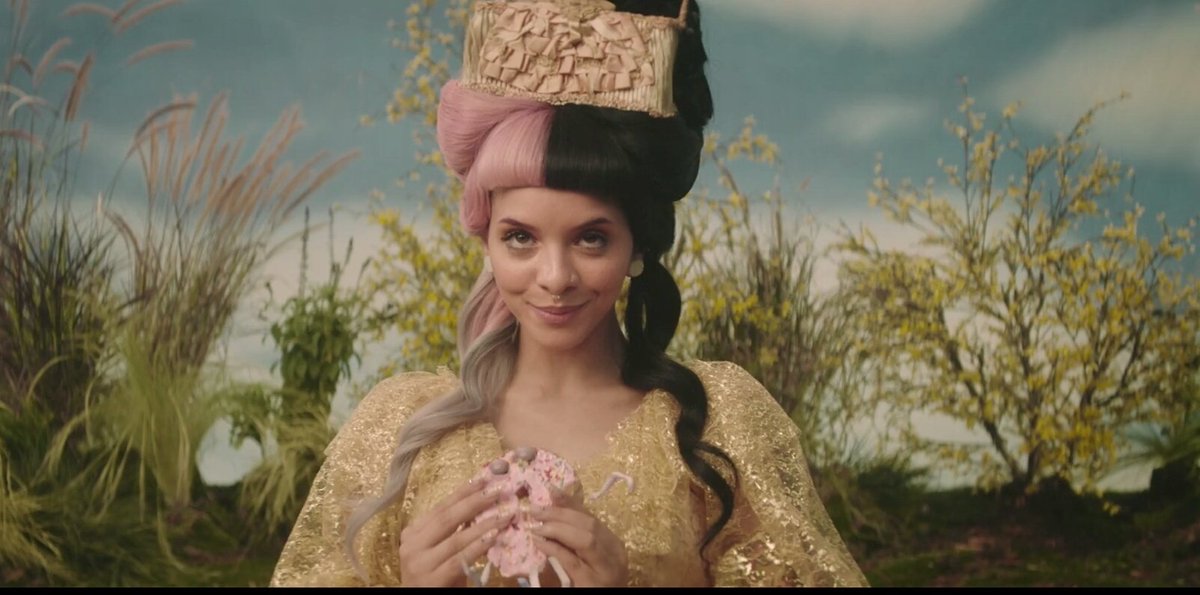
As próximas 3 faixas, “Pity Party”, “Tag, You're It”, e “Milk and Cookies” (“Festa de Dar Pena”, “Peguei, Tá com Você”, e “Leite e Biscoitos”) são as mais tristes para Cry Baby. Em Pity Party, é o aniversário de Cry Baby, e ela planeja uma grande festa com tema seiscentista, com música em vinil e cores em tons pastéis. Ela convida todos os seus amigos, inclusive Johnny, e escreve nos convites à mão, esperando ansiosamente por seu aniversário. O dia finalmente chega. Ela espera por seus convidados. E espera, e espera. E nada. Ninguém chega, nem seu amado. Ela então se pergunta “Será que eu deveria ter dito alguma coisa pra fazer com que eles viessem à minha festa?” e fica bem triste. BEM triste. Cansada de ser decepcionada pelos outros, ela solta um grito e simplesmente destrói a festa: estoura os balões, retira o recheio dos bichos de pelúcia, derruba o bolo de propósito, e por aí vai. Aqui temos os primeiros brilhos de loucura na vida de Cry Baby. Depois de sua bagunça, ela leva os restos de enfeites de sua festa para o lixo, e parte para o supermercado, o que leva à experiência mais traumatizante de sua vida até agora.
A próxima faixa, “Tag, You're It”, é bem perturbadora de se escutar, mas mesmo assim é necessária. Ela relata, através de mudanças de voz feitas por Martinez para encarnar outro personagem, o sequestro de Cry Baby por um lobo sorveteiro no estacionamento de um supermercado. Assim como diz no refrão:
“Correndo pelo estacionamento
Ele me perseguia e não parava
Peguei, tá com você, peguei, peguei, tá com você
Agarrou meu cabelo, me empurrou
Tirou as palavras da minha boca
Peguei, tá com você, peguei, peguei, tá com você”
O ritmo da música chega a beirar o assustador, as mudanças de vozes são bem sinistras (você começa ouvindo a voz doce de Martinez, aí de repente muda pra uma voz super grossa, que ainda é da Melanie, mas que agora está com o papel do lobo), e o final da música me assombra até agora. Mas vamos lembrar que dois podem jogar esse jogo, e na próxima faixa, “Milk and Cookies”, chegou a vez de Cry Baby revidar.
Em “Milk and Cookies”, vemos Cry Baby no esconderijo do lobo sorveteiro, e ele dá uma missão obrigatória para nossa protagonista: fazer leite e biscoitos para o mesmo. Aí Cry Baby lembra que a atendente do supermercado onde ela fora sequestrada deu um pequeno frasco com um líquido estranho dentro. Ela, supondo que o líquido seja veneno, despeja o frasco inteiro em sua mistura de biscoitos. O tempo necessário acaba, e Cry Baby serve os biscoitos para seu sequestrador. Sua suposição estava certa: o lobo começa a engasgar com os biscoitos envenenados, e, finalizando o trabalho, Cry Baby despeja uma garrafa de leite sobre o lobo e sai do esconderijo, com sua loucura aumentando ainda mais.
(The next 3 tracks, “Pity Party”, “Tag, You're It” and “Milk and Cookies”, are the saddest ones in Cry Baby's point of view. In Pity Party, it's Cry Baby's birthday and she plans a big party with a 60s theme, with vinyl music and pastel colours. She invites all her friends, including Johnny, and makes handmade invitations, waiting anxiously for her birthday. The day finally comes. She waits for her guests. And waits some more, and then some more time. And nothing. Nobody comes, not even her loved one. She then asks herself “Should I have told them something so they would've come to my party?” and she gets really sad. REALLY sad. Tired of being disappointed by others, she screams really loud and simply destroys the party: pops the balloons, pulls out the filling of the stuffed animals, drops the cake on purpose, and it goes further. Here we have the first glimmers of madness in Cry Baby. After her mess, she goes to put the rest of the things she used in her party in the garbage, and heads to the supermarket, which leads to the most traumatizing experience in her life so far.
The next track, “Tag, You're It”, is really disturbing to hear, but it's necessary whatsoever. It tells the story, through voice changes Martinez made to play another character, of how Cry Baby got kidnapped by a Big Bad Wolf ice cream man, in the parking lot of a supermarket. Just like it says on the chorus:
“Running through the parking lot
He chased me and he wouldn't stop
Tag, you're it, tag, tag, you're it
Grabbed my hair, pushed me down
Took the words right out of my mouth
Tag, you're it, tag, tag, you're it”
The song's beat becomes a little creepy, the voice changes are quite terrifying (you start to hear Martinez's sweet voice, and then, all of a sudden, you start to hear a super thick voice, which is also Martinez's, but now playing the role of the wolf), and the ending haunts me even now. But let's remember two can play this game, and in the next track, “Milk and Cookies”, it's Cry Baby's turn to play.
In “Milk and Cookies”, we see Cry Baby in the wolf's lair, where he gives her a mandatory mission: to bake cookies for him to eat with some milk. And then Cry Baby remembers that the cashier from the supermarket gave her a flask with a mysterious blue liquid inside. She, guessing it's poison, pours the entire bottle in her cookie mix. The time comes to an end, and she gives her kidnapper his milk and cookies. Her guess was right: the wolf starts to choke with the poisoned cookies, and, to finish the job, she pours an entire bottle of milk on his head and heads out of the lair, with her madness growing and growing.)


Agora, chegamos à reta final do álbum: “Pacify Her”, “Mrs. Potato Head”, e “Mad Hatter” (Acalme-a, Sra. Cabeça de Batata e Chapeleiro Maluco). Em “Pacify Her”, vemos uma Cry Baby insana tentando roubar um garoto comprometido. Ela manda bilhetes, atrai sua atenção, faz ele sorrir, tenta brincar com ele, mas a namorada do garoto mostra os seios para ele, o que o deixa em um transe. Hipnotizado, o garoto e sua namorada saem do recinto onde eles estão, deixando Cry Baby sozinha mais uma vez, o que leva ela a pensar sobre questões de estética.
Ela vai para sua casa, e para se descontrair, liga a TV, onde há comerciais de pílulas para emagrecimento e perucas loiras. Cry Baby, destruída pelos acontecimentos de sua vida e o recente acontecimento em Pacify Her, estufa seu peito com lenços para parecer mais volumoso, e toma pílulas de dieta e coloca uma peruca loira. Se sentindo “satisfeita”, ela volta à sala e se senta para assistir ao programa da Sra. Cabeça de Batata. Aí entramos em “Mrs. Potato Head”, uma crítica social brilhante aos padrões atuais de estética e uma das minhas músicas favoritas do álbum. Nela, acompanhamos uma mulher que um dia, recebe presentes de seu namorado, e um deles é um tipo de cirurgia plástica, que modifica o seu rosto inteiro. Depois da cirurgia, o namorado retira as gazes que tampam o rosto da “Sra. Cabeça de Batata”, revelando que o rosto dela ficou bem diferente do que antes da cirurgia. Ela tenta “melhorar” o visual, colocando batom e uma peruca loira, mas aí ela avista uma coisa que a faz se arrepender de tudo que ela fez com ela mesma: o namorado dela dando em cima de outra mulher. Devastada, ela chora.
Impressionada com o programa, Cry Baby retira a peruca e os enchimentos de seu peito, culminando em “Mad Hatter”, onde ela aceita quem ela é, com a insanidade e tudo. O videoclipe mostra Cry Baby em uma viagem no melhor estilo de Alice no País das Maravilhas, onde ela arruma “amigos” tão loucos como ela, e aceita sua loucura, como diz no refrão:
“Sou louca, querido, sou insana
A amiga mais maluca que você já teve
Você pensa que sou uma psicopata, você pensa que eu perdi a noção
Conte pro psiquiatra que algo está errado
Com um parafuso a menos, totalmente maluca
Você gosta mais de mim quando estou fora da minha zona de conforto
Vou te contar um segredo, não estou alarmada
E daí se eu sou louca?
Todas as melhores pessoas são”
A música fecha o álbum com um tom creepy e divertido ao mesmo tempo, com o videoclipe deixando frestas abertas para o segundo álbum de Melanie Martinez, o qual terá como acompanhamento um filme (sim, você ouviu direito) em vez de 13 videoclipes.
Esse álbum é um dos meus favoritos, e eu mal posso esperar pelo segundo CD da Melanie. ADORO TANTO ESSE ÁLBUM!!!

Nota: 10 de 10!!

(Now we get to the final lap of the album: “Pacify Her”, “Mrs. Potato Head” and “Mad Hatter”. In Pacify Her, we see a completely insane Cry Baby trying to steal a boy that's already committed. She sends notes, attracts his attention, makes him laugh, tries to play with him, but then, his girlfriend shows him her breasts, getting him into some sort of trance. Hypnotized, the boy and his girlfriend leave Cry Baby, alone once again, which leads her to think about esthetics.
She goes to her home, and turns on the TV, where she watches commercials for diet pills and blonde wigs. Cry Baby, a wreck because of all the stuff happening in her life, and because of the recent Pacify Her happening, fills up her chest with paper towels to “augment” its volume, takes some diet pills and puts on a blonde wig. Feeling “satisfied” with herself, she goes back to the TV room and sits to watch the Mrs Potato Head TV show. Then, we go into “Mrs. Potato Head”, a brilliant social review about the actual esthetics pattern and one of my favorite songs on the album. In it, we follow a young woman that, one day, receives presents from her boyfriend, one of them being a facelift plastic surgery. After the surgery, her boyfriend cuts off her bandages, revealing that her face has been severely disfigured. She tries to make it “better”, putting on makeup and a blonde wig, but then she sees something that makes her regret everything she has done about herself: her boyfriend hitting on another woman. Devastated, she cries.
Shocked with the program, Cry Baby removes the paper towels from her chest and the blonde wig, leading on to “Mad Hatter”, where she accepts who she really is, crazy and all. The music video shows Cry Baby on an “Alice in Wonderland” trip, where she encounters “friends” who are just as crazy as she is, and she accepts her craziness, as she says on the chorus:
“I'm nuts, baby, I'm mad
The craziest friend that you've ever had
You think I'm psycho, you think I'm gone
Tell the psychiatrist something is wrong
Over the bend, entirely bonkers
You like me best when I'm off my rocker
Tell you a secret, I'm not alarmed
So what if I'm crazy?
The best people are”
The song closes the album in a creepy, fun way, with the music video leaving doors open for Melanie Martinez's second album and its accompanying movie (yeah, you heard that right) instead of 13 music videos.
This album is one of my favorites, and I can't wait for Martinez's sophomore album. I LOVE IT SO MUCH!!!!

I give it a 10 out of 10!!!)


Bom, então é isso pessoal! Espero que tenham gostado!! Até a próxima!!
João Pedro
(Well, so, that's all, folks! I hope you liked it! See you next time!!
João Pedro)