Translate

sexta-feira, 19 de novembro de 2021

"Saga", de Brian K. Vaughan e Fiona Staples - Vols. 1-9: a melhor HQ da atualidade (Bilíngue)

E não se esqueçam de curtir e seguir o blog nas redes sociais:

(And don't forget to like and follow the blog in social medias:)

Facebook: https://www.facebook.com/NoCinemaComJoaoPedroBlog/

Twitter: @nocinemacomjp2

Instagram: @nocinemacomjp


“Todas as boas histórias para crianças são as mesmas: jovem criatura quebra regras, tem uma incrível aventura, aí retorna para casa com o conhecimento que as regras mencionadas estão lá por uma razão. É claro, a verdadeira mensagem para o leitor atento é: quebre as regras frequentemente quando puder, porque quem diabos não quer ter uma aventura?” - D. Oswald Heist

(“All good children's stories are the same: young creature breaks rules, has incredible adventure, then returns home with the knowledge that aforementioned rules are there for a reason. Of course, the actual message to the careful reader is: break the rules as often as you can, because who the hell doesn't want to have an adventure?” - D. Oswald Heist)


E aí, meus caros cinéfilos! Tudo bem com vocês? Estou de volta, para falar sobre uma das melhores leituras que fiz neste ano! Quebrando todas as regras do meio, e abordando temas relevantes, sensíveis e surpreendentemente humanos, mesmo em meio à um cenário fantasioso, a obra em questão conta uma história original, ousada, viciante e cativante, povoada por personagens fascinantes e reviravoltas chocantes que deixarão o leitor ansioso e faminto para o que está por vir. Então, sem mais delongas, vamos falar sobre os volumes 1 a 9 de “Saga”, série de histórias em quadrinhos escrita por Brian K. Vaughan e ilustrada por Fiona Staples. Vamos lá!

(What's up, my dear film buffs! How are you guys doing? I'm back, in order to talk about one of the best reads I've had the pleasure of doing this year! Breaking all the rules in the medium, and dealing with relevant, sensitive and surprisingly human themes, even if amidst a fantasy scenario, the work I'm about to review tells an original, bold, addictive and captivating story, which is populated by utterly fascinating characters and shocking twists that will leave the viewer anxious and hungry for what comes next. So, without further ado, let's talk about volumes 1-9 of “Saga”, a comic book series written by Brian K. Vaughan and illustrated by Fiona Staples. Let's go!)


A série de quadrinhos acompanha a jornada de Alana e Marko, dois soldados de mundos diferentes que se encontram em constante guerra um com o outro. Ela, uma oficial pertencente à um planeta altamente tecnológico, e ele, um prisioneiro de guerra nativo da lua repleta de magia que orbita ao redor do planeta inimigo, se apaixonam e têm uma filha juntos, a pequena Hazel, que narra cada capítulo já quando adulta. Por Marko e Alana terem se apaixonado e tido uma filha juntos, os três se tornam fugitivos da lei, viajando de planeta à planeta e conseguindo novos e improváveis aliados, tudo isso enquanto são constantemente perseguidos por um príncipe robô, um caçador de recompensas e figuras distantes de seus passados.

(The comic book series follows the journey of Alana and Marko, two soldiers from different worlds that are in constant war with each other. They, Alana as an officer belonging to a highly technological planet, and Marko as a prisoner of war who's a native to the magic-filled moon that orbits around its enemy planet, end up falling in love and having a daughter together, little Hazel, who narrates every chapter as an unseen adult. Because Marko and Alana fell in love and had a child together, the three of them become fugitives of the law, travelling from planet to planet and making new and unlikely allies, all while being constantly chased by a robot prince, a bounty hunter and distant figures from their pasts.)


Ok, aí vai um fato: assim como aconteceu com “Sandman”, série de quadrinhos escrita por Neil Gaiman que acabou sendo a melhor obra de ficção que eu já li em minha vida (inclusive, até fiz uma resenha aqui no blog, vocês podem lê-la aqui:), recebi a recomendação para ler “Saga” de uma das minhas melhores amigas. E literalmente nenhuma das recomendações desta amiga falha em me surpreender. Então, Angela, se você estiver lendo isso, MUITO OBRIGADO. Não conhecia nada da série, mesmo com o co-criador Brian K. Vaughan (responsável por “Y: O Último Homem” e “Fugitivos”) não sendo um completo estranho, mas lembro muito de ver algumas postagens equiparando “Saga” à uma mistura entre “Star Wars” e “Game of Thrones”.

E é exatamente isso pela superfície, mas como um todo, acaba sendo muito, mas muito mais do que essa simples comparação. É algo tão mais abrangente, épico e envolvente, que mesmo se eu escrevesse “'Saga' é incrível” umas mil vezes aqui nesta resenha, não chegaria nem perto de descrever o quão maravilhosa essa série de quadrinhos é. Diga-se de passagem que, mesmo com a citação na introdução sendo de um personagem da obra em questão, “Saga” é uma série feita estritamente para o público ADULTO. Vou trabalhar isso mais a frente na resenha, mas só digo por agora que a série não é comparada à “Game of Thrones” por acidente ou coincidência.

Ok, então, com isso dito, vamos falar um pouco sobre o enredo de “Saga”, primeiro sobre as coisas que ele têm em comum com outras obras em quadrinhos e depois passando por alguns diferenciais específicos da série em relação à estas outras obras. Primeiro, é essencial destacar a amálgama de gêneros presente nos primeiros nove volumes da obra de Vaughan e Staples. A história mistura aspectos de ficção-científica, romance, coming-of-age (ou amadurecimento), comédia, ação, aventura, drama e até faroeste em alguns momentos, e de alguma forma, essa “gororoba” de gêneros estabelecida pelos autores acaba dando certo, devido à maneira que eles manipulam cada um destes elementos e os transformam em algo único, de modo que qualquer comparação feita com a obra não chegará perto do que ela realmente é.

Depois, há a construção de mundo e os personagens de “Saga”, aspectos onde a narração feita pela Hazel adulta assume um protagonismo, e acaba sendo expositiva da melhor maneira possível. A cada capítulo, novas ambientações, circunstâncias e personagens são introduzidos, de modo que o escopo narrativo da obra só vai aumentando. Eu amei o desenvolvimento de cada um destes personagens perfeitamente imperfeitos nos primeiros nove volumes, os quais são compostos por 54 capítulos no total. Por mais alienígenas que pareçam ser visualmente, a narrativa de Vaughan e Staples faz com que cada personagem se torne cada vez mais humano ao longo dos capítulos já publicados, e eu simplesmente adoro quando uma obra de ficção faz com que suas ambientações e personagens pareçam com nós mesmos e o mundo em que vivemos, especialmente quando ela parece estar tão distante da atualidade.

E a última semelhança que gostaria de fazer entre “Saga” e outras histórias em quadrinhos é a qualidade viciante da prosa do autor. Cada página é repleta de diálogos, narrações e ações visuais que mergulham o leitor no universo fascinante e abrangente criado por Vaughan e Staples. Assim como aconteceu em “Sandman”, “Saga” me capturou na primeira página e só foi me soltar quando terminei a última. É simplesmente impossível não se apaixonar por cada um dos personagens presentes ao longo dos primeiros nove volumes, de tão cativantes, carismáticos e humanos que eles são. Vou trabalhar mais sobre a prosa de Vaughan mais à frente, mas por enquanto, as semelhanças são essas.

Passando para os diferenciais, Vaughan e Staples injetam o universo de “Saga” com uma irrefutável e impactante humanidade, um atributo que acaba abrindo portas para que os autores trabalhem temas surpreendente próximos à atualidade, mesmo que a ambientação pareça estar à milênios de distância. Só pela sinopse que coloquei no início da resenha, é possível ver que alguns dos temas abordados são o racismo, o preconceito, a miscigenação, o contraste entre o progresso e a tradição, a guerra e a xenofobia, mas também se fazem presentes aqui temas universais, como o trauma, a redenção e o perdão. Há uma variedade de outras temáticas trabalhadas nos 54 primeiros capítulos de “Saga”, mas não irei aprofundar em todas, para não entrar em território de spoiler.

E falando em spoiler, temos aqui um outro diferencial da obra em questão: as suas reviravoltas, cada uma mais chocante que a outra, com o trabalho de Vaughan e Staples realmente merecendo ser comparado à “Game of Thrones”. Não se enganem: só porque “Saga” é uma história em quadrinhos, não quer dizer que os personagens não irão morrer. O material promocional de “O Esquadrão Suicida” já avisava: “Não se apeguem demais”, e o mesmo pode ser aplicado aqui, porém a tarefa de não se apegar emocionalmente aos personagens de “Saga” é particularmente difícil, pela quantidade de desenvolvimento que eles têm ao longo da trama. Aí, quando os autores dão uma de George R.R. Martin e resolvem matar um deles, é tipo reassistir a já icônica cena do Casamento Vermelho de “GoT”, tudo de novo.

Eu acho simplesmente incrível como Vaughan e Staples conseguem terminar cada capítulo com um cliffhanger (aquele suspense maldito que só será resolvido no próximo capítulo de algo), e na grande maioria das vezes, estes cliffhangers me deixaram boquiaberto, especialmente aqueles que terminam os volumes, ou seja, a cada 6 capítulos. É bem incomum os volumes de “Saga” terminarem de uma maneira que não seja chocante, deixando uma narração da Hazel ou uma informação visual que aumente as expectativas do leitor para os próximos passos da trama. Eu mal posso esperar pelo retorno de “Saga” em janeiro, para que os autores voltem a me deixar boquiaberto com os desenrolares e reviravoltas deste fascinante universo que eles criaram.

E, por último, mas não menos importante, temos aqui outro fator que aproxima “Saga” de “Game of Thrones”: as inúmeras, extensas e explícitas cenas de violência grotesca, uso de drogas, sexo e nudez. Lembram quando eu disse na introdução que a série quebra todas as regras do meio de histórias em quadrinhos? Pois é, essa escolha criativa é uma das razões do porquê disso acontecer. O co-criador Brian K. Vaughan já recebeu várias propostas de adaptação do material para outras mídias, mas ele negou todas elas, restringindo “Saga” ao seu meio original, explicando que “[ele] quis fazer algo que era caro demais para ir para a televisão e obsceno e adulto demais para ser um blockbuster”, e isso é claramente exposto no primeiro capítulo da obra.

Em seus melhores momentos, o conteúdo explícito de “Saga”, como a violência, o sexo e o uso de drogas, é usado com o propósito de introduzir e aprofundar certos personagens, e isso funciona. Mas o problema (e isso, pra mim, é a única falha dessa incrível obra de ficção) é que, muitas vezes, o uso destes conteúdos não é justificado, fazendo com que algumas cenas, situações e até ambientações sejam essencialmente gratuitas, só com o intuito de “aparecer”, “causar”, “lacrar”, e por aí vai. Como dito anteriormente, “Saga” é uma série estritamente direcionada para o público adulto, mas mesmo com o seu público-alvo restrito, Vaughan e Staples às vezes desperdiçam algumas oportunidades que eles têm de desenvolver certas subtramas interessantes, e acabam inserindo momentos desnecessários e, muitas vezes, desconexos da trama principal, só com o intuito de colocá-las lá mesmo, com nenhum objetivo narrativo visível.

(Okay, here's a fun fact: as it happened with “The Sandman”, a comic book series written by Neil Gaiman that ended up being the greatest work of fiction I've ever read in my life (by the way, I even wrote a review for it on the blog, you can read it here:), I was recommended to read “Saga” by one of my best friends. And literally none of this friend's book recommendations ever fails to surprise me. So, Angela, if you're reading this, THANK YOU VERY MUCH. I didn't know anything about this series, even though if its co-creator Brian K. Vaughan (responsible for “Y: The Last Man” and “Runaways”) wasn't a complete stranger to me, but I'm fairly reminded of reading some posts on the Internet, which compared “Saga” to a mix between “Star Wars” and “Game of Thrones”.

And that's exactly what it is on the surface, but as a whole, it ends up being so, so much more than that simple comparison. It's something that's so much more comprehensive, epic and envolving, that even if I wrote “'Saga' is amazing” a thousand times in this review, it still wouldn't come even close to describe how wonderful this comic book series is. By the way, I have to state that, even though the quote in the intro belongs to a character from this work, “Saga” is a series strictly made for an ADULT audience. I'll work on that more ahead on the review, but, for now, I'll just say that it doesn't get compared to “Game of Thrones” by accident or coincidence.

Okay, so, with that said, let's talk about the general plot of “Saga”, firstly on the things that it has in common with other comic book works and then going through some specific different things about it that makes the series stand out among other comic books. First off, it's essential to reinforce the amalgamous amount of genres present in the first nine volumes of Vaughan and Staples' work. The story blends aspects from science fiction, romance, coming-of-age, comedy, action, adventure, drama and even Western in a few parts, and somehow, this smorgasbord of genres established by the authors ends up actually working, due to the way they manipulate each one of these elements and transform them into something unique, in a way that any comparison made with it won't even come close to what it really is.

Then, there's the world-building and characters of “Saga”, aspects in which the narration by adult Hazel assume a fairly main role, and ends up being a tool of exposition in the best way possible. In each chapter, new settings, circumstances and characters are introduced, in a way that the work's narrative scope is constantly expanding. I loved the development of each one of these perfectly imperfect characters throughout the first nine volumes, which are composed by a total of 54 chapters. As alien as they may seem visually, Vaughan and Staples' narrative makes each character become more and more human throughout its already-published chapters, and I just love it when a work of fiction makes its settings and characters feel like ourselves and the world we live in, especially when it seems so far away from reality.

And the last similarity I'd like to point out between “Saga” and other comic books is the addictive quality of the author's prose. Each page is filled with dialogue, narrations and visual actions that immerse the reader into the fascinating and comprehensive universe created by Vaughan and Staples. Just like it happened in “Sandman”, “Saga” captured me on the first page, and only let me go when I was through with the last one. It's simply impossible not to fall in love with each one of the characters present throughout the first nine volumes, due to their charisma, emotional depth and humanity. I'll work more on Vaughan's prose later on, but for now, these are the similarities it has in comparison to other comics.

Onto the differences, Vaughan and Staples inject the universe of “Saga” with an irrefutable and impactful humanity, an attribute that ends up opening doors for the authors to work with themes that are surprisingly close to today's times, even though its setting seems like a million miles away. Just from the synopsis I've written in the beginning of this review, it's possible to see that some of the themes dealt with here are racism, prejudice, miscigenation, the contrast between progress and tradition, war and xenophobia, but there are also some universal themes here, such as trauma, redemption and forgiveness. There's a variety of other themes worked and dealt with in the 54 chapters of “Saga”, but I won't delve deep into them, so that I don't risk going into spoiler territory.

And speaking of spoilers, we have here yet another difference of the work reviewed here: its plot twists, which get more shocking as the plot moves forward, with Vaughan and Staples' work really earning that comparison to “Game of Thrones”. Don't be fooled: only because “Saga” is a comic book, it doesn't mean its characters can't die. The “The Suicide Squad” promotional material already warned us: “Don't get too attached”, and the same can be applied here, but the task of not getting emotionally attached to the characters of “Saga” is particularly tough, because of the amount of development they get throughout the plot. Then, when the authors decide to pull off a George R.R. Martin and kill one of them off, it's like rewatching the already iconic Red Wedding scene from “GoT”, all over again.

I think it's absolutely amazing how Vaughan and Staples manage to finish off every chapter with a cliffhanger, and in most of the times, those cliffhangers leave my jaw dropped to the floor, especially the ones that finish off the volumes, meaning every 6 chapters. It's quite unusual for a volume of “Saga” to end in a way that's not shocking, leaving behind a narration by Hazel or some visual information that lifts the reader's expectations all the way to the top to see the story's next steps forward. I simply can't wait for the return of “Saga” in January, so that the authors can leave my jaw dropped to the floor again with the developments and plot twists in this fascinating universe they've created.

And at last, but not least, we have another factor that brings “Saga” closer to “Game of Thrones”: its numerous, extended and explicit sequences of grotesque violence, drug use, sex and nudity. Remember when I said in the intro that the series breaks every rule in the comic book medium? Yeah, this creative choice is one of the reasons why that happens. Co-creator Brian K. Vaughan has already received several propositions to adapt the source material to other media, but he declined all of them, restraining “Saga” to its original medium, explaining that “[he] wanted to do something that was way too expensive to be TV and too dirty and grown-up to be a four-quadrant blockbuster”, and that's clearly exposed in the first chapter of the series.

In its best moments, the explicit content of “Saga”, such as violence, sex and drug use, is used with the purpose of introducing or deepening the characters' development, and that works. But the problem (and that, for me, is the only flaw in this amazing work of fiction) is that, in most of the times, the use of such content is not entirely justified, making some scenes, situations and even settings seem essentially gratuitous, only with the objective of “baring it all”, “showing off”, “making a scene”, and so it goes. As previously stated, “Saga” is a series that's strictly directed towards an adult audience, but even with its restricted target audience, Vaughan and Staples often waste some opportunities they get of working on interesting subplots, and end up inserting unnecessary scenes that are, at many times, disconnected from the main plot, just for the sake of placing them there, without any visible narrative objective.)


É bem difícil falar dos personagens de “Saga”, pois o desenvolvimento deles é tão aprofundado ao longo dos primeiros nove volumes, que é quase impossível dissertar sobre o arco narrativo de cada um sem entrar em território de spoiler, já que muitos destes personagens são introduzidos de surpresa, mas vou tentar fazer o meu melhor. O Marko e a Alana são os melhores protagonistas de uma série de quadrinhos contínua que eu já vi. Eu adoro os contrastes entre os dois, em termos de personalidade. Enquanto o Marko pode ser mais filosófico, pacífico e contido, a Alana é sarcástica, imprudente e extrovertida, mas isso não significa que os personagens estão presos à estas características, e isso é o mais mágico sobre o desenvolvimento de todos os personagens de “Saga”.

Assim como em “Life is Strange 2”, os personagens coadjuvantes criados por Vaughan e Staples são fantásticos e adicionam muita profundidade e escopo à trama de “Saga”. Falando dos personagens mencionados na sinopse: o príncipe robô é um dos meus personagens favoritos da série, sendo ao mesmo tempo temível, implacável e sarcástico, dono de um senso de humor ácido; o caçador de recompensas é, de longe, o personagem mais humano de “Saga”, tanto visualmente quanto emocionalmente, e é uma das principais ferramentas utilizadas pelos autores para trabalhar o tema recorrente do trauma, e as cicatrizes que um evento traumático pode deixar em uma pessoa.

E por último, mas certamente, não menos importante, temos os vilões, que se apresentam mais através de uma maneira simbólica e temática do que em carne e osso. Eu acho isso brilhante porque, diferente das pessoas, que podem mudar de comportamento constantemente, os temas que Vaughan e Staples abordam em “Saga”, como o preconceito e a guerra, nunca mudam, e ainda por cima, estes temas são todos criados e estabelecidos pelos seres humanos, o que dá ao cenário geral da série uma dose extra de humanidade, mesmo sendo ambientada em uma realidade que parece estar extremamente distante da nossa.

(It's quite hard to talk about the characters of “Saga”, as their development is so deepened throughout its first nine volumes, that it's almost impossible to discuss about each of their narrative arcs without entering spoiler territory, as many of these characters are introduced by surprise, but I'll try and do my best. Marko and Alana are the best protagonists in a continuous comic book series I've ever seen. I love the contrasts between both of them, when it comes to their personalities. While Marko can be more philosophical, peaceful and contained, Alana is sarcastic, reckless and extroverted, but that doesn't mean the characters are stuck with these qualities, and that's the most magical thing on the development of every character in “Saga”.

Just like in “Life is Strange 2”, the supporting characters created by Vaughan and Staples are fantastic and add extremely large amounts of depth and scope to the plot of “Saga”. Speaking of the characters mentioned in the synopsis: the robot prince is one of my favorite characters in the series, being simultaneously fearsome, relentless and sarcastic, owning a very acid sense of humor; the bounty hunter is, by far, the most human character in “Saga”, both visually and emotionally, and he's one of the main tools used by the authors to work and deal with the recurring theme of trauma, and the scars that a traumatic event can leave on a person.

And at last, but certainly, not least, we have the villains, which are presented a lot more in a symbolic and thematic way than they do in flesh and bone. I personally think that's brilliant because, unlike people, who can constantly change their behaviour and way of living, the themes that Vaughn and Staples work with in “Saga”, such as prejudice and war, never change, and as a matter of fact, those themes were all created and established by human beings, which gives the series's general scenario an extra dose of humanity, even if it's set in a reality that seems like it's a million miles away from our own.)
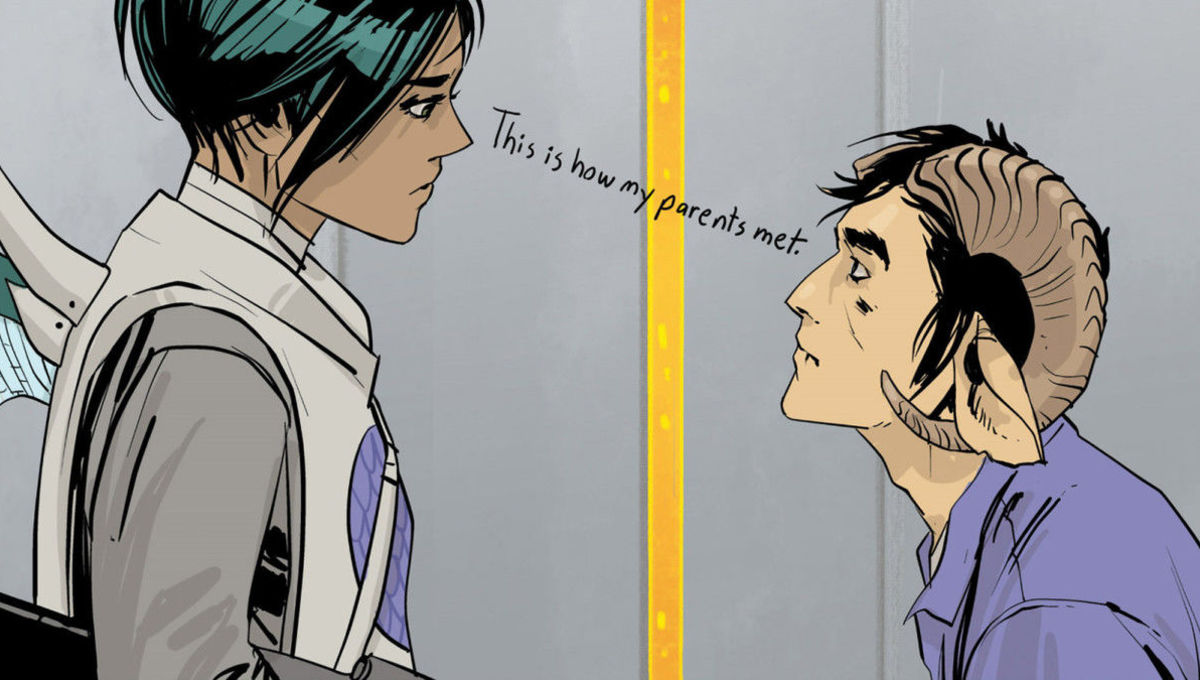


Eu fico constantemente impressionado com o trabalho que ilustradores de histórias de quadrinhos precisam fazer para que cada quadro planejado no roteiro ganhe vida, visualmente. Alguns, como os de “Sandman”, conseguem ser bastante inventivos na maneira de montar as páginas, às vezes expandindo a ação para duas páginas ao invés de uma, ou mudando a direção dos quadros ao longo da página. Em “Sandman”, foi preciso de uma equipe de várias pessoas para dar vida à visão narrativa de Neil Gaiman. Em “Saga”, eu fico ainda mais impressionado, por toda a composição visual da narrativa, dos personagens e das ambientações ficar inteiramente sobre os ombros de uma pessoa: a ilustradora e co-criadora da série, Fiona Staples.

Brian K. Vaughan, co-autor de “Saga”, pode até ter falado que ele criou a série com o objetivo de restringi-la aos quadrinhos e evitar que ela seja adaptada para outras mídias, como o cinema e a TV. Mas, ao ver as composições visuais de Staples feitas ao longo dos 54 capítulos publicados, é quase impossível não ter o seguinte pensamento voando pela sua cabeça: “Nossa, isso daria um baita filmão”, de modo que todas as cenas criadas pela ilustradora são essencialmente cinematográficas. As cenas de ação possuem uma sensação inegável de fluidez e movimento, como se os quadros parados estivessem, por si mesmos, em movimento, de tão rápida, dinâmica e precisa que a arte de Staples consegue ser.

Os personagens são outro destaque do trabalho de Staples em “Saga”, especialmente pela diversidade e pela criatividade que a ilustradora consegue injetar neles. Só para vocês terem uma ideia do quão diverso o elenco de personagens de “Saga” é: dos doze personagens principais da série, somente um se identifica como branco. Nas palavras de Staples, em entrevista ao Hero Complex: “A representatividade e a diversidade em HQs é algo importante para mim, e eu também acho que isso faz com que o universo que você esteja criando seja mais realista e autêntico. […] A grande maioria das pessoas na Terra não são brancas. Por quê esta galáxia seria?”. Outro detalhe em relação ao design dos personagens é a presença de vários pulos temporais entre os volumes, e Staples faz um ótimo trabalho em explorar as mudanças físicas sofridas pelos personagens, com algumas destas mudanças sendo quase inacreditáveis de tão drásticas.

E, por último, temos as ambientações, cada uma mais fascinante e complexa que a anterior. O mais interessante fica com o contraste entre as duas ambientações principais: Landfall, planeta de Alana; e Wreath, lua de Marko. Enquanto Landfall parece mais uma metrópole, com seus arranha-céus e avanços tecnológicos, Wreath parece ser uma floresta em formato de lua, com Staples dando destaque à natureza presente na ambientação, o que é bem legal. Além desses dois cenários principais, há uma pluralidade surpreendente de ambientações ao longo dos nove volumes de “Saga”, e o mais incrível de se perceber é como cada ambientação parece ter sido tirada da realidade e ter ganho uma roupagem fantasiosa, devido à natureza da obra. É algo realmente impressionante.

(I get constantly impressed with the amount of work that comic book illustrators have to go through in order to make every frame planned on the script come alive, visually. Some of them, like the ones in “The Sandman”, manage to be really inventive when assembling their pages, sometimes expanding one action to two pages instead of just one, or changing the direction of the frames as the page goes on. In “Sandman”, it took an entire crew to bring Neil Gaiman's ambitious narrative vision to life. In “Saga”, I get even more impressed, because the entire visual composition of the story, characters and settings relies solely over the shoulders of one single artist: the series's illustrator and co-creator, Fiona Staples.

Brian K. Vaughan, co-author of “Saga”, may even have stated that he created the series with the objective of restraining it to the comic book medium and preventing it from being adapted to other media, such as movies or TV. But, when we see Staples's visual compositions throughout its published 54 chapters, it's almost impossible not to have the following thought floating through our heads: “Damn, that would make one hell of a movie”, in a way that every scene created by the illustrator is essentially cinematic. The action scenes have an undeniable feeling of fluidity and motion, as if the still frames are, by themselves, in motion, all thanks to the quick, dynamic and precise tone that Staples injects in her art.

The characters are another highlight of Staples's work in “Saga”, especially for the diversity and creativity the illustrator displays and injects into them. Just so you can get an idea of how diverse the cast of characters of “Saga” is: out of the twelve main characters in the series, only one of them identifies as white. In Staples's words, when interviewed by Hero Complex: “Representation and diversity in comics is something that's important to me, and I also think it just makes a more realistic universe when you're constructing a brand-new world and you want it to feel authentic. Most of the people on Earth are not white. Why would this galaxy be?”. Another detail when it comes to designing the characters is the presence of several time jumps inbetween volumes, and Staples does a terrific job in exploring the physical changes suffered by the characters, with some of these changes being so drastic they're nearly unbelievable.

And, at last, we have the settings, each one more fascinating and complex than the last. The most interesting thing about them relies on the contrast between its two main settings: Landfall, Alana's planet; and Wreath, Marko's moon. While Landfall is similar to a metropolis of sorts, with its skyscrapers and cutting-edge technological advances, Wreath seems like a forest shaped like a moon, with Staples highlighting the nature in the setting, which is pretty cool. Besides those two main scenarios, there's a surprising plurality of settings throughout the nine volumes of “Saga”, and the most incredible thing to realize is how every setting seems taken off or based on reality, and gained a fantasy outfit, due to the work's nature. It's something really impressive.)


Resumindo, os nove primeiros volumes de “Saga” consagram a obra de Brian K. Vaughan e Fiona Staples como uma das histórias em quadrinhos mais originais, ousadas, criativas e únicas dos últimos tempos. A série pode exagerar um pouco nos conteúdos mais explícitos, mas os autores conseguem manter a atenção do leitor com perfeição, devido à história cativante e cheia de reviravoltas chocantes elaborada por Vaughan; aos personagens, que vão ficando cada vez mais humanos ao longo da trama; e à arte de Staples, que exalta e celebra a diversidade presente nas ambientações e protagonistas da trama. Que venham os próximos nove volumes, para a conclusão da saga épica de Alana e Marko!

Nota: 9,9 de 10!!

É isso, pessoal! Espero que tenham gostado! Até a próxima,

João Pedro

(In a nutshell, the first nine volumes of “Saga” celebrate Brian K. Vaughan and Fiona Staples' work as one of the most original, daring, creative and unique comic books in recent memory. It might go a little too far in its more explicit content, but the authors manage to perfectly maintain the reader's attention, due to the captivating story filled with shocking twists elaborated by Vaughan; to the characters, who become more and more human throughout the plot; and to Staples's art, which highlights and celebrates the diversity in the plot's settings and protagonists. May the next nine volumes come, for the conclusion of Alana and Marko's epic saga!

I give it a 9,9 out of 10!!

That's it, guys! I hope you liked it! See you next time,

João Pedro)


sábado, 13 de novembro de 2021

"Life is Strange 2": uma sequência narrativamente mais amadurecida e realista (Bilíngue)

E não se esqueçam de curtir e seguir o blog nas redes sociais:

(And don't forget to like and follow the blog in social medias:)

Facebook: https://www.facebook.com/NoCinemaComJoaoPedroBlog/

Twitter: @nocinemacomjp2

Instagram: @nocinemacomjp


E aí, meus caros cinéfilos! Tudo bem com vocês? Estou de volta, para fazer algo que não tenho feito desde ano passado: trazer uma resenha de videogame para o blog! E preparem-se, porque haverão muitas destas resenhas em um futuro próximo. Mas vamos ao que interessa: mesmo que o jogo em questão não alcance o caráter eletrizante, inventivo e único de seu aclamado (e já icônico) antecessor, a obra consegue compensar com uma história de amadurecimento extremamente cativante, personagens que se encontram em constante transformação ao longo do jogo, e um caráter sociopolítico essencialmente relevante, levando em conta sua época de lançamento. Então, sem mais delongas, vamos falar sobre “Life is Strange 2”. Vamos lá!

(What's up, my dear film buffs! How are you guys doing? I'm back, in order to do something I haven't done as much since last year: to bring a review of a videogame to the blog! And get ready, because there will be many of these reviews in the near future. But let's get to the point: even though the game I'm about to review doesn't reach the thrilling, inventive and unique feel of its acclaimed (and iconic) predecessor, the work manages to compensate with an extremely captivating coming-of-age story, characters who find themselves in constant change throughout the game, and an essentially relevant sociopolitical vein, considering its time of release. So, without further ado, let's talk about “Life is Strange 2”. Let's go!)


Ambientado no mesmo universo do primeiro jogo de “Life is Strange”, a sequência acompanha os irmãos latino-americanos Sean (voz original de Gonzalo Martin) e Daniel Diaz (voz original de Roman Dean George), que se tornam fugitivos da lei, devido à um acidente causado pelos poderes telecinéticos recém-descobertos de Daniel, o irmão mais novo, ao testemunhar a morte do pai por um policial. Juntos, Sean e Daniel viajam pela Costa Oeste dos EUA, reencontrando familiares distantes, fazendo amizades e novas descobertas, enquanto tentam manter os poderes de Daniel como um segredo, para evitar chamar a atenção da polícia.

(Set in the same universe as the first game in the “Life is Strange” series, the sequel follows Latin American brothers Sean (voiced by Gonzalo Martin) and Daniel Diaz (voiced by Roman Dean George), who become fugitives of the law, due to an accident caused by Daniel's recently discovered telekinetic abilities, after he witnesses his father's murder by a police officer. Together, Sean and Daniel travel across the US West Coast, reuniting with distant family members, making friends and new discoveries, while trying to keep Daniel's powers a secret, in order to avoid attracting the police's attention.)


Ok, para começo de conversa, eu AMO o primeiro jogo da série “Life is Strange”. Inclusive, já fiz um texto aqui no blog sobre o game (se quiserem, podem lê-lo aqui: https://nocinemacomjoaopedro.blogspot.com/2018/03/life-is-strange-uma-experiencia-de.html). Para quem não sabe, o primeiro jogo de “Life is Strange” conta a história de Max Caulfield, uma estudante aspirante à fotógrafa que, certo dia, testemunha o assassinato de uma velha amiga por outro estudante. Ao reagir, Max descobre que possui a habilidade de voltar no tempo para consertar erros passados e, por consequência, mudar o futuro.

É um jogo baseado inteiramente em escolhas, onde as escolhas do jogador irão impactar a trama do jogo de maneira significativa, de forma bem parecida com os jogos da Telltale, como “The Walking Dead”, com a função Rewind (Rebobinar, em tradução livre) sendo o verdadeiro diferencial do jogo em relação aos outros que seguem a mesma estratégia. Então, vocês podem imaginar o quanto as minhas expectativas diminuíram em relação à sequência quando descobri que ela não teria a função que tornou o primeiro jogo uma experiência tão única para mim, razão do porquê eu também não havia jogado (e ainda não joguei) o prólogo de “Life is Strange”, intitulado “Before the Storm” (Antes da Tempestade, em referência à um evento-chave do primeiro jogo).

Antes da sequência em si ter sido lançada, eu joguei uma demonstração liberada gratuitamente pela Square Enix chamada “As Aventuras Iradas de Captain Spirit”, em 2018. Nela, assumimos o papel de Chris, um garoto que usa os poderes de sua imaginação para lidar com a perda recente da mãe em um acidente automobilístico e com o alcoolismo do pai, causado pela tragédia. Eu achei bem interessante a apresentação da nova trama, mesmo com Chris não sendo o protagonista da sequência, e gostei bastante da nova perspectiva de ver os eventos do jogo pelos olhos inocentes de uma criança. Admito que jogar a demo aumentou minhas expectativas um pouco para jogar “Life is Strange 2”, mas não compraria o jogo até 2021, após ler algumas matérias citando as vantagens da obra em relação ao game original.

E devo dizer que me surpreendi positivamente em relação à muitos aspectos do jogo, mesmo que ele não seja 100% perfeito. Ok, vamos falar do roteiro. Escrito por Christian Divine e Jean-Luc Cano (os mesmos roteiristas do primeiro jogo), a narrativa de “Life is Strange 2” já chama atenção por ser muito mais realista do que seu antecessor. Isto se dá diretamente ao fato da sequência não contar com a presença da função Rewind, que permitia a viagem no tempo característica do primeiro jogo, mas o realismo da trama elaborada por Divine e Cano se dá por vários outros aspectos, que acabam por aprofundar a obra de maneira impressionante.

Aqui, assumimos o papel de Sean, o irmão mais velho, que não tem nenhum poder especial, ao contrário de Max, protagonista do jogo original. Mesmo que essa escolha criativa tenha tirado o teor dinâmico da jogabilidade de “Life is Strange”, ela ao mesmo tempo permitiu que a sequência fosse inteiramente baseada em interações, as quais acabam revelando muitas coisas sobre os personagens que encontramos ao longo do caminho, seja através de diálogos compartilhados com estes personagens ou de documentos, cartas, fotos e referências que dissertam sobre o passado deles.

E falando neles, temos aqui uma variedade impressionante de personagens extremamente carismáticos e aprofundados, em termos de desenvolvimento. O mais interessante sobre os jogos de “Life is Strange” é como o desenvolvimento de seus personagens é diretamente dependente das escolhas feitas pelo jogador. Dependendo das alternativas que você escolher ao longo da jogatina, os relacionamentos do protagonista com aqueles ao seu redor podem tomar rumos completamente diferentes um do outro, podendo aproximá-los ou afastá-los do jogador.

Outro destaque que gostaria de fazer sobre a sequência é o aumento do alcance de suas ambientações. Ao contrário do primeiro jogo, cujos 5 episódios são estritamente ambientados na cidade de Arcadia Bay, uma vibe deliciosa de road movie é aplicada em “Life is Strange 2”, permitindo que cada episódio tenha uma ambientação completamente diferente da outra. A trama do jogo, como um todo, é literalmente uma viagem, onde os protagonistas vão visitando lugares novos, conhecendo pessoas e enfrentando obstáculos juntos. Esta pluralidade nas ambientações foi um dos meus aspectos narrativos preferidos de “Life is Strange 2”.

Outra escolha criativa brilhante feita pelos roteiristas diz respeito aos temas abordados na obra, que são extremamente relevantes, especialmente considerando a época em que os episódios foram lançados, entre 2018 e 2019. Não há nenhuma menção explícita ao assunto, mas fica bem claro que o jogo, como um todo, é ambientado nos EUA, enquanto o país é governado por Donald Trump. Esta escolha, adicionada ao fato de que os dois protagonistas são latino-americanos e filhos de um imigrante mexicano, permite que a sequência aborde temas relevantes como imigração, racismo, preconceito, ideologias distorcidas e xenofobia.

Algumas escolhas feitas pelo jogador são diretamente relacionadas à estes temas, contando com alternativas que tornam o ato de escolher cada vez mais difícil, com o risco do resultado levar à violência e até à humilhação. Há uma parte em particular no quarto capítulo que foi o equivalente emocional à uma facada no coração, completa com algumas torcidas, para mim. Enquanto o primeiro jogo se preocupou em trabalhar com temas recorrentes no público adolescente, como suicídio, bullying, depressão e abuso, “Life is Strange 2” dá um passo a frente e consegue se tornar um verdadeiro depoimento sociopolítico sobre como foi viver como um imigrante nos EUA durante o governo de Trump, com esta escolha de temas aprofundando a relevância e a urgência da obra de uma maneira impressionante.

Uma curiosidade é que, assim como os poderes de Max no primeiro jogo, a origem dos poderes de Daniel é algo incerto. Para aqueles que esperam uma explicação lógica do porquê do personagem possuir tais habilidades, sinto muito, mas vocês vão se decepcionar. Contudo, a ausência de uma explicação lógica permite que o jogador aplique uma origem metafórica para estas habilidades. Coincidentemente, os poderes dos dois personagens foram descobertos quando eles testemunharam o assassinato injusto de alguém próximo a eles. Então, pode-se dizer que os poderes sejam uma ferramenta que os personagens possam usar para retirar a injustiça do mundo, ou algo do tipo, o que eu acho bem interessante.

A única ressalva que gostaria de fazer em respeito à narrativa é a escolha do personagem jogável. Como dito anteriormente, controlamos Sean, o irmão mais velho, que não tem habilidades especiais. Mesmo que o protagonista seja muito bem desenvolvido, e os relacionamentos forjados e fortalecidos por ele sejam bem cativantes, a escolha de fazer com que o jogador tenha que controlar alguém que não tem nenhum diferencial, em termos de jogabilidade, pode fazer com que a jogatina seja um tanto repetitiva, pois, como já disse, a sequência é baseada inteiramente em interações e relacionamentos.

Na minha opinião, pelo menos, teria sido bem melhor (e bem mais fiel às mecânicas inventivas do primeiro jogo) se o personagem jogável de “Life is Strange 2” fosse o Daniel, o irmão mais novo, que possui habilidades telecinéticas. Esta escolha não só teria replicado o dinamismo da jogabilidade do game original, como também teria se mantido fiel à nova perspectiva apresentada na demonstração da sequência, “As Aventuras Iradas de Captain Spirit”, na qual controlamos um garoto da mesma idade de Daniel. E se a perspectiva principal do jogo fosse a de uma criança da idade de Daniel e Chris, isso colaboraria ainda mais para a vibe de coming-of-age (amadurecimento) presente ao longo da trama, talvez oferecendo as escolhas de se tornar cada vez mais independente ou dependente do irmão mais velho, ao mesmo tempo que aborda temas como a perda da inocência e a responsabilidade de fazer escolhas difíceis.

(Okay, for starters, I LOVE the first game in the “Life is Strange” series. As a matter of fact, I've even written a text about it right here, on the blog (if you'd like, you could read it here: https://nocinemacomjoaopedro.blogspot.com/2018/03/life-is-strange-uma-experiencia-de.html). For those who don't know, the first “Life is Strange” game tells the story of Max Caulfield, a student and aspiring photographer who, one day, witnesses the murder of an old friend by another student. By reacting to it, Max discovers she has the ability of going back in time in order to fix past mistakes and, consequently, change the future.

It's a game based entirely on choices, where the player's choices will make a significant impact to the game's plot, in a way that's similar to the videogames released by Telltale, such as “The Walking Dead”, with its Rewind function being the game's true difference when compared to other games that follow the same strategy. So, you can imagine how much my expectations dropped for the sequel when I found out that it wouldn't have the function that made the first one such a unique experience for me, the same reason why I still haven't played the prologue to “Life is Strange”, titled “Before the Storm” (in reference to a key event from the first game).

Before the sequel itself was released, I played a demo that was freely distributed by Square Enix called “The Awesome Adventures of Captain Spirit”, in 2018. In it, we assume the role of Chris, a boy who uses the powers of his imagination to deal with the recent loss of his mother due to a hit-and-run and with his father's alcoholism, which was caused by the tragedy. I thought that the presentation of the new plot was quite interesting, even with Chris not being the sequel's protagonist, and I really liked the new perspective of seeing the game's events through the innocent eyes of a child. I admit that playing the demo lifted my expectations a little higher to play “Life is Strange 2”, but I wouldn't buy the game until 2021, after reading a few Internet pieces highlighting its advantages in comparison to the original game.

And I must say I was positively surprised with many aspects of the game, even though it's not 100% perfect. Okay, let's talk about the script. Written by Christian Divine and Jean-Luc Cano (the same writers as the first game), the narrative for “Life is Strange 2” already gets our attention for being way more realistic than its predecessor. This is directly due to the fact that the sequel doesn't have the Rewind function, which allowed the first game's inventive use of time travel, but the realism in the plot elaborated by Divine and Cano is apparent through various other aspects, which end up making the game something impressively deeper than expected.

Here, we take on the role of Sean, the older brother, who doesn't have any special ability, unlike Max, the first game's protagonist. Even though this creative choice has taken away the dynamic tone of the gameplay in “Life is Strange”, it simultaneously allowed the sequel to be based entirely on interactions, which end up revealing many things about the characters we find along the way, either through dialogue we share with these characters, or through documents, letters, photographs and references that tell us more about their pasts.

And speaking of which, we have an astounding variety of extremely charismatic and deepened characters, when it comes to their development. The most interesting thing about the “Life is Strange” games is how the development of its characters is directly dependent on the choices made by the player. Depending on the alternatives that you choose throughout your gameplay, the protagonist's relationships with those around him could take completely different paths, being able to bring them closer or pull them apart from the player.

Another highlight I'd like to make on the sequel is the enhancement on the range of its settings. Unlike the first game, where its 5 episodes are strictly set in the fictional town of Arcadia Bay, a delightful road movie vibe is applied to “Life is Strange 2”, allowing each episode to have a setting that's completely different from the previous one. The plot of the game, as a whole, is literally a road trip, where the main characters travel and visit new places, meet new people, acquaintances and friends, and face obstacles together. This plurality in the settings was one of my favorite narrative aspects in “Life is Strange 2”.

Another brilliant creative choice made by the writers pays respect to the themes their work deals with, which are extremely relevant, especially considering the time in which the episodes were released, between the years of 2018 and 2019. There isn't any explicit mention to it, but it becomes quite clear that the game, as a whole, is set in the United States, as when the country had Donald Trump as its president. This choice, added to the fact that the two protagonists are Latin-American and sons of a Mexican immigrant, allows the sequel to deal with relevant themes, such as immigration, racism, prejudice, distorted ideologies and xenophobia.

Some of the choices made by the player are directly related to those themes, relying on alternatives that make the act of choosing between them harder as the game goes on, with the risk of its result leading to violence and even humiliation. There's a particular part in the fourth chapter that's the emotional equivalent of a stab to the heart, complete with a few twists in the knife, for me. While the first game worried in dealing with themes that were frequent among the teenage audience, such as suicide, bullying, depression and abuse, “Life is Strange 2” takes one step forward and manages to become a true sociopolitical statement on how it was to live as an immigrant in the US during Trump's administration, with this choice of themes deepening the work's relevance and urgency in an impressive way.

One fun fact is that, like Max's powers in the first game, the origin of Daniel's powers is something uncertain. For those who expect a logical explanation of why the character has those abilities, I'm sorry, but you will be let down by these games. However, the absence of a logical explanation allows the player to apply a metaphorical origin to these abilities. Coincidently, both of these characters' powers were discovered when they witnessed the unfair murder of someone close to them. So, it can be said that the powers could be a tool that the characters can use to take injustice out of the equation, or something like that, which I think is really interesting.

The only setback that I'd like to make when it comes to the narrative is the choice of the playable character. As previously stated, we control Sean, the older brother, who doesn't have any special abilities. Even though the protagonist is really well-developed, and the relationships he forges and strengthens are really captivating, the choice of making the player control someone who doesn't have anything different, when it comes to gameplay mechanics, can make the player's walkthrough a tad too repetitive, now that, as previously stated, the sequel is entirely based on interactions and relationships.

In my opinion, at least, it would've been way better (and way more faithful to the inventive mechanics in the first game) if the playable character of “Life is Strange 2” were to be Daniel, the younger brother, who has telekinetic abilities. That choice not only would've replicated the dynamic tone of the original game's gameplay, but also would maintain the game faithful to the new perspective introduced in the sequel's demonstration, “The Awesome Adventures of Captain Spirit”, in which we control a boy that's the same age as Daniel. And if the game's main perspective was that of a child in the same age as Daniel and Chris, it would collaborate even more to the coming-of-age vibe present throughout the plot, maybe offering the choices to become more independent or dependent of your older brother, at the same time it deals with themes like the loss of innocence and the responsibility of making difficult choices.)


Como dito na seção anterior, a trama de “Life is Strange 2” é povoada por uma variedade de personagens incríveis, mas não há dúvidas que o centro emocional da narrativa seja a relação entre os dois irmãos protagonistas. Vamos por partes, começando com o nosso personagem jogável. Eu adorei a amálgama de emoções pelas quais vemos o Sean passar ao longo do jogo, como um todo. Ele começa como um adolescente revoltado e rebelde, podendo ser capaz de roubar suprimentos para uma festa; mas aí, depois da morte do pai, ele vê uma série de responsabilidades que ele irá ter que assumir como o único familiar próximo do irmão mais novo, e estas novas funções que ele terá que cumprir acabam por colaborar para um amadurecimento impressionante por parte do personagem. É algo realmente incrível, e ainda mais maduro e significativo do que o desenvolvimento da protagonista do primeiro jogo.

O Daniel, o irmão mais novo, é outro personagem incrivelmente amadurecido, para alguém da idade dele, e este amadurecimento (assim como o de Sean) ocorre de maneira gradual, especialmente quando se diz respeito aos seus poderes. Assim como no crescimento de uma criança, a demonstração dos poderes de Daniel inicialmente ocorre quando ele está sob imensa pressão, onde um turbilhão de emoções o atinge de uma vez só, permitindo assim que seus poderes sejam mais destrutivos e descuidados. Ao longo dos 5 episódios, Sean acaba treinando Daniel a controlar e canalizar seus poderes, o que pode ser uma conexão metafórica ao amadurecimento das emoções do personagem com o passar dos anos.

Os personagens coadjuvantes também são muito bem desenvolvidos. Eu gostei de como, a princípio, o jogo nos leva a acreditar que alguns deles não serão confiáveis, mas que, ao decorrer da jogatina, o desenrolar da trama nos mostra que não haveriam pessoas melhores para os protagonistas confiarem do que aquelas. O interesse amoroso de Sean aqui é alguém que é impossível o jogador não se apaixonar também. Ela é literalmente uma versão hippie da Chloe, do primeiro “Life is Strange”, e tem o mesmo espírito livre da personagem icônica do jogo original. Há alguns personagens maravilhosos relacionados à família dos protagonistas, os quais não serão aprofundados nesse texto, para não entrar em território de spoiler.

Os vilões de “Life is Strange 2” são a principal maneira que os roteiristas encontram de trabalhar os temas abordados na trama. E o interessante é que nem todos seguem o estereótipo de serem homens brancos racistas, o que é bem revigorante. Há mulheres, pessoas negras e até latinas que assumem papéis de vilões ao longo dos episódios. A antagonista do quarto capítulo foi a que mais me chamou a atenção, por ser extremamente parecida com uma das melhores personagens da minissérie “Missa da Meia-Noite”, que foi uma das melhores coisas que eu vi em 2021 até agora.

(As said in the previous section, the plot of “Life is Strange 2” is populated by a variety of amazing characters, but there's no doubt that the narrative's emotional core is indeed the relationship between its two sibling protagonists. Let's do this by parts, starting off with our playable character. I loved the collection of emotions which we see Sean go through in the game, as a whole. He starts off as a revolted and rebellious teenager, being able to even steal supplies from his house for a party; but then, after his father's death, he sees a series of responsibilities that he'll have to take charge as his younger brother's only next of kin, and these new functions that he'll have to fulfill end up collaborating for the character's impressive coming-of-age throughout the plot. It's something really amazing, and even more mature and significant than the development of the first game's protagonist.

Daniel, the younger brother, is yet another character who's incredibly mature, for someone his age, and his coming of age (like Sean's) happens in a gradual manner, especially when it comes to his powers. Just as it happens on the growth of a child, the demonstration of Daniel's powers initially happens when he's under immense pressure, when a whirlwind of emotions hits him all at once, allowing his powers to become more destructive and reckless. Throughout the five episodes, Sean ends up training Daniel to control and channel his powers, which could be a metaphorical connection of the character's more mature emotions with the passage of years.

The supporting characters are also really well developed. I liked how, at first, the game leads us to believe that some of these characters won't be reliable, but that, throughout the gameplay, the plot's unraveling shows us there aren't any better people for the protagonists to trust than those characters. Sean's love interest here is someone the player can't help falling in love with as well. She's basically a hippie version of Chloe, from the first “Life is Strange”, and she has the same free spirit as the iconic character from the original game. There are some wonderful characters related to the protagonists' family, which will not be dealt with here on a deeper level in order to avoid treading into spoiler territory.

The villains of “Life is Strange 2” are the main way the writers use to work with the themes that are dealt with in the plot. And the interesting thing is that not all of them take on the stereotype of being racist white men, which is really refreshing. There are women, Black people, and even Latino people who take on the role of villains throughout the episodes. The antagonist in the fourth chapter caught my particular attention, as her portrayal is extremely similar to one of the best characters in the limited series “Midnight Mass”, which was one of the best things I've watched in 2021 so far.)


Tecnicamente, “Life is Strange 2” tem seus altos e baixos. Os gráficos melhoraram bastante desde o lançamento do primeiro jogo em 2015, é possível ver que há muito mais textura nas ambientações e nos personagens; permitindo, assim, que a sequência seja visualmente mais realista. Eu gostei bastante de como o visual conseguiu trabalhar as diferentes ambientações do jogo, e permitiu que cada uma delas fosse o mais crível possível. A única ressalva no visual da sequência, para mim, fica na sincronização dos movimentos labiais e corporais dos personagens nos momentos de jogabilidade por diálogo, como se os lábios dos personagens não estivessem dizendo o que os atores queriam dizer. Não polui o jogo por completo, mas, assim como no primeiro “Life is Strange”, é uma falha notável, considerando a diferença de 3 anos entre os dois jogos principais da franquia.

A jogabilidade, como dito anteriormente, pode ser meio repetitiva, por ser inteiramente baseada em interações, sem nenhum diferencial que adicione um dinamismo à jogatina, como a função Rewind no primeiro jogo. Mas isso, assim como o visual citado acima, colabora para um maior realismo à jogabilidade da sequência, o que é uma mudança extremamente bem-vinda, no meu ponto de vista. E, do mesmo jeito, na grande maioria das vezes, é o próprio Sean que fala para Daniel usar seus poderes, então, de certo modo, o jogador também controla as ações do irmão mais novo.

E, por último, mas não menos importante, assim como no primeiro jogo, a trilha sonora de “Life is Strange 2” é composta de faixas instrumentais originais do compositor Jonathan Morali, vocalista da banda de rock indie Syd Matters. O trabalho dele aqui me lembrou bastante das melhores partes instrumentais da trilha do primeiro “Life is Strange”, o que é muito bom. Já na trilha sonora compilada, temos algumas canções incríveis de artistas e bandas independentes e alternativos como Sufjan Stevens, Phoenix, Gorillaz e Mt. Wolf, o que pode colaborar para a descoberta de novos artistas musicais pelo público-alvo da franquia.

(Technically, “Life is Strange 2” has its ups and downs. The graphics have improved a lot ever since the first game's release in 2015, it's possible to see that's there's a lot more texture in the settings and in the characters; allowing that the sequel is visually more realistic and down-to-earth. I really enjoyed how the visuals managed to work with the game's different settings, and allowed that each one of them is as believable and as real as they can be. The only setback on the sequel's visuals stay with the characters' lip-synching and body language in the moments of gameplay by dialogue, as if the characters' lips aren't actually saying what the voice actors wanted to say. It doesn't pollute the game as a whole, but, just like in the first “Life is Strange”, it's a notable flaw, especially considering the 3-year difference between the two main games in the franchise.

The gameplay, as previously stated, can come out as a bit repetitive, as the sequel is entirely based on interactions, without any difference that could add a dynamic tone to the walkthrough, such as the Rewind function in the first game. But that, like the visuals mentioned above, collaborates for a larger sense of realism to the sequel's gameplay, which is an extremely welcome change of pace, in my point of view. And, as a matter of fact, in a great majority of times, it's Sean himself who tells Daniel when to use his powers, so, in a way, the player is also controlling the younger brother's actions.

And, at last, but not least, in a similar manner to the first “Life is Strange” game, the soundtrack of “Life is Strange 2” is composed by original instrumental tracks by songwriter Jonathan Morali, who's the frontman of the indie rock band Syd Matters. His work here reminded me a lot of the best instrumental parts in the first game's original score, which is really good. And when it comes to a compiled soundtrack, we have a collection of amazing songs by independent and alternative artists and bands, such as Sufjan Stevens, Phoenix, Gorillaz and Mt. Wolf, which may collaborate for the discovery of new musical artists by the franchise's target audience.)


Resumindo, mesmo que a jogabilidade não tenha o caráter dinâmico e inventivo de seu antecessor, “Life is Strange 2” consegue compensar com uma história de amadurecimento extremamente cativante, personagens incrivelmente aprofundados e uma abordagem sociopolítica impressionante de temas relevantes como a imigração e o preconceito, a qual ajuda os roteiristas Christian Divine e Jean-Luc Cano a manterem a narrativa da sequência fincada na realidade, e a transformarem em um verdadeiro depoimento sobre como foi viver como imigrante na América de Donald Trump. Podem comprar sem medo para a plataforma preferida de vocês (PC, PS4 ou Xbox One), porque vale a pena, especialmente se forem fãs do primeiro jogo!

Nota: 9,0 de 10!!

É isso, pessoal! Espero que tenham gostado! Até a próxima,

João Pedro

(In a nutshell, even if its gameplay fails to retain its predecessor's dynamic and inventive feel, “Life is Strange 2” manages to compensate with an extremely captivating coming-of-age story, incredibly layered and developedd characters and an impressive sociopolitical approach of relevant themes such as immigration and prejudice, which helps writers Christian Divine and Jean-Luc Cano mantain the sequel's narrative grounded to reality, and transform it into a true statement on how it was to live as an immigrant in Donald Trump's America. You can trust me when I tell you to buy it for your favorite platform (PC, PS4 or Xbox One), because it's worth it, especially if you're a fan of the first game!

I give it a 9,0 out of 10!!

That's it, guys! I hope you liked it! See you next time,

João Pedro)


segunda-feira, 8 de novembro de 2021

"Eternos": o filme mais diferente da Marvel, no bom sentido (Bilíngue)

E não se esqueçam de curtir e seguir o blog nas redes sociais:

(And don't forget to like and follow the blog in social medias:)

Facebook: https://www.facebook.com/NoCinemaComJoaoPedroBlog/

Twitter: @nocinemacomjp2

Instagram: @nocinemacomjp


E aí, meus caros cinéfilos! Tudo bem com vocês? Estou de volta, para falar sobre a mais recente obra da Marvel Studios, que já está em exibição nos cinemas! Com a visão e direção da cineasta vencedora do Oscar Chloé Zhao por trás das câmeras, o filme em questão faz algumas mudanças significativas na fórmula típica da Marvel, contando uma história essencialmente humana que lida com temas atemporais e universais, a qual é povoada por um elenco diversificado de personagens novos fascinantes, uma mitologia um tanto quanto complexa e algumas das cenas de ação mais naturais e práticas do Universo Cinematográfico da Marvel, resultando na obra mais diferente (no bom sentido) do estúdio até o momento. Então, sem mais delongas, vamos falar sobre “Eternos”. Vamos lá!

(What's up, my dear film buffs! How are you guys doing? I'm back, in order to talk about the most recent film released by Marvel Studios, which is now playing only on movie theaters! Counting on the vision and direction of Oscar-winning filmmaker Chloé Zhao from behind the camera, the film I'm about to review makes some significant changes to Marvel's typical formula, telling an essentially human story that deals with timeless and universal themes, which is populated by a diverse cast of new and fascinating characters, a mythology that's a little too complex at times and some of the most natural, practical action scenes in the Marvel Cinematic Universe, resulting in the studio's most different (in a good way) work so far. So, without further ado, let's talk about “Eternals”. Let's go!)


Ambientado após os eventos decisivos de “Vingadores: Ultimato”, uma tragédia inesperada força os Eternos, antigos seres alienígenas que vivem na Terra secretamente por milhares de anos, a saírem das sombras e se juntarem em uma luta contra a raça inimiga dos Deviantes, que se alimenta de vida inteligente. O filme explora o passado e o presente dos personagens-título, acompanhando Sersi (Gemma Chan), Ikaris (Richard Madden), Thena (Angelina Jolie), Kingo (Kumail Nanjiani), Ajak (Salma Hayek), Phastos (Brian Tyree Henry), Duende (Lia McHugh), Makkari (Lauren Ridloff), Gilgamesh (Don Lee) e Druig (Barry Keoghan) ao experimentarem a verdadeira essência de ser humano, a qual pode transformá-los tanto para o bem, quanto para o mal.

(Set after the decisive events of “Avengers: Endgame”, an unexpected tragedy forces the Eternals, ancient alien beings who have been living on Earth in secret for thousands of years, out of the shadows to work together in a fight against the enemy race of the Deviants, which feeds on intelligent life. The film explores the past and the present of the title characters, following Sersi (Gemma Chan), Ikaris (Richard Madden), Thena (Angelina Jolie), Kingo (Kumail Nanjiani), Ajak (Salma Hayek), Phastos (Brian Tyree Henry), Sprite (Lia McHugh), Makkari (Lauren Ridloff), Gilgamesh (Don Lee) and Druig (Barry Keoghan) as they experiment the true essence of being human, which could transform them for the better, or for the worse.)


Como grande parte dos espectadores da Marvel, eu não tinha a mínima ideia de quem eram os Eternos quando o filme foi inicialmente anunciado, em 2019, durante um painel na San Diego Comic-Con. Eu também não era familiarizado com a diretora do filme, a chinesa Chloé Zhao, já que ela ainda não tinha alcançado o nível de reconhecimento que o vencedor do Oscar de Melhor Filme deste ano, “Nomadland”, deu para sua carreira. A única coisa que me chamou a atenção, na época do anúncio inicial do filme, foi o elenco, que contava com nomes como Angelina Jolie, Kumail Nanjiani, Brian Tyree Henry, Richard Madden e Kit Harington, com os quais eu já era familiarizado.

O tempo passou, e veio 2020. As vitórias de “Nomadland” no Festival de Veneza e no Festival de Toronto, dois dos termômetros mais importantes para a temporada de premiações, colocaram a diretora Chloé Zhao no meu radar. Aí, um ano depois, no início de 2021, finalmente consegui assistir ao filme vencedor de 4 Oscars, e fiquei encantado pela crueza, naturalidade e humanidade utilizadas pela diretora ao retratar o dia a dia e as motivações da comunidade nômade estadunidense, explorando o que inspirou aquelas pessoas a seguirem aquele modo de vida em particular. Quando Zhao venceu tanto o Oscar de Melhor Direção quanto o prêmio principal de Melhor Filme pelo seu trabalho em “Nomadland”, pensei: “Pronto, agora eu PRECISO ver 'Eternos'”.

Estava particularmente curioso para ver se Zhao, como diretora de um filme extremamente restrito (em termos de público) como “Nomadland”, iria se sair bem trabalhando com blockbusters, como os da Marvel. O material promocional lançado pelo estúdio dava destaque para a naturalidade das ambientações (o que me lembrou muito do trabalho anterior de Zhao), mas não deixava as cenas de ação características da Marvel Studios de lado, o que me deixou bem satisfeito, pensando que haveria um equilíbrio muito bom entre estas duas vertentes. Após ter visto “Nomadland”, minhas expectativas para ver “Eternos” chegaram à um nível tão alto, que fiquei chocado quando descobri que o filme fora massacrado pela crítica internacional, resultando no filme do Universo Cinematográfico da Marvel com o menor percentual de críticas positivas no agregador de críticas Rotten Tomatoes.

No momento de escritura desta resenha, o filme tem uma pontuação de 47%, de um total de 293 críticas. Ou seja, de 293 críticas, somente 47% tiveram uma reação majoritariamente positiva. Alguns reclamaram por causa de Zhao ter se rendido à fórmula da Marvel, outros pelo número enorme de personagens novos, outros porque ficava meio confuso diferenciar o passado do presente. E, assim como em “Querido Evan Hansen”, fico muito feliz em dizer que tais reclamações, pelo menos para mim, não fizeram o menor sentido, porque, mesmo com suas imperfeições, “Eternos” é a segunda melhor obra da Marvel lançada em 2021 para mim, perdendo somente para “WandaVision”.

Ok, com isso dito, vamos falar do roteiro. Escrita por Zhao, Patrick Burleigh, e os primos Ryan e Kaz Firpo, a narrativa de “Eternos” retém a essência da fórmula já estabelecida da Marvel, ao mesmo tempo que leva esta fórmula para novas e promissoras direções. Vamos começar falando das semelhanças que “Eternos” tem em relação às obras anteriores do estúdio, para depois falarmos de seus diferenciais. Quando se pensa em Marvel, duas coisas normalmente vêm à mente das pessoas: cenas de ação com muitos efeitos visuais e um senso de humor bem leve, o que, às vezes pode servir de contraste perfeito com as partes mais sombrias da história. Felizmente, todos estes aspectos estão presentes aqui, permitindo que, mesmo tendo uma estrutura narrativa diferente, “Eternos” pareça um filme da Marvel.

As cenas de ação são de tirar o fôlego, contando com o uso de tanto efeitos práticos quanto efeitos em computação gráfica. Já um diferencial que “Eternos” tem em relação às obras anteriores da Marvel é que as cenas de ação são bem mais contínuas, descartando o uso de cortes rápidos para adicionar um caráter mais dinâmico, natural, urgente e realista às sequências, nos fazendo lembrar mais da ação presente em obras cultuadas como “O Regresso”, “Filhos da Esperança”, “1917” e “Blade Runner 2049” do que de filmes anteriores de super-heróis. Por exemplo, há uma cena de ação aqui envolvendo uma luta entre um Eterno e um Deviante que me lembrou bastante da cena do ataque do urso em “O Regresso”.

O senso de humor característico do estúdio também se faz presente aqui, e não só através de apenas um personagem, como é esperado. Há alguns diálogos bem engraçados vindo das pessoas que o espectador menos espera, e é bem legal fazer este contraste entre os personagens que já são alívio cômico por essência e aqueles que não querem ser engraçados, mas que naquele momento, acabam sendo. Há alguns momentos brilhantes de quebra de expectativa, onde o tom da cena muda rapidamente para efeitos cômicos. Por exemplo, há uma cena de ação que termina de modo bem violento. Aí, no segundo seguinte, há uma troca de diálogos extremamente descontraída, como se a sequência anterior não tivesse acontecido. Isso pode ser um defeito para alguns, mas para mim, foi um exemplo perfeito do alívio cômico de “Eternos”.

Uma das tarefas mais difíceis dos roteiristas certamente foi introduzir um conjunto bem diversificado de nada menos que 10 personagens novos, os quais nunca deram as caras em nenhuma das obras anteriores do estúdio. Cada um tem suas particularidades, motivações e histórias de fundo, com os roteiristas fazendo uso de diversos flashbacks para introduzir os personagens que estarão em tela na cena seguinte. Claro que, com um tempo de duração de 2 horas e 37 minutos, alguns acabam sendo mais desenvolvidos do que outros, mas cada um ganha o desenvolvimento necessário para que o espectador tenha simpatia com a jornada que eles farão ao longo da trama. Há, inclusive, algumas reviravoltas bem legais que aprofundam o desenvolvimento de alguns destes personagens.

Já partindo para os diferenciais de “Eternos” em relação às demais obras da Marvel, pode-se dizer que o filme de Chloé Zhao é a primeira obra do estúdio cujo objetivo é provocar uma reflexão no espectador. Em sua essência, o filme é sobre as transformações que estes seres sofrem ao experimentarem os aspectos essenciais da vida humana: a vida, a morte, o amor, a guerra, as crenças, as decepções, entre outros; e como a experiência e perseverança deles em relação à estes aspectos podem transformá-los em pessoas boas, ou, caso tais aspectos forem distorcidos, em pessoas ruins. Eu gostei bastante das várias analogias que “Eternos” pode ter em relação à Bíblia e à religião cristã, com a abordagem de temas polêmicos como o livre-arbítrio me lembrando bastante de obras como a trilogia literária “Fronteiras do Universo”, escrita por Philip Pullman, e a primeira temporada de “Loki”, também da Marvel Studios.

Outro diferencial que a diretora impõe sobre a fórmula Marvel é o passo mais lento da narrativa. Como dito anteriormente, “Eternos” tem uma duração robusta de 2 horas e 37 minutos, sendo o segundo filme mais longo do estúdio até o momento. Felizmente, para os fãs de “Nomadland”, Zhao e os roteiristas não apressam um segundo na trama, levando o tempo necessário para desenvolver os personagens da maneira mais humana, natural e abrangente possível, e funciona. Para mim, este diferencial em particular foi uma das coisas que distanciou “Eternos” da mesmice do gênero e o aproximou em direção à um caráter mais cultuado, o que foi uma mudança muito bem-vinda.

Um último diferencial da trama, e a única falha da narrativa, no meu ponto de vista, é a mitologia. Eu adorei como os personagens-título se encaixam na criação de várias figuras mitológicas, em especial da mitologia grega, e como estou lendo “Percy Jackson” atualmente, estas referências foram uma surpresa muito positiva. Mas o problema é que “Eternos” tenta introduzir um material teórico equivalente à uma trilogia em um filme só, resultando em alguns momentos expositivos difíceis de compreender. O problema não é o fato de ter dez protagonistas, mas sim o fato de que nenhum destes personagens novos ter sido ao menos apresentado em uma obra anterior da Marvel.

Eu sei o que vocês devem estar pensando: “Ué, João Pedro, mas os Guardiões da Galáxia também não apareceram em uma obra anterior da Marvel antes do filme deles, e foi ótimo.” Mas, ao contrário dos Guardiões, os Eternos têm ligações intrínsecas com as origens do Universo Cinematográfico da Marvel (bem antes de sua primeira ambientação em “Capitão América: O Primeiro Vingador), com o filme introduzindo três novas raças de alienígenas simultaneamente, e conectando-as com eventos anteriores da narrativa geral do universo, como o Blip de “Vingadores: Ultimato”.

Se “Eternos” tivesse feito o que, por exemplo, “Shang-Chi” fez, ao apresentar o Mandarim e os Dez Anéis em “Homem de Ferro” e “Homem de Ferro 3”, para depois tratar estes mesmos personagens com mais profundidade em um filme próprio, é bem possível que as partes mais expositivas teriam menos conteúdo, o que facilitaria a compreensão do espectador. Mas isso não acontece aqui, resultando em algumas cenas confusas que misturam ação com exposição de uma maneira não tão orgânica, expondo conteúdo demais para um filme só.

Mas felizmente, esta superexposição da mitologia é a única falha da narrativa original, reflexiva e melancólica elaborada por Zhao, Burleigh e os Firpo, e eu mal posso esperar para ver estes personagens novamente em obras futuras do estúdio, especialmente quando as duas cenas pós-créditos presentes em “Eternos” dão dicas extremamente promissoras para o próximo passo que os personagens-título darão no Universo Cinematográfico da Marvel!

(Just like a great part of Marvel's regular spectators, I didn't have a single idea of who the Eternals were when the film was initially announced, in 2019, during a panel at San Diego Comic-Con. I also wasn't familiar with the film's director, Chinese filmmaker Chloé Zhao, as she hadn't yet reached the level of recognition that this year's Best Picture Oscar winner, “Nomadland”, gave to her career. The only thing that caught my eye, at the time of the announcement, was the cast, which had names like Angelina Jolie, Kumail Nanjiani, Brian Tyree Henry, Richard Madden and Kit Harington, all of which I was already familiar with.

Time passed by, and then came 2020. “Nomadland”'s victories in winning the main awards at both the Venice Film Festival and the Toronto International Film Festival, two of the most important thermometers for award seasons, put director Chloé Zhao on my radar. Then, one year later, in early 2021, I finally managed to watch the 4-Oscar-winning film, and I was enchanted with the rawness, naturalness and humanity that the director used when portraying the daily lives and motivations of the US nomad community, exploring what inspired those people into following that particular lifestyle. When Zhao won both the Oscar for Best Director and the main award for Best Picture for her work in “Nomadland”, I thought: “Okay, now I NEED to see 'Eternals'”.

I was particularly curious to see if Zhao, as a director of something as restricted (when it comes to an audience) as “Nomadland”, would do a good job when working with blockbusters, like the ones Marvel does. The promotional material released by the studio highlighted the settings' naturalness (which reminded me a lot of Zhao's previous work), but didn't cast Marvel Studios' characteristic action scenes aside, which left me quite satisfied, thinking that there would be a good balance between these two sides. After watching “Nomadland”, my expectations to watch “Eternals” became so high, that I was shocked when I found out that the film had been massacred by international critics, resulting in the MCU film with the lowest percentage of positive reviews on aggregator Rotten Tomatoes.

At the moment I'm writing this review, the film sits on a score of 47%, out of a total of 293 reviews. Which means that, out of 293 reviews, only 47% of them had a mostly positive reaction to it. Some of them complained about director Chloé Zhao surrendering to the basic Marvel formula, others about the huge number of brand-new characters, others about how confusing it was to differ the present day scenes from the flashback sequences. And, just like in the “Dear Evan Hansen” adaptation, I'm very glad to say that those complaints, at least for me, didn't make any sense, because, even though it's not perfect, “Eternals” is the second best work Marvel has released in 2021 for me, losing only to “WandaVision”.

Okay, with that said, let's talk about the screenplay. Written by Zhao, Patrick Burleigh and cousins Ryan and Kaz Firpo, the narrative of “Eternals” retains the essence of the already-established Marvel formula, at the same time it takes this formula to new and promising directions. Let's talk about what's similar in “Eternals” to what we've seen before by the studio, so that then we can talk about what makes it different from their previous work. When people think about Marvel, two things usually come to mind: action scenes filled with special effects and a very light sense of humor, which could serve as a perfect contrast to the story's darker parts. Fortunately, all these aspects mark their presence here, allowing that, even though it has a different narrative structure, “Eternals” gets to look like a Marvel movie.

The action scenes are breathtaking, relying on the use of both practical and computer-generated visual effects. One difference that “Eternals” has in comparison with Marvel's previous work is that its action scenes are way more continuous, discarding the use of quick cuts to add a more dynamic, natural, urgent and realistic feel to these sequences, reminding us a lot more of the action present in celebrated films such as “The Revenant”, “Children of Men”, “1917” and “Blade Runner 2049” than previous superhero films. For example, there's a fight sequence here between an Eternal and a Deviant that really resembles the bear attack scene from “The Revenant”.

The studio's characteristic sense of humor is also present here, and not only through one character, as you usually expect it to be. There are some pretty funny dialogues coming from the people you least expect to say them, and it's pretty cool to make that contrast between those characters who are comic reliefs by nature and those who don't want to be funny, but at that moment, they end up being so. There are some brilliant moments that break the viewer's expectations, where the scene's tone quickly changes for comic effect. For example, there's an action scene that ends in a very violent way. Then, in the following second, there's an extremely uncompromised dialogue exchange, as if the previous sequence never happened. This could come out as a flaw for some, but for me, it was a perfect example of comic relief in “Eternals”.

One of the screenwriters' most difficult tasks was certainly to introduce a very diversified cast of nothing less than 10 brand-new characters, with none of them making an appearance in any of the studio's previous work. Each one has their particularities, motivations and backstories, with the screenwriters using several flashback sequences in order to introduce the character that'll be onscreen for the following scene. Of course that, with a runtime of 2 hours and 37 minutes, some of them end up being more developed than others, but each one gets their necessary development to make the viewer feel sympathy for their journey throughout the plot. There are, in fact, some really nice plot twists that deepen the development of some of these characters.

Moving on to the things that make “Eternals” different from other Marvel works, it can be said that Chloé Zhao's film is the studio's first work where the objective is to make the viewer reflect and think. In its essence, the film is about the transformations these beings suffer when making contact with the essential aspects of human life: life, death, love, war, beliefs, heartbreaks, among others; and how their experience and endurance regarding these aspects can lead them into becoming good people, or, if those aspects were to be distorted and twisted, into bad people. I really like the various analogies “Eternals” may have in regards to the Bible and the Christian religion, with its approach of controversial themes such as free will reminding me a lot of other works, such as Philip Pullman's “His Dark Materials” book trilogy, and the first season of “Loki”, also from Marvel Studios.

Another difference that the director imposes over the Marvel formula is the narrative's slower pace. As previously stated, it has a robust runtime of 2 hours and 37 minutes, being the second longest film by the studio as of now. Fortunately, for the “Nomadland” fans, Zhao and the screenwriters don't rush one single second in the plot, taking as much time as they need to develop the characters in the most human, natural and open way possible, and it works. To me, this particular difference was one of the things that set “Eternals” apart from the same old structure in the genre and led it towards a more cult feel to the film, which was a very welcome change, in my humble opinion.

One last difference in the plot, and the narrative's only flaw, in my point of view, is the mythology. I loved how the title characters seem to fit in the creation of several mythological figures, especially those from the Greek mythology, and as I'm reading “Percy Jackson” right now, those references were a really fun surprise. But the problem is that “Eternals” tries to introduce a base theory material that's equivalent to a whole trilogy in one single movie, resulting in some exposition moments that are difficult to follow through. The problem is not the fact that it has ten protagonists, but the fact that none of these characters at least appeared in one of Marvel's previous works.

I know what you must be thinking: “But, João Pedro, the Guardians of the Galaxy also never made an appearance in a work by Marvel until their own ensemble film, and it was great.” But, unlike the Guardians, the Eternals are essentially connected with the origins of the Marvel Cinematic Universe (way before its first setting in “Captain America: The First Avenger”), with the film introducing three new alien races simultaneously, and connecting them to previous events in the universe's general narrative, such as the Blip from “Avengers: Endgame”.

If “Eternals” had done what, for example, “Shang-Chi” did, by introducing the Mandarin and the Ten Rings in “Iron Man” and “Iron Man 3”, so that later, those same characters get to be dealt with in a deeper way on their own film, it's quite possible that its more exposition-like sequences would be less filled with content, which would make the viewer's comprehension of it a little easier. But that doesn't happen here, resulting in a few scenes that mix action and exposition in a way that's not as organic as it seems, exposing too much content for one single film.

But fortunately, this overexposition of its mythology is the only flaw in the original, thought-provoking and melancholic narrative elaborated by Zhao, Burleigh and the Firpos, and I can't wait to see these characters again in future works by the studio, especially when the two post-credit scenes in “Eternals” give extremely promising hints on the next step that the title characters will take in the Marvel Cinematic Universe!)


Antes de falar do desempenho de cada um dos protagonistas de “Eternos”, é preciso ressaltar a diversidade e a representatividade presente neste elenco. Composto pelas mais variadas etnias, nacionalidades e grupos sociais, como negros, orientais, surdos, latinos e paquistaneses, o elenco de “Eternos” é provavelmente o mais diverso da Marvel até agora, e é um passo promissor à frente para a representação de minorias sociais em um gênero tão onipresente nos dias de hoje como o de super-heróis.

Começando com o trio mais desenvolvido de personagens, interpretados pela Gemma Chan, Richard Madden e Kumail Nanjiani. Eu gostei bastante de como os roteiristas escolheram a personagem de Chan para ser a âncora emocional principal do filme, ao invés de escolherem um nome mais conhecido, como Salma Hayek ou Angelina Jolie. A personagem de Chan é repleta de sensibilidade e carinho em relação aos seres humanos, e o carisma da atriz consegue capturar a atenção do espectador desde seus primeiros momentos em tela. Já no caso de Madden, o ator faz um trabalho muito bom em contrastar o carisma de Chan com uma frieza palpável que dá ao seu personagem um caráter ameaçador, especialmente pelos seus poderes serem parecidos com os do Superman.

A química dele com Chan é excelente, e é bem interessante notar as diferenças no comportamento de seu personagem: nas cenas de luta, como um dos Eternos mais poderosos, ele assume uma “persona” feroz, vigorosa e impiedosa; já nas cenas que ele contracena com outros personagens, o ator faz um ótimo trabalho em equilibrar o caráter frio de seu personagem com uma sensibilidade incrível. O Kumail Nanjiani é um excelente alívio cômico, com seu personagem sendo um dos melhores do filme. Juntamente com Hiresh Patel, Nanjiani consegue trazer uma leveza necessária à um filme bem sobrecarregado, em termos de conteúdo.

A Angelina Jolie interpreta a personagem mais badass do filme, de longe. Ela protagoniza a grande maioria das cenas de ação presentes ao longo da trama, e o desenvolvimento emocional de sua personagem é um dos mais profundos do roteiro, se não for o mais profundo. Mal posso esperar para ver mais da personagem dela. Eu gostei bastante da presença da Salma Hayek, especialmente pela calma e serenidade na voz dela ao protagonizar grande parte das cenas expositivas do longa-metragem. O caráter sereno e quase angelical de sua personagem ajuda bastante o espectador a compreender as partes complexas mais facilmente.

Eu amei como a performance da Lia McHugh me fez imaginar o quão velha sua personagem realmente é, mesmo com aparência de criança. A atriz injeta sua personagem com uma amargura, maturidade, melancolia e sagacidade perceptíveis, nos surpreendendo constantemente com seu desenvolvimento ao longo da trama. Eu gostei bastante da performance do Brian Tyree Henry, especialmente ao ver como o ator lida com a confiança de seu personagem na humanidade. Há uma cena em particular na metade do filme que é de cortar o coração de tão impactante, que até nos faz entender o porquê dele ser um pouco distante ao reencontrar os Eternos depois de tanto tempo.

Os personagens interpretados pelo Barry Keoghan, Lauren Ridloff e Don Lee possuem menos desenvolvimento, mas cada um consegue deixar sua marca: amei como Keoghan consegue ser o mais anarquista do grupo, frequentemente desafiando as decisões tomadas pelos líderes; Ridloff protagoniza algumas das sequências de ação mais criativas do longa (queria ter visto mais de sua personagem, mas isto provavelmente vai acontecer nas sequências, já que foi confirmado que os Eternos irão retornar); e Lee subverte nossas expectativas ao equilibrar uma veia mais cômica e descontraída com uma sensibilidade impressionante, ao contracenar com Jolie. E, de bandeja, temos uma participação incrível do Kit Harington, cujo terreno é preparado aqui para um futuro extremamente promissor no Universo Cinematográfico da Marvel.

(Before I talk about each one of the protagonists' performances in “Eternals”, I have to reinforce the diversity and representativeness present in this cast. Composed by a wide variety of ethnicities, nationalities and social groups, such as Black, Asian, deaf, Latino and Pakistani people, the cast for “Eternals” is probably the most diverse one in a Marvel film so far, and it is a promising step forward for representation of social minorities in a genre that's as omnipresent in today's times as the superhero genre is.

Starting off with the most developed trio of characters, portrayed by Gemma Chan, Richard Madden and Kumail Nanjiani. I really enjoyed how the screenwriters chose Chan's character to be the film's main emotional anchor, rather than picking a more well-known name, such as Angelina Jolie or Salma Hayek. Chan's character is filled with sensibility and care for all human beings, and the actress's charisma manages to capture the viewer's attention from her first moment onscreen. When it comes to Madden, the actor manages to contrast Chan's charisma really well with a perceptible coldness that gives his character a more threatening feel, especially because his powers are extremely similar to those of Superman.

His chemistry with Chan is excellent, and it's quite interesting to note the differences in his character's behavior: during the fight sequences, as one of the most powerful Eternals, he displays a “persona” that's fierce, vigorous and merciless; yet in the scenes where he shares the screen with other characters, the actor does a great job in balancing the cold feel in his character with an incredible sensibility. Kumail Nanjiani is an excellent comic relief, with his character being one of the film's best. Along with Hiresh Patel, Nanjiani brings a necessary lightness to a film that's heavy and overcrowded, when it comes to content.

Angelina Jolie plays the most bad-ass character in the film, by far. She plays a main role in the great majority of the action scenes present throughout the plot, and the emotional development of her character is one of the deepest, if not the deepest one in the screenplay. I simply can't wait to see more of her character. I really enjoyed Salma Hayek's presence here, especially because of her calm and serene voice when playing a main part in a great amount of the film's exposition scenes. Her character's serene and almost angel-like aura makes the viewer's comprehension of its complex bits a little easier.

I loved how Lia McHugh's performance made me wonder how old her character actually is, even though she looks like a child. The actress injects her character with perceptible bitterness, maturity, melancholy and wit, constantly surprising us with her development throughout the plot. I really enjoyed Brian Tyree Henry's performance, especially when seeing how the actor deals with his character's trust in humanity. There's a particular scene halfway through the film that's heart-wrenching because it's so impactful, that the viewer even understands why he's so distant at first, when he reunites with the Eternals after a long time apart.

The characters portrayed by Barry Keoghan, Lauren Ridloff and Don Lee have less development, but each one marks their presence here: I loved how Keoghan managed to be the most anarchist one in the group, constantly challenging his leaders' decisions; Ridloff plays a main role in some of the film's most creative action sequences (I wish I could've seen more of her character, but that'll likely happen in the sequels, as it's confirmed that the Eternals will return); and Lee subverts our expectations when balancing a more comical, uncompromising vein with an amazing sensibility, when sharing the screen with Jolie. And, as a bonus, we have an amazing appearance from Kit Harington, whose ground is prepared here for an extremely promising future in the Marvel Cinematic Universe.)


Visualmente e esteticamente, os aspectos técnicos de “Eternos” ajudam o filme a ser, ao mesmo tempo, a obra mais natural e a mais ambiciosa da Marvel até o momento. A direção de fotografia do Ben Davis é extremamente realista e contemplativa, nos fazendo lembrar muito mais dos trabalhos anteriores da diretora Chloé Zhao, como “Nomadland” (curiosidade: um dos operadores de câmera de “Eternos” é Joshua James Richards, diretor de fotografia dos filmes de Zhao), do que filmes anteriores do gênero e do estúdio. A iluminação é bem natural na grande maioria das ambientações, colaborando para um maior realismo visual. Creio fortemente que o trabalho de Davis aqui pode ter reconhecimento na vindoura temporada de premiações.

Como dito anteriormente, as cenas de ação são muito mais contínuas, e Davis e os montadores Craig Wood e Dylan Tichenor trabalham em conjunto para replicar a urgência, a naturalidade e o teor dinâmico das sequências de ação elaboradas por diretores de fotografia como Emmanuel Lubezki e Roger Deakins em obras como “Birdman”, “O Regresso”, “Filhos da Esperança”, “1917” e “Blade Runner 2049”, respectivamente. Gostei bastante da mistura entre efeitos práticos e CGI presente nestas sequências, colaborando para que elas sejam mais naturais e realistas, mesmo com os atores não interagindo com criaturas alienígenas na vida real. (Risos)

E por fim, mas não menos importante, temos a trilha sonora instrumental, composta pelo Ramin Djawadi, conhecido por seu trabalho no primeiro filme do Universo Cinematográfico da Marvel, “Homem de Ferro” e na série “Game of Thrones”. As faixas compostas por Djawadi são companheiras perfeitas tanto para as sequências de ação quanto para as cenas mais focadas nos personagens. Nas cenas de ação, o compositor consegue replicar perfeitamente o teor épico, grandioso e excitante de seu trabalho em “Game of Thrones”; já nas cenas mais contemplativas, as melodias mais lentas com o auxílio de algumas vozes ajudam a complementar a melancolia e a humanidade presentes na trama.

(Visually and aesthetically, the technical aspects of “Eternals” help the film in being, simultaneously, Marvel's most natural and ambitious work yet. Ben Davis's cinematography is extremely realistic and contemplative, reminding us a whole lot more of director Chloé Zhao's previous work, such as “Nomadland” (fun fact: one of the camera operators in “Eternals” is Joshua James Richards, the director of photography of Zhao's films), than previous films in the studio and genre. The lighting is really natural-like in the great majority of settings, collaborating for a larger visual realism. I strongly believe that Davis's work here could have some recognition in the upcoming award season.

As previously stated, the action scenes are way more continuous-looking, and Davis and editors Craig Wood and Dylan Tichenor work together in order to replicate the urgent, natural, and dynamic tone in the action sequences elaborated by celebrated cinematographers such as Emmanuel Lubezki and Roger Deakins in works like “Birdman”, “The Revenant”, “Children of Men”, “1917” and “Blade Runner 2049”, respectively. I really enjoyed the mix between practical effects and CGI present in these sequences, collaborating for them to have a more natural and realistic feel, even if the actors aren't interacting with alien creatures in real life. (LOL)

And at last, but definitely not least, we have the original score, composed by Ramin Djawadi, known for his work in the first film in the Marvel Cinematic Universe, “Iron Man” and in the TV show “Game of Thrones”. The tracks composed by Djawadi are perfect companions to both the action sequences and the scenes that are more character-focused. In the action scenes, the composer manages to perfectly replicate the epic, grand and exciting tone of his work in “Game of Thrones”; in the more contemplative scenes, the slower melodies with the aid of a few voices help in complementing the melancholy and humanity present in the plot.)


Resumindo, “Eternos” é o filme mais diferente da Marvel Studios, no bom sentido. Sob a direção fantástica de Chloé Zhao, o vigésimo-sexto filme deste universo cinematográfico não é 100% perfeito, mas retém a essência da fórmula característica do estúdio e leva esta mesma fórmula para direções novas, promissoras e surpreendentemente reflexivas. Os personagens introduzidos na trama são fascinantes, humanos e complexos, sendo interpretados por um elenco extremamente talentoso, do qual eu quero ver mais no futuro. E, tecnicamente, o filme consegue equilibrar muito bem o escopo grandioso de uma obra da Marvel e a visão íntima e realista da diretora Chloé Zhao, resultando em um dos melhores filmes de super-heróis do ano.

Nota: 9,5 de 10!!

É isso, pessoal! Espero que tenham gostado! Até a próxima,

João Pedro

(In a nutshell, “Eternals” is Marvel Studios's most different film yet, in a good way. Under Chloé Zhao's fantastic direction, the twenty-sixth film in this cinematic universe isn't 100% perfect, but it manages to retain the studio's characteristic formula and it leads that very same formula towards new, promising and surprisingly thought-provoking directions. The characters introduced in the plot are fascinating, human and complex, being portrayed by an extremely talented cast, of which I wish to see more in the future. And, technically, the film manages to balance really well the grand scope of something by Marvel with director Chloé Zhao's intimate and realistic vision, resulting in one of the year's best superhero films.

I give it a 9,5 out of 10!!

That's it, guys! I hope you liked it! See you next time,

João Pedro)