Translate

quinta-feira, 11 de fevereiro de 2021

"Relatos do Mundo": um faroeste vistoso, cativante e emocionante (Bilíngue)

 E não se esqueçam de curtir e seguir o blog nas redes sociais:

(And don't forget to like and follow the blog in social medias:)

Facebook: https://www.facebook.com/NoCinemaComJoaoPedroBlog/

Twitter: @nocinemacomjp2

Instagram: @nocinemacomjp


E aí, meus caros cinéfilos! Tudo bem com vocês? Estou de volta, para falar sobre o lançamento mais recente no catálogo original da Netflix. Um faroeste que concentra mais no desenvolvimento de seus protagonistas ao invés do esperado “bangue-bangue”, o filme em questão é só mais uma prova da imbatível versatilidade de Tom Hanks e a descoberta de um novo talento promissor na atriz mirim Helena Zengel. Então, sem mais delongas, vamos falar sobre “Relatos do Mundo”. Vamos lá!

(What's up, my dear film buffs! How are you guys doing? I'm back, in order to talk about one of the most recent releases on VOD. An old-fashioned Western that focuses more on the development of its main characters rather than the expected bloody action, the film I'm about to analyze is just another proof of Tom Hanks's invincible versatility and the discovery of a new promising talent in child actress Helena Zengel. So, without further ado, let's talk about “News of the World”. Let's go!)


Ambientado após a Guerra Civil Americana, o filme segue o veterano Capitão Jefferson Kyle Kidd (Tom Hanks), que ganha a vida viajando pelo país e lendo as notícias de jornais para aqueles dispostos a ouvir. Certo dia, na estrada, Kidd encontra uma garota órfã (Helena Zengel), criada por uma tribo de índios que a sequestrou depois de assassinar seus pais e irmã. Incapaz de ver outra opção, Kidd embarca em uma viagem perigosa pelo Texas para levar a garota para os sobreviventes de sua família.

(Set after the American Civil War, the film follows veteran Captain Jefferson Kyle Kidd (Tom Hanks), who makes a living by traveling across the country and reading the news from newspapers to those willing to hear them. One day, on the road, Kidd finds an orphan girl (Helena Zengel), who was raised by a tribe of Native Americans that kidnapped her after murdering her parents and sister. Unable of seeing any other option, Kidd embarks on a dangerous journey across Texas in order to take the girl to her surviving family.)
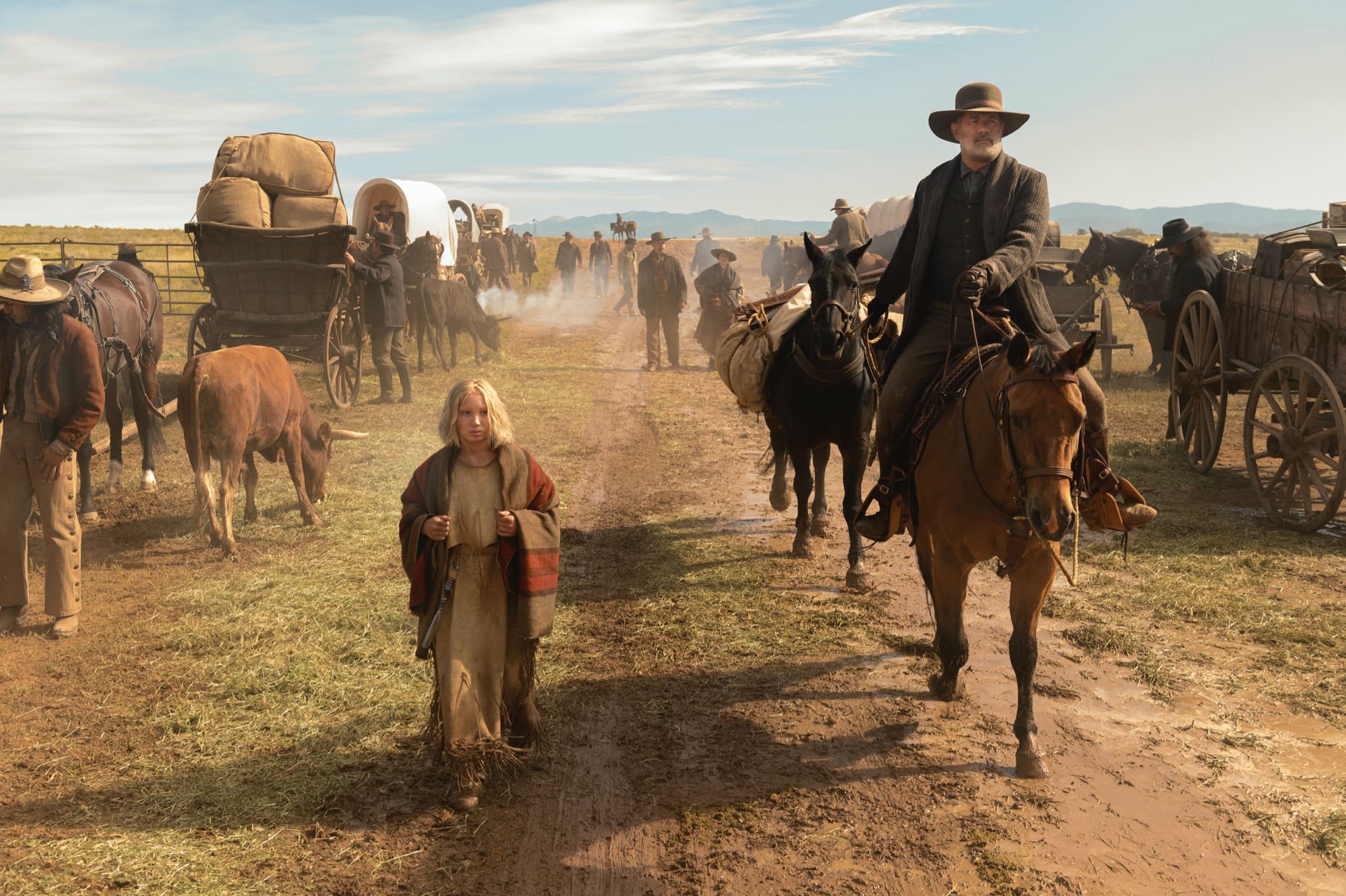


Na minha opinião, todo ano no Oscar, há pelo menos um indicado a Melhor Filme que pode ser caracterizado como “crowd-pleaser” (ou seja, que agrada multidões). São geralmente filmes que não possuem nada de realmente importante a dizer, costumam seguir uma fórmula, e eles agradam o espectador por causa do alto fator de entretenimento, sendo um filme cheio de energia. Nos anos passados, tivemos “Ford vs. Ferrari”, “Nasce uma Estrela”, “Bohemian Rhapsody” e “La La Land”, que cumpriram seus objetivos com louvor, a ponto de receberem uma indicação ao prêmio principal da temporada em que eles concorriam. Cada pedacinho de mim pensava que “Relatos do Mundo” seguiria essa mesma vibe, focando mais na ação que caracteriza o gênero faroeste e no entretenimento para manter o espectador engajado na história. Mas fico bem feliz que o co-roteirista e diretor Paul Greengrass, responsável por grande parte da franquia Jason Bourne e por “Capitão Phillips”, tinha outros planos. O roteiro, escrito por Greengrass e Luke Davies, tomando como base o romance homônimo de Paulette Jiles, é uma ótima versão de faroeste do que eu gosto de chamar de fórmula “Joel e Ellie”, personagens principais do videogame “The Last of Us”, ou seja, o fio condutor da trama focaria mais na dinâmica e na evolução do relacionamento entre os dois protagonistas do que na ação em si, como acontece no videogame. Mas há um ou outro detalhe aqui e ali que faz de “Relatos do Mundo” um pouco diferente dos “crowd-pleasers” citados acima. A começar pela ambientação, a qual é em 1870, 5 anos após a Guerra Civil Americana, período onde os EUA se dividiram em dois, por causa de discórdias em relação à escravidão nos estados sulistas. E ainda melhor, é ambientado no Texas, que era um estado escravista na época, e que, de acordo com o filme, ainda sofria com os preconceitos em respeito aos negros, imigrantes e nativos, mesmo após a abolição da escravidão. E isso, querendo ou não, adicionou um fator sociopolítico que eu não esperava no filme, mas fiquei bem satisfeito dos roteiristas terem abordado esses temas. Depois, e isso realmente colabora para um bom funcionamento da fórmula Joel e Ellie, temos o desenvolvimento dos dois protagonistas, que são excepcionalmente “quebrados”. Ele lutou na Guerra Civil Americana (do lado sulista) e, por consequência, se afastou da esposa, e constantemente se culpa por isso; enquanto ela teve sua infância roubada e também foi afastada da verdadeira família, adotando um estilo de vida completamente diferente do que o esperado. O roteiro explora muito bem a evolução na relação entre os dois, analisando as semelhanças e as diferenças entre eles, e através dessa exploração, eles acabam se aproximando. Essa abordagem do gênero dá ao filme um aspecto familiar (uma dinâmica muito parecida seria a do filme “Logan”, entre o protagonista e a X-23), mas ao mesmo tempo, inegavelmente aconchegante, nos investindo emocionalmente nesses personagens, nos fazendo desejar que nada de ruim aconteça com eles. Eles aprendem um com o outro, compartilham seus costumes, e veem no outro a peça que faltava para que suas vidas ficassem completas. Isso, por mais clichê que pareça ser, é uma coisa linda de se ver. Como dito anteriormente, é um filme que foca mais na história do que na ação, mas quando o roteiro investe no “bangue-bangue”, o resultado são cenas incrivelmente tensas que acabam fortalecendo o relacionamento entre os dois protagonistas. É um filme que faz ótimo uso de sua enxuta duração de 2 horas, e o final, apesar de eu particularmente achar que poderia ser um pouquinho melhor e mais intenso, acaba combinando perfeitamente com a vibe e a mensagem que o roteiro quer passar. Resumindo, o roteiro de “Relatos do Mundo” conta uma ótima história sobre perda, descoberta de identidade e família que certamente emocionará o espectador.

(In my opinion, every year at the Oscars, there's at least one Best Picture nominee that can be classified as a “crowdpleaser”. They are generally films that don't have anything really important to say, they usually follow a formula, and they please the viewer due to their high entertainment factor, being a film full of energy. In the past years, we've had “Ford vs Ferrari”, “A Star is Born”, “Bohemian Rhapsody” and “La La Land”, who successfully achieved their goals, to the point of being nominated for the main award in their respective seasons. Every little bit of me thought that “News of the World” would follow this same vibe, focusing more on the characteristic action of the Western genre and in entertainment to keep the viewers engaged in the story. But I'm really glad that co-writer and director Paul Greengrass, who was responsible for a larger part of the Jason Bourne franchise and “Captain Phillips”, had other plans. The screenplay, written by Greengrass and Luke Davies, based on the novel of the same name by Paulette Jiles, is a great Western twist on what I like to call the “Joel and Ellie” formula, inspired by the main characters in the videogame “The Last of Us”, meaning that the main conductive force of the plot would be the dynamics and evolution of the relationship between the two protagonists rather than the action itself, as it happens in the videogame. But there's some little details here and there that make “News of the World” different from the crowdpleasers mentioned above. Starting off with the setting, which is 1870, 5 years after the American Civil War, a period when the US divided themselves into two, because of disagreements regarding slavery in the Southern states. And even better, it's set in Texas, which was a slave state at the time, and that, according to the film, still suffered with the prejudices towards Black people, immigrants and Native Americans, even after the abolition of slavery. And that unexpectedly added a sociopolitical factor to the film, which I'm really glad the screenwriters were able to deal with these themes. Then, and this collaborates a lot for a good twist on the Joel and Ellie formula, we have the development of the two main characters, who are exceptionally broken. He fought in the American Civil War (in the Southern side) and, as a consequence, he distanced himself from his wife, and constantly blames himself for it; while she got robbed of her childhood and also distanced herself from her real family, adapting a lifestyle that's totally different than the one expected. The screenplay explores the evolution in their relationship really well, analyzing both their similarities and differences, and through these explorations, the two are brought a little bit closer to each other. This approach to the genre gives the film a vibe that's at the same time familiar (a similar dynamic was explored in the film “Logan”, between Logan and X-23) yet undeniably heartwarming, investing us emotionally with these characters, leaving us wishing nothing bad happens to them. They learn from each other, share their habits, and see in the other the missing piece for their life to become complete. This, as clichéd as it may sound, is a beautiful thing to behold. As previously stated, this is a film that focuses more on the story than it does on action, but when the script decides to make an action scene, it goes all in, resulting in incredibly tense scenes that end up making the bond between the two protagonists stronger. It's a film that makes great use of its concise 2-hour running time, and the ending, although I think it could've been a little bit better and more intense, perfectly fits the vibe and the message the screenplay wants to transmit. To sum it up, the screenplay for “News of the World” tells a great story on loss, discovery of identity and family that'll certainly hit at all of the viewer's emotional strings.)


Todos no elenco fazem um bom trabalho, por mais breve que as aparições de personagens secundários sejam, mas, como dito no parágrafo anterior, o foco aqui é dado para a dinâmica entre o Tom Hanks e a Helena Zengel, que é quase idêntica à dinâmica entre o Hugh Jackman e a Dafne Keen em “Logan”, mas tão eficiente quanto. Diferente dos protagonistas de “Logan” e “The Last of Us”, o personagem do Tom Hanks é altamente simpático, e ele é bem engenhoso. A atuação dele me lembrou bastante do Rooster Cogburn, protagonista de “Bravura Indômita”. Com o personagem dele sendo um veterano de guerra, o filme é só mais uma prova da versatilidade do ator vencedor de 2 Oscars. Com 64 anos, Hanks se mostra ainda capaz de cavalgar em alta velocidade, ser bom de mira, e ser a simpatia em pessoa que ele é. Não acho que seja material pra Oscar, mas é uma ótima performance, como era de se esperar. A verdadeira surpresa está na atuação da Helena Zengel, que já foi consagrada com indicações ao Globo de Ouro e ao Prêmio do Sindicato dos Atores de Melhor Atriz Coadjuvante por seu trabalho aqui. Assim como a estrutura em si do roteiro me lembrou muito de “Logan”, a performance de Zengel é bem similar à de Dafne Keen como X-23. O foco na personagem dela está muito mais no rosto expressivo e nos grunhidos primitivos que a atriz é capaz de transmitir do que na fala em si. Também me lembrou muito do desempenho da Millie Bobby Brown na primeira temporada de “Stranger Things”, nesse aspecto de ser uma atuação mais expressiva do que comunicativa. Ela já consegue dar um show em sua primeira performance fora de seu país natal (Alemanha), e mal posso esperar pelo próximo trabalho dela. A única ressalva que tenho em relação ao elenco é o Fred Hechinger. Ele interpreta um personagem interessante que poderia ter adicionado uma pitada cativante de alívio cômico na dinâmica eletrizante entre Hanks e Zengel, mas infelizmente, não foi bem aproveitado na trama.

(Everyone in the cast does a good job, as brief as the appearances by supporting characters may be, but, as previously stated in the previous paragraph, the focus here is given to the dynamics between Tom Hanks and Helena Zengel, which is almost identical to the one between Hugh Jackman and Dafne Keen in “Logan”, yet just as efficient. Unlike the main characters from “Logan” and “The Last of Us”, Tom Hanks's character is highly sympathetic, while also being very resourceful. His performance reminded me a lot of Rooster Cogburn, main character of “True Grit”. With his character being a war veteran, the film is yet another proof of the 2-time Oscar-winning actor's versatility. With the age of 64, Hanks shows himself still able of riding a horse in top speed, being a terrific shot, and the personification of symapthy he actually is. I don't believe it is Oscar material, but it's a great performance, as it was to be expected. The true surprise lies in Helena Zengel's performance, who has been already graced with nominations to the Golden Globe and Screen Actors Guild Award for Best Supporting Actress for her work here. Just like the screenplay's structure itself reminded me a lot of “Logan”, Zengel's performance is really similar to Dafne Keen's as X-23. The focus on her character is way more lined up with her expressive face and primal grunts she is able to transmit than in speech itself. She also reminded me a lot of Millie Bobby Brown's performance in the first season of “Stranger Things”, in that aspect of being a more expressive performance than a comunicative one. She's already a showstopper in her first performance outside her home country (Germany), and I can't wait for what she does next. The only setback I have regarding the cast concerns Fred Hechinger. He plays an interesting character who could've added a captivating comic relief touch to Hanks and Zengel's electrifying dynamics, but unfortunately, his role was underappreciated by the screenplay.)


Como todo faroeste, “Relatos do Mundo” é um filme bem vistoso. Como uma mudança de ar, o longa tem mais ambientações naturais, com foco nos terrenos rochosos e na sequidão do deserto, ao invés de investir em cenários já familiares do gênero, tais como saloons e delegacias. O diretor de fotografia Dariusz Wolski, conhecido por seus trabalhos na franquia “Piratas do Caribe”, faz um ótimo trabalho aqui. Ele consegue captar aquela aura rebuscada e antiquada (no bom sentido) dos filmes clássicos de faroeste, ou até de alguns mais modernos, como “Django Livre”, por exemplo. A direção de arte aposta completamente nos cenários clássicos do gênero e acerta em cheio. É um filme vistoso, com ambientações típicas. A montagem do William Goldenberg é muito bem feita. Não há um segundo aqui onde uma cena parece estar sendo esticada ou encurtada, é muito eficiente. E como a cereja no topo desse bolo maravilhoso, temos a trilha sonora original do James Newton Howard, que é serena, cativante, aumenta o teor emocional de certas cenas, e resgata a eficiência de algumas das melhores trilhas do gênero, em especial as do Ennio Morricone para os faroestes spaghetti de Sergio Leone.

(As it happens with every Western, “News of the World” is a visually astonishing film. As a change of pace, the film has a lot more natural settings, focusing on the rocky terrains and the dryness of the desert than betting on settings familiar to the genre, such as saloons and sheriff stations. Cinematographer Dariusz Wolski, known for his work in the “Pirates of the Caribbean” franchise, does a great job here. He's able to capture that good, old-fashioned (in a good way) aura that's in every classic Western film, or even in some of the modern ones, such as “Django Unchained”, for example. The art direction bets all of its cards on the classic scenarios in the genre and hits the jackpot. It's a really beautiful film, visually, with typical settings. William Goldenberg's editing is really well done. There isn't a single second in here in which a scene seems to be stretched out or cut too short, it's really efficient. And as the cherry on top of this marvelous cake, we have James Newton Howard's original score, which is serene, captivating, enhances the emotional tone of some scenes, and rescues the efficiency of some of the best scores in the genre, especially those of Ennio Morricone for Sergio Leone's spaghetti Westerns.)


Resumindo, a estrutura de roteiro de “Relatos do Mundo” pode parecer um pouco familiar, mas a dinâmica eletrizante entre Tom Hanks e Helena Zengel injeta uma quantidade enorme de carisma e energia para essa história cativante sobre perda, descoberta de identidade e família, enquanto os aspectos técnicos nos fazem lembrar de tudo que gostamos sobre o gênero faroeste.

Nota: 9,5 de 10!!

É isso, pessoal! Espero que tenham gostado! Até a próxima,

João Pedro

(In a nutshell, the screenplay structure of “News of the World” might feel a little familiar, but the electrifying dynamic between Tom Hanks and Helena Zengel adds a huge amount of charisma and energy to this captivating story on loss, discovery of identity and family, while the technical aspects remind us of everything we love about the Western genre.

I give it a 9,5 out of 10!!

That's it, guys! I hope you liked it! See you next time,

João Pedro)


terça-feira, 9 de fevereiro de 2021

"O Som do Silêncio": uma experiência cinematográfica extremamente imersiva (Bilíngue)

 E não se esqueçam de curtir e seguir o blog nas redes sociais:

(And don't forget to like and follow the blog in social medias:)

Facebook: https://www.facebook.com/NoCinemaComJoaoPedroBlog/

Twitter: @nocinemacomjp2

Instagram: @nocinemacomjp


Para a minha avó Cétura, minha intérprete de linguagem de sinais favorita. - JP

(To my grandmother Cétura, my favorite sign language interpreter. - JP)


E aí, meus caros cinéfilos! Tudo bem com vocês? Estou de volta, para trazer a resenha (levemente atrasada) do filme que promete ser um dos principais concorrentes à várias categorias na presente temporada de premiações. Uma história tocante de superação e auto-aceitação elevada pela performance altamente dedicada de seu protagonista, o filme em questão é provavelmente o melhor longa-metragem disponível no catálogo original da Amazon Prime Video. Então, sem mais delongas, vamos falar sobre “O Som do Silêncio”. Vamos lá!

(What's up, my dear film buffs! How are you guys doing? I'm back, in order to bring the (slightly delayed) review to the film that promises to be one of the main contenders to several categories in this year's award season. A touching story about overcoming obstacles and self-acceptance that's elevated by its protagonist's highly committed performance, the film I'm about to analyze might as well be the best one available on Amazon Prime Video's original catalog. So, without further ado, let's talk about “Sound of Metal”. Let's go!)


O filme segue o baterista e ex-viciado em heroína Ruben (Riz Ahmed), que começa a perder a audição durante um show, onde ele toca com sua namorada, Lou (Olivia Cooke). Quando um médico lhe diz que seu estado vai piorar, ele pensa que sua vida e carreira acabaram. Para evitar uma recaída, Lou leva Ruben para um lar de reabilitação para surdos, liderado por Joe (Paul Raci), que o ajuda a se adaptar à sua nova vida.

(The film follows drummer and former heroin addict Ruben (Riz Ahmed), who starts to lose his sense of hearing during a concert, where he plays with his girlfriend, Lou (Olivia Cooke). When a doctor tells him that his condition will get worse, he thinks his life and career have come to an end. In order to avoid a setback in his addiction, Lou takes Ruben to a rehab home for the deaf, led by Joe (Paul Raci), who helps him adapt to his new life.)


Antes de começar a falar do filme em si, deixem-me esclarecer o porquê de eu ter demorado tanto em trazer a resenha dele para o blog. Dezembro foi um mês extremamente cheio de filmes que eu considerava prioridades. “Mank” (que estreou no mesmo dia), “A Voz Suprema do Blues”, “Soul”, “Wolfwalkers” (que acabou sendo o melhor filme de 2020, pra mim), e “O Som do Silêncio”, em frente a essa competição, infelizmente ficou em segundo plano. Meus avós tinham assistido ao filme antes de mim, e me falaram que tinham gostado muito. Até algum tempo atrás, “O Som do Silêncio” não tinha chamado a minha atenção completamente. Mas aí, apareceram as primeiras listas de indicados e vencedores de premiações dessa temporada. Quando descobri que o longa tinha sido nomeado como um dos 10 melhores filmes de 2020 pelo American Film Institute e pelo National Board of Review (ambos costumam prever os indicados ao Oscar de Melhor Filme) e indicado à vários prêmios pelas atuações de Riz Ahmed e Paul Raci, eu falei pra mim mesmo: “Pronto, eu preciso ver esse filme.”. E estaria mentindo se dissesse que “O Som do Silêncio” não é uma das experiências cinematográficas mais imersivas que tive nesse início de ano. O filme é co-escrito e dirigido pelo estreante Darius Marder, que consegue nos inserir na cabeça de seu protagonista com muita eficiência através de seu engenhoso roteiro, co-autorado com seu irmão Abraham. Eu simplesmente amei a escolha feita pelos roteiristas de fazer com que os primeiros minutos de projeção sejam propositalmente os mais barulhentos do longa, o que serve como o contraste perfeito para o silêncio que dominará o restante da trama. Iniciando o filme com uma sequência musical cheia de energia, os irmãos Marder fazem um corte bem feito para uma cena mais pacífica, onde novamente, os vários barulhos são destacados. O bater de um liquidificador, o eco feito no ambiente quando Ruben faz exercícios físicos. O trabalho de som em “O Som do Silêncio” é algo extraordinário, e vou discuti-lo mais à frente. Mas o objetivo principal do roteiro dos Marder é estabelecer um arco de personagem completo para o Ruben, e isso eles conseguem fazer com maestria. O desenvolvimento do protagonista começou a me lembrar bastante do desenvolvimento do Matthew McConaughey em “Clube de Compras Dallas”. Assim como o Ron Woodruff, o Ruben começa o filme rejeitando a condição atual em que ele se encontra, ignorando as sugestões de profissionais sobre o assunto. Aí quando a situação piora para o lado dele, ele muda de atitude. Mas essa mudança não é abrupta, de modo algum. É uma adaptação lenta, gradual, que por consequência, ajuda o espectador a criar laços mais fortes com ele. Outro aspecto genial do roteiro é a falta de tradução para a linguagem de sinais usada por vários dos personagens coadjuvantes do filme à primeira vista. Isso colabora para um sentimento de igualdade entre o espectador e o protagonista, como se estivéssemos na mesma página. Ele começa não entendendo, então nós também começamos o filme não entendendo. Assim como o Wes Anderson consegue nos inserir na mente dos cachorros (que falam inglês em uma cidade dominada pela língua japonesa) em “Ilha dos Cachorros”, os irmãos Marder conseguem nos inserir na mente de alguém que está em constante adaptação à sua nova vida, com o processo incluindo o aprendizado de uma língua nova. Os roteiristas conseguem tratar um assunto extremamente delicado de forma bastante humana, apaixonante e surpreendentemente didática, escalando atores surdos como a Lauren Ridloff, que vai interpretar a primeira super-heroína surda do Universo Cinematográfico da Marvel no vindouro “Eternos”. Ver o Ruben aprendendo linguagem de sinais foi algo tão tocante que me deu até vontade de aprender por conta própria. Grande parte da carga emocional do roteiro dos Marder vem do fato da história em si ser uma história de adaptação, de superação, e principalmente, de auto-aceitação. Nós vemos o Ruben tendo inúmeras dificuldades em se adaptar à primeira vista, mas ao longo do tempo de duração conciso de 2 horas do filme, nós o acompanhamos no desenvolvimento e conclusão de seu arco de personagem, e ao final da projeção, não há outro jeito de terminar de assisti-lo senão com um sorriso no rosto e uma ou duas lágrimas derramadas. Bravo!

(Before I start talking about the film itself, let me clarify why it took me so long to finally bring this review to the blog. December was a month that was filled with films I considered to be priorities. “Mank” (which premiered at the exact same day), “Ma Rainey's Black Bottom”, “Soul”, “Wolfwalkers” (which ended up being the best film of 2020, for me), and “Sound of Metal”, facing this competition, unfortunately got left behind. My grandparents had watched it before me, and I remember them telling me that they had liked it a lot. Until some time ago, “Sound of Metal” hadn't fully caught my attention. But then, the first lists of nominees and winners of this year's award season came. When I found out that it was named one of the 10 best films of 2020 by the American Film Institute and the National Board of Review (both tend to predict the season's Oscar nominees for Best Picture) and that it got nominated for several awards because of Riz Ahmed and Paul Raci's performances, I thought to myself: “Okay. I have to see this movie.”. And I would be lying if I didn't say that “Sound of Metal” was one of the most immersive film experiences I've had this year so far. The film is co-written and directed by Darius Marder, who manages to effectively put us inside its protagonist's head through his clever screenplay, co-authored with his brother Abraham. I simply loved the choice the screenwriters made by making its first minutes the loudest ones in the film, which serves as the perfect contrast to the quietness that will dominate the rest of the plot. Starting it off with a high-energy musical number, the Marder brothers make a swift cut to a more peaceful scene, where once again, the several noises are highlighted. The whirring of a blender, the echo in a space where Ruben does physical exercises. The sound work in “Sound of Metal” is something extraordinary, which will be discussed more ahead. But the main objective of the Marders' screenplay is to provide Ruben with a complete character arc, and they manage to do that masterfully. The protagonist's development reminded me a lot of Matthew McConaughey's in “Dallas Buyers Club”. Just like Ron Woodruff, Ruben starts off rejecting his current condition, ignoring the advice from professionals on the subject. Then, when the situation becomes worse, he changes his attitude. Yet this change isn't abrupt, at all. It's a slow, gradual adaptation, which consequently helps the viewer create stronger bonds with him. Another genius aspect from the screenplay is the fact that they don't provide us with the translation for the sign language used by many of its characters at first. This collaborates for a feeling of equality between character and viewer, like if we were on the same boat. He starts off not understanding anything, and so do we, as viewers. Just like Wes Anderson managed to put us inside the mind of dogs (who speak English in a city dominated by the Japanese language) in “Isle of Dogs”, the Marder brothers manage to put us inside the mind of someone who is in constant adaptation to his new life, with the process including the learning of a new language. The screenwriters manage to treat an extremely delicate theme in a way that's human, passionate and surprisingly didactic, casting deaf performers such as Lauren Ridloff, who will portray the first deaf superhero in the Marvel Cinematic Universe in the upcoming “Eternals”. Seeing Ruben learning sign language was something so touching that it even made me want to learn it myself. A great part of the emotional weight in the Marders' screenplay comes from the fact that the story itself is about adaptation, about overcoming obstacles, and mainly, about self-acceptance. We see Ruben having numerous difficulties in adapting at first, but throughout its concise running time of 2 hours, we follow him in the development and conclusion of his character arc, and when the credits start rolling, you can't help but finished watching it with a big smile on your face and maybe one or two tears shed. Bravo!)


O elenco principal de “O Som do Silêncio” é composto apenas por 5 atores, mas cada um dá um show à parte. Temos aqui a melhor performance da carreira do Riz Ahmed, que até então, tinha assumido papéis coadjuvantes em “O Abutre”, “Rogue One” e “Venom”. Dá pra ver que ele se dedicou bastante para interpretar o Ruben. O diretor Darius Marder constatou que o filme é contado na perspectiva de uma pessoa ouvinte que adentra a cultura surda. Nisso, Ahmed acerta em cheio. Há várias sequências onde ele é visto aprendendo com pessoas (até mais jovens do que ele) a se adaptar ao seu novo estilo de vida, e é simplesmente impossível o espectador não sentir simpatia por ele. Ele consegue manipular suas emoções muito bem. Há momentos em que ele literalmente surta, na mesma medida em que há momentos mais pacíficos e contemplativos para o personagem dele. É uma tremenda performance, e pra mim, é o principal concorrente nas categorias de Melhor Ator, juntamente com o Chadwick Boseman por “A Voz Suprema do Blues”. O personagem de Ahmed tem duas âncoras emocionais, representadas pelos personagens da Olivia Cooke e do Paul Raci. As expressões faciais de Cooke ao demonstrar preocupação pela condição atual do protagonista são legítimas e realistas. O desenvolvimento da personagem dela deixa um pouquinho a desejar, mas, por consequência, temos um peso emocional e narrativo maior através da dinâmica entre Ahmed e Paul Raci, que vai além da amizade, como se fosse um relacionamento entre pai e filho. Filho ouvinte de pais surdos, Raci dá um verdadeiro show aqui. Há uma troca de diálogos entre seu personagem e o protagonista que acaba fazendo muito sentido na cena final do longa. Eu facilmente o indicaria a todos os prêmios de Melhor Ator Coadjuvante dessa temporada. Em papéis mais secundários, temos a Lauren Ridloff que, assim como Raci, ajuda o protagonista a se adaptar à sua nova vida; e o Mathieu Amalric, que providencia um breve pano de fundo para a personagem de Cooke.

(The main cast of “Sound of Metal” is composed only by 5 actors, but each one gives one hell of a show here. We have the best performance in Riz Ahmed's career, who until then, had taken on supporting roles in “Nightcrawler”, “Rogue One” and “Venom”. You can see that he's put a lot of work in portraying Ruben. Director Darius Marder stated that the film is told in the perspective of a hearing person who enters deaf culture. And in that, Ahmed nails it. There are several sequences in which he is seen learning with people (who are even younger than him) to adapt to his new lifestyle, and it's impossible for the viewer to not have sympathy for him. He manages to manipulate his emotions really well. There are moments in which he literally freaks out, in the same way there are more peaceful, contemplative moments for his character. It's a tremendous performance, and for me, he's the main contender for the Best Actor awards, along with Chadwick Boseman for “Ma Rainey's Black Bottom”. Ahmed's character has two main emotional anchors, represented by the characters portrayed by Olivia Cooke and Paul Raci. Cooke's facial expressions when showing concern for the protagonist's current condition are legitimate and realistic. Her character development leaves a little to be desired, but consequently, we have a much larger and emotional weight through the dynamics between Ahmed and Raci, which goes beyond friendship, like if it was a father-son relationship. Hearing son to deaf parents, Raci gives a showstopping performance here. There's an exchange of dialogue between his character and the main character which is touching, and ends up making tons of sense in the final scene. I'd easily nominate him to every single Best Supporting Actor award in the season. In more secondary roles, we have Lauren Ridloff, who, like Raci, helps the protagonist adapt to his new life; and Mathieu Amalric, who gives us a brief background on Cooke's character.)


Além do incrível desempenho do roteiro e do elenco, “O Som do Silêncio” também faz um uso excepcional de seus aspectos técnicos. A direção de fotografia do Daniël Bouquet faz um uso perfeito de muitos cenários naturais, pelo fato da maioria da trama ser ambientada em um local no campo. A direção de arte, em conjunto com Bouquet, consegue fazer um contraste nítido entre o ambiente de reabilitação, que é limpo e pacífico; e os espaços urbanos, que são extremamente barulhentos. A trilha sonora do Abraham Marder e do Nicolas Becker é pouco presente, mas quando entra em cena, ela tem potência. É um filme bem silencioso, em termos de música. Mas a verdadeira magia na proeza técnica de “O Som do Silêncio” reside no design de som. Como dito anteriormente, os primeiros 5 ou 10 minutos de projeção são propositalmente os mais barulhentos do filme, contando com uma performance de metal e um foco nítido nos vários barulhos que dominam a vida do Ruben. Quando ele vai perdendo a audição, nós, como espectadores, “perdemos a nossa audição” com ele, porque, afinal, o roteiro coloca protagonista e espectador no mesmo barco. É simplesmente incrível (e extremo até) o contraste feito entre a primeira e a última cena do filme. É um dos melhores trabalhos de som que eu já vi desde “Um Lugar Silencioso” e “Em Ritmo de Fuga”, e deve ser um dos principais indicados ao Oscar de Melhor Som, juntamente com “Mank”.

(Besides the amazing performance by its screenplay and cast, “Sound of Metal” also makes an exceptional use of its technical aspects. Daniël Bouquet's cinematography perfectly uses many natural settings, because most of the plot is set in a countryside place. The art direction, working together with Bouquet, manages to make a clear contrast between the rehab environment, which is clean and peaceful; and the urban spaces, which are extremely noisy. Abraham Marder and Nicolas Becker's original score isn't that present, but when it comes into scene, it comes in hard. It's a really quiet film, when it comes to music. Yet the real magic in the technical prowess of “Sound of Metal” resides in its sound design. As previously stated, the first 5 or 10 minutes are purposefully the loudest ones in the film, relying on a metal performance and a clear focus on the several noises that dominate Ruben's life. When he begins losing his hearing, we, as viewers, “lose our hearing” with him, because, after all, the screenplay puts protagonist and viewer on the same page. It's simply amazing (and extreme, even) the contrast made between the film's first and final scene. It's one of the best sound work I've ever seen since “A Quiet Place” and “Baby Driver”, and should be one of the main contenders for the Oscar for Best Sound, alongside “Mank”.)


Resumindo, “O Som do Silêncio” é um dos melhores filmes de 2020. Fazendo o melhor uso de seu roteiro, elenco e aspectos técnicos, o diretor estreante Darius Marder cria aqui uma experiência cinematográfica extremamente imersiva, elevada à novas alturas pelas performances marcantes de Riz Ahmed e Paul Raci e pelo inventivo design de som.

Nota: 10 de 10!!

É isso, pessoal! Espero que tenham gostado! Até a próxima,

João Pedro

(In a nutshell, “Sound of Metal” is one of the best films of 2020. Making the best use of its screenplay, cast and technical aspects, debuting director Darius Marder creates an extremely immersive cinematic experience here, which is elevated to new heights by Riz Ahmed and Paul Raci's remarkable performances and its inventive sound design.

I give it a 10 out of 10!!

That's it, guys! I hope you liked it! See you next time,

João Pedro)


sexta-feira, 29 de janeiro de 2021

O Legado de "Pânico": 25 anos de gritos, metalinguagem e subversão (Bilíngue)

 E não se esqueçam de curtir e seguir o blog nas redes sociais:

(And don't forget to like and follow the blog in social medias:)

Facebook: https://www.facebook.com/NoCinemaComJoaoPedroBlog/

Twitter: @nocinemacomjp2

Instagram: @nocinemacomjp


E aí, meus caros cinéfilos! Tudo bem com vocês? Estou de volta, para falar sobre uma das minhas franquias de terror favoritas. Muitas franquias irão comemorar aniversários marcantes esse ano, especialmente as de “Harry Potter” e “O Senhor dos Anéis”, ambas iniciadas em 2001 (podem esperar textos sobre essas sagas ainda esse ano). Mas, na postagem de hoje, gostaria de discorrer sobre àquela responsável por revitalizar um dos subgêneros mais usados em filmes de terror, que completa 25 anos em 2021. Então, sem mais delongas, vamos falar sobre a franquia “Pânico”. Vamos lá!

(What's up, my dear film buffs! How are you guys doing? I'm back, in order to talk about one of my favorite horror franchises. Many franchises will celebrate groundbreaking anniversaries this year, especially those of “Harry Potter” and “The Lord of the Rings”, both starting off in 2001 (you can expect texts about those sagas later this year). But, in today's post, I'd like to shed light on the one responsible for revitalizing one of the most used subgenres in horror films, which completes 25 years of existence in 2021. So, without further ado, let's talk about the “Scream” franchise. Let's go!)


Para quem não sabe, a franquia “Pânico” é uma saga composta por quatro filmes de terror dirigidos por Wes Craven. Idealizado pelo roteirista Kevin Williamson, o enredo segue Sidney Prescott (Neve Campbell), uma jovem que vive na cidadezinha pacata de Woodsboro, Califórnia, que vê sua vida virar de cabeça pra baixo quando assassinatos brutais começam a aterrorizar a cidade, um ano após a morte misteriosa de sua mãe. Juntando forças com a jornalista Gale Weathers (Courteney Cox) e o policial Dewey Riley (David Arquette), Sidney embarca em uma jornada perigosa para tentar desmascarar o assassino. Craven e Williamson receberam créditos por revitalizar o gênero slasher (filmes onde há um assassino cuja arma registrada geralmente é uma lâmina, como uma faca), popularizado por filmes como “Halloween”, de John Carpenter, e “A Hora do Pesadelo”, do próprio Craven. “Pânico” ganhou popularidade por ser incrivelmente metalinguístico, contendo personagens cientes da fórmula de filmes de terror, discutindo os clichês presentes no gênero, os quais o filme deseja subverter. Até o presente momento, foram lançados quatro filmes dessa franquia, com o quinto previsto para o início de 2022, sob a direção de Matt Bertinelli-Olpin e Tyler Gillett, responsáveis pelo ótimo “Casamento Sangrento”. Pretendo fazer um ranking de todos os quatro filmes lançados, apontando os pontos positivos e negativos de cada um. Já digo de passagem, nenhum deles é ruim, mas alguns causam mais impacto do que outros. Então, com isso dito, vamos começar!

(For those who don't know, the “Scream” franchise is a saga composed by four horror films directed by Wes Craven. Created by screenwriter Kevin Williamson, the plot follows Sidney Prescott (Neve Campbell), a young woman living in the quiet little town of Woodsboro, California, who sees her life turn upside down when brutal murders begin to terrorize the city, one year after her mother's mysterious death. Joining forces with journalist Gale Weathers (Courteney Cox) and police officer Dewey Riley (David Arquette), Sidney embarks on a dangerous journey to try and unmask the killer. Craven and Williamson received credit for revitalizing the slasher genre (films where there's a killer whose signature weapon is generally a blade, like a knife), made popular by films such as John Carpenter's “Halloween” and Craven's own “A Nightmare on Elm Street”. “Scream” gained popularity for being incredibly meta, containing characters that are self-aware of the horror film formula, discussing all the clichés in the genre, which the film wishes to subvert. To this moment, four films of this franchise have been released, with the fifth one scheduled to premiere in early 2022, directed by Matt Bertinelli-Olpin and Tyler Gillett, who made the great “Ready or Not”. I intend to rank all the released four films, pointing out each one's pros and cons. I'll already tell you, none of these films is bad, but some cause a little more impact than others. So, with that said, let's begin!)


  1. PÂNICO 3” (2000)

    (“SCREAM 3” (2000))

O único filme dos quatro lançados a não ter seu roteiro escrito por Kevin Williamson, o terceiro longa da franquia tem seus altos e baixos. Olhando pelos lados positivos, é o filme mais metalinguístico da saga, ambientando seus acontecimentos inteiramente dentro de um set de filmagens. Não tem como ficar mais metalinguístico do que isso. Os novos nomes adicionados no elenco fazem um bom trabalho, em especial a Parker Posey, que tem uma dinâmica hilária com a Courteney Cox. Em aspectos de arcos de personagem, é o longa que lida melhor com o trauma sofrido pela protagonista nos dois primeiros filmes. Seja por meio de pequenos momentos ou sequências intensas, “Pânico 3” é o filme que melhor extrai o que a Neve Campbell é capaz de fazer, estabelecendo uma boa continuidade em respeito aos eventos de “Pânico” 1 e 2. Agora, em comparação com o que os dois primeiros filmes fizeram, o roteiro escrito pelo Ehren Kruger mostra uma visível familiaridade na fórmula do enredo. Um dos pontos mais marcantes da franquia em si é o fator de ver alguma coisa que o espectador não esperava. Não estou falando dos sustos, mas do desenrolar dos eventos. E “Pânico 3” repete a fórmula dos dois primeiros filmes de forma bem previsível. Tem uma cena em particular que expõe o quanto essa estrutura ficou batida com o tempo, onde a Parker Posey e a Courteney Cox gritam do jeito mais falso e mecânico possível. Outra coisa que me incomodou muito foi a jornada pela identidade do assassino, a qual, nos outros três filmes, mantém o espectador pensando o tempo inteiro até ele finalmente ser revelado. E o assassino de “Pânico 3” não é só facilmente identificado, como também reescreve a mitologia estabelecida nos filmes anteriores, de uma maneira até bizarra, pra falar a verdade. Resumindo, o terceiro longa da franquia “Pânico” não é descartável e ainda aproveita alguns aspectos da metalinguagem marcante da saga de forma criativa, mas está longe de ser tão eficiente quanto “Pânico” 1, 2, ou 4.

(The only one of all four released films to not have its screenplay written by Kevin Williamson, the third film in the franchise has its ups and downs. Looking on the brighter sides, it is the most metalinguistic film in the saga, setting its events entirely inside a film set. You literally can't get more meta than that. The new names added to the cast do a good job, especially Parker Posey, who has an hilarious dynamic with Courteney Cox. When it comes to character arcs, it's the film that deals the best with the trauma the main character suffers with in the first two movies. Whether it's through small moments or intense sequences, “Scream 3” is the film that best extracts what Neve Campbell is able to do, establishing a good continuity regarding the events of “Scream” 1 and 2. Now, in comparison to what the two first films did, Ehren Kruger's screenplay shows a perceptive familiarity in the plot's formula. One of the most remarkable points in the franchise itself is the fact that the viewer sees something he wasn't expecting to see. I'm not talking about the scares, but about the unraveling of the plot. And “Scream 3” repeats the formula established in the two first films in a very predictable way. There's a particular scene that exposes how this structure got tiring with time, where Parker Posey and Courteney Cox scream in the most fake, mechanical way possible. Another thing that bothered me a lot was the journey for the killer's identity, which, in the other three films, keeps the viewer wondering all the time until they are finally revealed. And the killer in “Scream 3” is not only easily identifiable, but they also rewrite the mythology established in previous films, in a bizarre way, to tell the truth. To sum it up, the third film in the “Scream” franchise isn't disposable and still makes use of the saga's groundbreaking metalanguage in a creative way, but it's far from being as efficient as “Scream” 1, 2 or 4.)


  1. PÂNICO 2” (1997)

    (“SCREAM 2” (1997))

Com o sucesso do primeiro filme, era só questão de tempo que uma sequência fosse anunciada e Craven e companhia levaram menos de um ano após o lançamento de “Pânico” para trazer “Pânico 2” às telas. Eu particularmente gostei bastante da sequência. A cena de abertura satiriza a primeira cena do primeiro filme de maneira fantástica. (Inclusive, foi uma das melhores cenas satirizadas na franquia cômica “Todo Mundo em Pânico”.) Eu adorei a estrutura dos assassinatos. Normalmente, um assassino mataria uma pessoa ao acaso, sem planejamento nenhum, mas aqui não. O roteirista Kevin Williamson prepara um terreno de forma muito inteligente para que os mocinhos possam ficar um passo à frente. Um dos melhores personagens da franquia, o cinéfilo Randy, tem um papel mais extenso em “Pânico 2” e eu amei cada cena que ele aparecia. Ele participa de discussões fervorosas e divertidas sobre sequências de filmes na faculdade e é o maior recurso expositivo usado pelo roteirista para atualizar as regras da fórmula do primeiro filme. As mortes ficam mais elaboradas e criativas, são mais numerosas, e conseguem manter o espectador especulando sobre a identidade do assassino até o frenético ato final. Eu gostei de como Williamson conseguiu repetir o aspecto da ambiguidade moral dos personagens secundários, nos fazendo ficar alertas em respeito ao comportamento deles, e depois puxando o tapete e revirando o jogo de maneira sensacional. E o ato final tem uma das decisões mais inteligentes já tomadas em um filme de terror. Resumindo, “Pânico 2” aproveita o sucesso do primeiro filme da melhor maneira possível, ampliando sua criatividade e enriquecendo sua mitologia.

(With the first film's success, it was only a matter of time until a sequel was announced and Craven and his crew took less than a year after the release of “Scream” to bring “Scream 2” to the silver screen. I particularly liked the sequel. The opening scene satirizes the first film's opening scene in a fantastic way. (By the way, it was one of the best scenes satirized in the “Scary Movie” comedy franchise.) I loved how the murders were structured. Normally, a killer would kill someone out of the blue, without any planning, but not here. Screenwriter Kevin Williamson sets the ground in a very clever way for the good guys to be one step ahead. One of the franchise's best characters, movie expert Randy, has a more extended role in “Scream 2” and I loved every scene he was in. He participates in fervorous and fun discussions on movie sequels in college and he's the most used expositional resource by the screenwriter to update the rules in the first film's formula. Deaths get more elaborate and creative, they come at a higher number, and manage to keep the viewer speculating on the killer's identity until the action-packed final act. I liked how Williamson managed to repeat the aspect of side characters' moral ambiguity, making us stay alert over their behavior, and then pulling the rug and turning everything around in the most sensational way. And the final act has one of the smartest decisions ever taken in a horror film. To sum it up, “Scream 2” rides on the first one's success in the best way possible, enhancing its creativity and expanding its mythology.)


  1. PÂNICO 4” (2011)

    (“SCREAM 4” (2011))

Acredito que a maior parte da recepção negativa de “Pânico 4” se deu à distância gigantesca de 11 anos, levando em conta o lançamento do filme anterior em 2000. Os espectadores deveriam estar pensando: “Mas eles vão fazer isso DE NOVO? Pela QUARTA vez?”. Também é bem provável que o terceiro filme (que, até 2011, era o último de uma trilogia) tenha deixado um gosto amargo em muita gente. Mas assistindo ao quarto filme agora, em uma época onde uma certa empresa investe incessantemente em remakes e reboots, “Pânico 4” acerta em cheio na relevância do assunto abordado e no frescor característico da franquia. Craven (em seu último filme como diretor, tendo falecido em 2015) e Williamson conseguem trazer um conceito dos anos 1990 para o século XXI com sucesso. Eu gostei da mudança de foco que o quarto filme mostrou. Ao invés de focar no trio principal de Sidney, Gale e Dewey, o roteiro de Williamson brilhou um holofote no sensacional elenco adolescente, encabeçado por Emma Roberts, Erik Knudsen, Rory Culkin e Hayden Panettiere, que transborda com muito talento. A cena inicial satiriza a arte de refilmar e refazer as mesmas fórmulas com perfeição, mas o verdadeiro trunfo do quarto filme é a sua crítica social. Aí, vocês podem perguntar “Como um filme de terror genérico pode ter uma crítica social?”, e a resposta é: pela ambientação. Durante a era digital, os moradores de Woodsboro (mais conhecidos como alvos do assassino) são extremamente obcecados em serem vistos e notados na internet. Isso é mostrado de forma clara e eficiente pelo personagem Robbie, que literalmente grava cada segundo da vida dele com uma mini-câmera e transmite ao vivo pela internet. E inserindo essa crítica em um filme de terror, podemos descobrir uma nova camada para análise, a qual é “O quão longe uma pessoa poderia ir pra ter seus 15 minutos de fama?”. Sem spoilers aqui, mas “Pânico 4” é o filme que melhor retrata a jornada para desmascarar o assassino. O espectador, como no segundo filme, fica alerta com o comportamento de alguns personagens, o qual fica ainda mais suspeito com o uso inteligente dos aspectos técnicos. E novamente, o roteirista surpreende o espectador com as reviravoltas no enredo. Resumindo, “Pânico 4” é a melhor sequência da franquia, funcionando tanto pela nostalgia de ver os mesmos personagens de 1996, quanto pela relevância de sua ambientação.

(I believe that most of the negative reception of “Scream 4” was due to its gigantic distance of 11 years, regarding the previous film's release in 2000. The viewers might have been thinking: “But they'll do that AGAIN? For the FOURTH time?” It's also very likely that the third film (which, until 2011, was the last one in a trilogy) might have left a bitter taste in a lot of people. But watching the fourth film now, in a time where a certain film company keeps on investing in remakes and reboots, “Scream 4” hits the jackpot when it comes to the timelessness of its themes and the franchise's characteristic freshness. Craven (in his last film as director, passing away in 2015) and Williamson manage to successfully bring a 1990s concept to the 21st century. I really enjoyed the fourth film's change of focus. Instead of focusing on the main trio of Sidney, Gale and Dewey, Williamson's screenplay sheds a light on the outstanding teen cast, headed by Emma Roberts, Erik Knudsen, Rory Culkin and Hayden Panettiere, which overflows with a lot of talent. The opening scene satirizes the art of refilming and remaking the same formulas with perfection, but the distinctive aspect of the fourth film is its social criticism. Then, you may ask “How can a generic horror flick have something to say?”, and the answer is: through the setting. During the digital era, the residents of Woodsboro (also known as the killer's targets) are extremely obsessed with being seen and noticed on the internet. This is shown clearly and efficiently through the character Robbie, who literally records every second of his life with a tiny camera and streams it live on the internet. And by inserting that theme in a horror film, we can unravel a whole new layer for analysis, which is “How far could a person go to have their 15 minutes of fame?”. No spoilers here, but “Scream 4” is the film that best portrays the journey towards the killer's unmasking. The viewer, as it happens in the second film, stays sharp with the behavior of some characters, which gets even more suspicious due to the clever use of technical aspects. And, once again, the screenwriter surprises the viewer with the plot's twists and turns. To sum it up, “Scream 4” is the best sequel in the franchise, making it work both for the nostalgia of seeing the same ol' characters from 1996, and for the relevance of its setting.)


  1. PÂNICO” (1996)

    (“SCREAM” (1996))

Todo mundo provavelmente lembra da primeira vez que viram a já icônica sequência de abertura do primeiro filme da franquia “Pânico”. A esperteza e a originalidade do roteiro de Williamson somada com a sinistra trilha sonora de Marco Beltrami, a direção experiente de Wes Craven e a atuação autêntica de Drew Barrymore colaboraram para uma das cenas de abertura mais memoráveis dos últimos tempos, que daria sequência ao filme que iria soprar um necessário frescor em um subgênero que tinha se tornado cada vez mais ridículo e explícito com o passar do tempo. Já da primeira cena, dava para ver que não estávamos vendo qualquer filme de terror, porque que filme iria sacrificar o nome mais famoso do elenco (que estava até no pôster) como a primeira vítima? Se a primeira cena não fosse o suficiente para Williamson atrair o público, a próxima cena envolve uma troca de diálogos genial sobre diferentes versões de “O Exorcista” para falar do relacionamento amoroso da protagonista. O primeiro “Pânico” introduziu com sucesso a metalinguagem e a "auto-consciência" da fórmula de filmes de terror que iriam percorrer a saga inteira. Há uma cena em particular que brinca com a estrutura e as “regras” dos slashers dos anos 1970 e 1980, e o roteiro em si vai e subverte essas regras (literalmente) na próxima cena. Mas o melhor aspecto no enredo do filme, de longe, é a pergunta que Williamson implanta na mente dos espectadores e dos personagens: “Quem é o assassino?”. Não é uma estratégia revolucionária, tendo sido usada em filmes como “Janela Indiscreta” e “Psicose”, mas é pouco presente no subgênero slasher, porque nós sabemos exatamente quem são os assassinos em filmes como “Halloween” ou “Sexta-Feira 13”. Enquanto o personagem pode pensar “Meu Deus, quem é esse cara que usa máscara de hóquei e por quê ele tá tentando me matar com um facão?”, o espectador já chega à conclusão: “é o Jason”. Isso não acontece em “Pânico” e o suspense chega a nos sufocar de tão envolvente e engenhoso, até o claustrofóbico ato final. E ainda, Williamson também consegue criar uma final girl (última sobrevivente em um filme de terror, geralmente uma jovem virgem) subversiva para a época de lançamento do filme, para carregar a tocha popularizada por Laurie Strode, protagonista de “Halloween”, interpretada pela Jamie Lee Curtis. Resumindo, o primeiro “Pânico” já tem 25 anos, mas sua originalidade, suspense e metalinguagem ainda são inteiramente capazes de impressionar novas gerações de espectadores.

(Everyone probably remembers the first time they watched the already iconic opening sequence of the first film in the “Scream” franchise. The cleverness and originality in Williamson's screenplay combined with Marco Beltrami's sinister score, Wes Craven's expert directing and Drew Barrymore's authentic performance collaborate for one of the most memorable opening scenes in recent times, which would serve as an overture to the film that would breathe a necessary freshness into a subgenre that had become all the more ridiculous and explicit with the passage of time. From the first scene, we could see we weren't watching any regular horror film, because what film would sacrifice the most famous name in the cast (who even was on the poster) as its first victim? If the first scene wasn't enough for Williamson to draw the viewer in, the next scene involves a genius exchange of dialogue on different versions of “The Exorcist” to talk about the protagonist's relationship with her boyfriend. The first “Scream” successfully intoduced the metalanguage and the self-awareness of horror movie tropes that were going to be there for the long haul. There's a particular scene that plays on the structure and “rules” of 1970s and 1980s slashers, and the screenplay itself subverts those rules (literally) in the next scene. But the greatest aspect in the movie's plot, by far, is the question Williamson implants into the viewers' and the characters' minds: “Who is the killer?”. It's not a revolutionary strategy, having been used in films like “Rear Window” and “Psycho”, but it's not that present in the slasher subgenre, because we know exactly who the killers are in films like “Halloween” and “Friday the 13th”. While the character might think “Oh, my God, who the hell is this guy who's wearing a hockey mask and why is he trying to kill me with a machete?”, the viewer already jumps to conclusion: “it's Jason”. This doesn't happen in “Scream” and the suspense is able to suffocate us because of its ingenious development, until the claustrophobic final act. And still, Williamson also manages to create a subversive final girl (the last survivor in a horror film, generally a virgin young girl) for the film's time of release, to carry the torch made popular by the protagonist of “Halloween”, Laurie Strode, played by Jamie Lee Curtis. To sum it up, the first “Scream” film is already 25 years old, but its originality, suspense and metalanguage are still fully capable of making an impression on new generations of viewers.)


É isso, pessoal! Espero que tenham gostado! Até a próxima,

João Pedro

(That's it, guys! I hope you liked it! See you next time,

João Pedro)


quarta-feira, 27 de janeiro de 2021

Os Filmes Mais Esperados de 2021 (Bilíngue)

 E não se esqueçam de curtir e seguir o blog nas redes sociais:

(And don't forget to like and follow the blog in social medias:)

Facebook: https://www.facebook.com/NoCinemaComJoaoPedroBlog/

Twitter: @nocinemacomjp2

Instagram: @nocinemacomjp


E aí, meus caros cinéfilos! Tudo bem com vocês? Estou de volta, para falar sobre os meus filmes mais aguardados de 2021! Com os últimos filmes da presente temporada de premiações sendo lançados nos EUA no mês que vem, acho que é uma boa hora para trazer para vocês os 5 filmes que estou mais ansioso para ver este ano! Então, sem mais delongas, vamos lá!

(What's up, my dear film buffs! How are you guys doing? I'm back, in order to talk about my most anticipated films of 2021! With the final films in the current award season being released to the general audience next month, I think it's a perfect time for me to bring to you the 5 films I'm most excited to watch this year! So, without further ado, let's do this!)


Confesso que 2021 vai ser um ano complicado para escolher só 5 filmes, já que 4 dos meus 5 títulos mais aguardados do ano passado foram adiados para este ano. Tive bastante tempo para pensar, e acho que consegui alcançar uma solução que abarca tanto os filmes adiados de 2020 quanto aqueles já programados para estrearem este ano. É claro, como sempre, irei deixar algumas menções honrosas abaixo do top 5, contendo os filmes que iriam compor um provável top 10. Também irei colocar a data de estreia de cada um (se já tiverem), mas devido aos contínuos adiamentos, considerem essas informações como provisórias. Então, com isso dito, vamos começar!

(I confess that 2021 will be a complicated year to choose only 5 films from, as 4 of my 5 most anticipated titles from last year were delayed to this year. I've had a lot of time to think, and I think I was able to reach a solution that embraces both the delayed 2020 films and those already scheduled to premiere this year. Of course, as always, I'll leave some honorable mentions below the top 5, containing the films that would've composed a likely top 10 list. I'll also put the release date of each one of them (if they already have one), but due to the continuous delays, consider these pieces of information as temporary. So, with that out of our way, let's begin!)


  1. SEQUÊNCIA AINDA SEM TÍTULO DE “HOMEM-ARANHA: LONGE DE CASA”, dirigido por Jon Watts – Data de estreia: 16 de dezembro

    (UNTITLED SEQUEL TO “SPIDER-MAN: FAR FROM HOME”, directed by Jon Watts – When to expect it: December 17th)

Há diversas razões para esse ser o filme de super-heróis mais aguardado de 2021 para mim. A primeira delas é: eu AMO o personagem do Homem-Aranha. (Se você ainda não sabia disso, o que acho impossível, agora sabe.) Ele é engraçado, inteligente, e acima de tudo, ele enfrentou muitos traumas no passado, o que acaba por injetar muita humanidade no personagem. A versão do Tom Holland, especialmente. Porque, além de perder o Tio Ben (que nós nunca vimos), ele também perdeu o seu mentor, Tony Stark, com o filme “Homem-Aranha: Longe de Casa” fazendo uma boa exploração dessa perda. A cena pós-créditos desse filme já era o bastante para o terceiro longa do personagem me atrair, mas as diversas novidades no enredo e no elenco só foram alimentando minhas expectativas exponencialmente. A confirmação de Benedict Cumberbatch como Dr. Estranho no filme deu origem à uma série de especulações sobre um “Aranhaverso” live-action, as quais foram se provando cada vez mais plausíveis com as escalações de Jamie Foxx e Alfred Molina como Electro e Dr. Octopus, reprisando seus papéis de “O Espetacular Homem-Aranha 2” e “Homem-Aranha 2”, respectivamente. E é claro, os incontáveis rumores do retorno de Tobey Maguire, Andrew Garfield, Kirsten Dunst e Emma Stone em seus papéis como os Homens-Aranha e os interesses amorosos de suas respectivas iterações do herói também capturaram minha atenção. Mas além do elenco, há duas razões que me animam bastante no enredo: 1) terá uma ligação direta com o enredo de “WandaVision”, que também irá interferir em “Dr. Estranho no Multiverso da Loucura”; 2) será ambientado no Natal, minha época favorita do ano. O que não é absolutamente surpreendente, levando em conta a estreia em dezembro. Resumindo, esses rumores, juntamente com as informações já confirmadas, têm alimentado bastante as minhas expectativas. Realmente espero que a Sony me dê um presentão de Natal e aniversário antecipado sem adiamentos, e um novo clássico de Natal, talvez. Quem sabe?

(There are several reasons for this to be my most anticipated superhero film of the year. The first one of them is: I LOVE the character of Spider-Man. (If you still didn't know that, which I think is impossible, now you do.) He's funny, smart, and above all, he's been through a lot of traumatic events, which end up injecting the character with lots of humanity. Tom Holland's version of him, especially. Because, besides losing Uncle Ben (who we never got to see), he also loses his mentor, Tony Stark, with the film “Spider-Man: Far from Home” making a good exploration of this loss. The post-credit scene in this film was enough to draw me in for the third one, but the several news regarding the plot and the cast were only putting my expectations on a higher level. Benedict Cumberbatch's confirmed return as Dr. Strange originated a series of speculations on a live-action “Spider-Verse”, which became all the more plausible with the casting of Jamie Foxx and Alfred Molina as Electro and Doc Ock, reprising their roles from “The Amazing Spider-Man 2” and “Spider-Man 2”, respectively. And of course, the countless rumors of the return of Tobey Maguire, Andrew Garfield, Kirsten Dunst and Emma Stone as the Spider-Men and the love interests of their respective iterations of the character also captured my attention. But besides the cast, there are two reasons that excite me a lot regarding the plot: 1) it'll have a direct connection with the plot of “WandaVision”, which will also interfere with “Doctor Strange in the Multiverse of Madness”; 2) it'll be set in Christmas, my favorite time of the year. Which doesn't come as an absolute surprise, with a December release date. To sum it up, these rumors, along with the already confirmed information, have been improving on my expectations. I really hope Sony gives me a hell of a Christmas and anticipated birthday present without any delays, and a new Christmas classic, maybe. Who knows?)


  1. NOITE PASSADA EM SOHO”, dirigido por Edgar Wright – Data de estreia: 21 de outubro

    (“LAST NIGHT IN SOHO”, directed by Edgar Wright – Release date: October 22nd)

O marketing de “Noite Passada em SoHo” foi bem interessante até agora. Previsto para estrear em setembro do ano passado, o filme foi adiado para abril desse ano e novamente para o segundo semestre. Até o momento, nenhum teaser ou trailer foi liberado para o público geral. O diretor se reduziu à liberar imagens misteriosas e aparentemente desconectadas uma da outra. Mas o enredo, por mais oculto que seja, possa ajudar a entender o fio condutor da história. O filme narrará a história de uma aspirante à designer de moda que viaja misteriosamente para os anos 1960, onde ela encontra seu ídolo, uma cantora em ascensão. Mas ela logo descobre que a Londres que ela tanto sonhava não é o que parece ser, e tudo começa a desmoronar com consequências sombrias. Eu fiquei bem surpreso pelo Edgar Wright escolher o gênero completamente oposto àquele pelo qual ele é conhecido, mas levando em conta as inspirações dele para seu novo filme, que incluem o sufocante “Repulsa ao Sexo”, suspense psicológico dos anos 60 dirigido por Roman Polanski, teremos aqui um dos candidatos mais promissores à melhor filme de terror do ano. As imagens liberadas para o público até o momento conseguem evocar a atmosfera enervante e contagiosa do filme de Polanski com sucesso, e eu particularmente mal posso esperar para saber mais sobre a nova empreitada de Edgar Wright.

(The marketing campaign for “Last Night in SoHo” has been really interesting to this point. Initially scheduled to premiere last September, it has been delayed to this April and again for the latter half of 2021. To this moment, no teaser or trailer was released to the general audience. The director limited himself in releasing mysterious and apparently disconnected images. But the plot, as cryptic as it may seem, may help understanding the conductive force of the story. The film will follow the story of a wannabe fashion designer who mysteriously travels to the 1960s, where she finds her idol, a rising singer. But she soon finds out that the London she dreamed of isn't what it seems, and everything starts to fall apart with shady consequences. I was really surprised that Edgar Wright chose the complete opposite genre of which he is known for, but considering his inspirations for his new film, which include the suffocating “Repulsion”, a psychological thriller from the 60s directed by Roman Polanski, we'll have here one of the most promising contenders for best horror film of the year. The images released to the public to this day can successfully evoke the unsettling and contagious atmosphere of Polanski's film, and I personally can't wait to know more about Edgar Wright's new endeavour.)


  1. O BECO DAS ALMAS PERDIDAS”, dirigido por Guillermo del Toro – Janela de estreia: Dezembro de 2021 até Fevereiro de 2022

    (“NIGHTMARE ALLEY”, directed by Guillermo del Toro – Release date: December 3rd)

Há uma razão óbvia para eu estar animado para ver “O Beco das Almas Perdidas”, que é a direção do Guillermo del Toro, o meu segundo diretor favorito. Dois dos filmes dele estão na minha lista de melhores filmes de todos os tempos, ele faz obras simbólicas, brutais e realistas de fantasia (vide “O Labirinto do Fauno” e “A Forma da Água”), e nos últimos anos, provou sua versatilidade de contar histórias ao criar a trilogia Contos da Arcadia, um conjunto de três séries animadas de fantasia para crianças, as quais fazem parte do catálogo original da Netflix. Agora, seu novo filme será mais uma tentativa de provar sua versatilidade, pela confirmação que não haverá nenhum elemento mitológico ou fantástico em “O Beco das Almas Perdidas”. Uma adaptação do romance de William Lindsay Gresham, o filme acompanhará o mercado do showbiz pelos olhos de um funcionário de um circo itinerante com um talento para manipular as pessoas com suas palavras. Ele acaba se envolvendo com uma psiquiatra que é muito mais perigosa do que ele imaginava. No elenco, temos grandes nomes como Bradley Cooper, Cate Blanchett, Rooney Mara, Willem Dafoe, Toni Collette, Richard Jenkins e Ron Perlman. A maioria da equipe responsável pela proeza técnica de “A Forma da Água” irá retornar, incluindo o produtor J. Miles Dale e o diretor de fotografia Dan Laustsen. E nos EUA, o filme irá aproveitar a mesma janela do filme anterior do cineasta para impulsionar uma provável campanha ao Oscar. Expectativas a mil!

(There is one obvious reason why I'm excited to watch “Nightmare Alley”, which is that it is directed by Guillermo del Toro, my second favorite director. Two of his films are on my list of best films of all time, he makes symbolic, brutal and realistic fantasy works (see “Pan's Labyrinth” and “The Shape of Water”), and in the last years, has proved his versatility for storytelling by creating the Tales of Arcadia trilogy, a set of three animated children's fantasy shows, which are a part of Netflix's original catalog. Now, his new film will be yet another attempt to prove his versatility, as it was confirmed that “Nightmare Alley” won't have any mythological or fantastic element to it. An adaptation of William Lindsay Gresham's novel, the film will follow showbiz through the eyes of a carny with a talent of manipulating people with his words. He ends up getting involved with a psychiatrist who is way more dangerous than he imagined. In the cast, we have big names like Bradley Cooper, Cate Blanchett, Rooney Mara, Willem Dafoe, Toni Collette, Richard Jenkins and Ron Perlman. Most of the crew responsible for the technical prowess of “The Shape of Water” will return, including producer J. Miles Dale and cinematographer Dan Laustsen. And it'll take advantage of the same release window as the director's previous film to boost a likely Oscar campaign. I'm super excited!)


  1. PINÓQUIO”, dirigido por Guillermo del Toro – Previsto para esse ano na Netflix

    (“PINOCCHIO”, directed by Guillermo del Toro – Scheduled to premiere this year on Netflix)

Em 2021, teremos dois filmes dirigidos por Guillermo del Toro. É um fato tão incomum que merece ser repetido. EM 2021, TEREMOS DOIS FILMES DIRIGIDOS POR GUILLERMO DEL TORO! E a adaptação do atemporal conto de Carlo Collodi não pode ser mais diferente de “O Beco das Almas Perdidas”! Um projeto de longa data do diretor, que trabalha no filme desde 2008, o “Pinóquio” de Guillermo del Toro será um musical de fantasia sombria animado em stop-motion ambientado na Itália fascista durante a Segunda Guerra Mundial. O quão brilhante é esse conceito? Estive animadíssimo para esse filme desde que a Netflix anunciou a compra do projeto em 2018, e minhas expectativas nunca diminuíram desde então. A estreia do diretor em longas-metragens de animação, “Pinóquio” será co-dirigido por Mark Gustafson, que trabalhou em “O Fantástico Sr. Raposo”; terá seu roteiro co-escrito por Patrick McHale, criador da obra-prima que é a minissérie “Over the Garden Wall”; e marcará o retorno da parceria entre del Toro e o compositor Alexandre Desplat, que levou o Oscar de Melhor Trilha Sonora Original por seu trabalho em “A Forma da Água”. Por onde eu começo a falar do elenco de vozes desse filme? Ewan McGregor, David Bradley, Ron Perlman, Tilda Swinton, Christoph Waltz, Cate Blanchett, Tim Blake Nelson, Finn Wolfhard, John Turturro, MEU DEUS! “Pinóquio” já nasceu capturando minha atenção, disparando como um dos principais concorrentes a melhor filme do ano para mim.

(In 2021, we'll have two films directed by Guillermo del Toro. It's such an unusual fact that it deserves to be said twice. IN 2021, WE'LL HAVE TWO FILMS DIRECTED BY GUILLERMO DEL TORO! And the adaptation of Carlo Collodi's timeless tale couldn't be any more different from “Nightmare Alley”! A passion project for the filmmaker, who's been working on it since 2008, Guillermo del Toro's “Pinocchio” will be an animated dark fantasy stop-mtion musical set in fascist Italy during World War II. How brilliant is this concept? I've been really excited to see it ever since Netflix announced the project's purchase in 2018, and my expectations were never down ever since. Del Toro's animated feature-length directorial debut, “Pinocchio” will be co-directed by Mark Gustafson, who worked on “Fantastic Mr. Fox”; will have its script co-written by Patrick McHale, creator of the masterpiece that is the miniseries “Over the Garden Wall”; and will mark the return of the partnership between del Toro and composer Alexandre Desplat, who won the Oscar for Best Original Score for his work in “The Shape of Water”. Where do I begin talking about this film's voice cast? Ewan McGregor, David Bradley, Ron Perlman, Tilda Swinton, Christoph Waltz, Cate Blanchett, Tim Blake Nelson, Finn Wolfhard, John Turturro, MY GOD! “Pinocchio” was already born capturing my attention, blasting off as one of the main contenders for my favorite film of the year.)


  1. A CRÔNICA FRANCESA”, dirigido por Wes Anderson – Previsão de estreia: Segundo semestre de 2021

    (“THE FRENCH DISPATCH”, directed by Wes Anderson – Expected release date: Second half of 2021)

Vocês esperavam qualquer outra coisa aqui? Eu também não. O filme que ocupava o primeiro lugar na minha lista de filmes mais esperados de 2020, “A Crônica Francesa” estava previsto para estrear no Festival de Cannes do ano passado, que, infelizmente, foi cancelado. Desde então, o filme foi adiado de maio para outubro de 2020, e depois foi retirado do catálogo de estreias da Searchlight. Não se sabe ainda qual é o plano de lançamento, mas presumo que a Disney esteja planejando lançar o filme no Festival de Cannes desse ano, programado para Julho. E realmente, não há um lugar melhor para lançar o novo filme de Wes Anderson. Ambientado após a Segunda Guerra Mundial, “A Crônica Francesa” acompanha uma equipe de jornalistas que juntam as três melhores reportagens publicadas na revista em que eles trabalham, para fazer uma última edição em homenagem ao editor-chefe recentemente falecido. Pra quem ainda não sabe, Wes Anderson é o meu diretor favorito de todos os tempos. Seus filmes juntam elencos absurdamente talentosos para contar histórias excêntricas e cativantes sobre família e relações humanas, as quais são levadas a outro nível pela extraordinária proeza da equipe técnica. E “A Crônica Francesa” não é diferente. Contando com nomes familiares e novatos no cânone de Anderson (como Bill Murray, Tilda Swinton, Frances McDormand, Owen Wilson, Timothée Chalamet, Elizabeth Moss, Jeffrey Wright e Benicio del Toro), o diretor promete fazer seu primeiro filme antológico (composto por histórias aparentemente desconectadas uma da outra), possuindo qualidades técnicas que distinguem as linhas temporais de cada reportagem abordada. Acima de tudo, “A Crônica Francesa” terá um valor afetivo para este que vos fala, por se tratar de um filme sobre jornalismo, área na qual estudo na faculdade. Por várias fontes, entre elas o compositor Alexandre Desplat e o presidente do Festival de Cannes, Thierry Frémaux, o filme já está pronto e promete ser o mais ambicioso de Wes Anderson desde “O Grande Hotel Budapeste”. Não consigo colocar em palavras o quão eu me sentirei realizado ao finalmente assistir “A Crônica Francesa”, se Deus quiser, ainda esse ano.

(Did you expect anything else to be in here? Me neither. The film that occupied the first place in my list of anticipated movie releases of 2020, “The French Dispatch” was initially planned to premiere at last year's Cannes Film Festival, which, unfortunately, was cancelled. Since then, the film was delayed from July to October 2020, and then got indefinitely removed from Searchlight's release schedule. The release plan for it is still unknown, but I assume Disney plans on making a world premiere at this year's Cannes Film Festival, which is already scheduled for July. And really, there isn't a better place for Wes Anderson's new film to take a first bow. Set after WWII, “The French Dispatch” follows a group of journalists who gather the three best stories published in the magazine they work for, in order to make a final edition as a homage to their recently passed editor-in-chief. For those who still don't know, Wes Anderson is my favorite director of all time. His films gather absurdly talented ensemble casts to tell quirky, captivating stories on family and human relations, which are taken to another level by the extraordinary prowess of the technical crew. And “The French Dispatch” is no different. Relying on both familiar and new names to Anderson's roster (such as Bill Murray, Tilda Swinton, Frances McDormand, Owen Wilson, Timothée Chalamet, Elizabeth Moss, Jeffrey Wright and Benicio del Toro), the filmmaker promises to make his first anthology film (composed by apparently disconnected stories), possessing technical qualities that distinguish each of the stories' timeline. Above all, “The French Dispatch” will be dear to my heart, for being a film on journalism, a subject that I study in college. Through several sources, such as composer Alexandre Desplat and Cannes president Thierry Frémaux, the film is already finished and promises to be Wes Anderson's most ambitious one since “The Grand Budapest Hotel”. I can't put into words how fulfilled I'll feel when I finally watch “The French Dispatch”, hopefully, if it's God's will, this year.)


MENÇÕES HONROSAS:

(HONORABLE MENTIONS:)

  • CHERRY”, dirigido por Joe e Anthony Russo – Estreia dia 12 de março na Apple TV+

    (“CHERRY, directed by Joe and Anthony Russo – Release date: March 12th on Apple TV+)

Mini-comentário: Tom Holland e irmãos Russo juntos em uma adaptação de um livro autobiográfico sobre um veterano militar viciado em drogas que rouba bancos. Preciso dizer mais?

(Small comment: Tom Holland and the Russo brothers together in an adaptation of an autobiography on a junkie military veteran who robs banks. Do I need to say more?)


  • EM UM BAIRRO DE NOVA YORK”, dirigido por Jon M. Chu – Estreia em agosto

    (“IN THE HEIGHTS”, directed by Jon M. Chu – Release date: June 18th)

Mini-comentário: adaptação do primeiro musical de Lin-Manuel Miranda, criador da obra-prima que é “Hamilton”. É isso.

(Small comment: it's an adaptation of the first musical by Lin-Manuel Miranda, who created the masterpiece that is “Hamilton”. That's it.)


  • tick, tick... BOOM!”, dirigido por Lin-Manuel Miranda – Previsto para esse ano na Netflix

    (“tick, tick... BOOM!”, directed by Lin-Manuel Miranda – Scheduled to premiere this year on Netflix)

Mini-comentário: Andrew Garfield em um musical dirigido por Lin-Manuel Miranda, adaptado de uma obra autobiográfica teatral de Jonathan Larson, o criador de “Rent”. Não pode ficar melhor do que isso.

(Small comment: Andrew Garfield in a musical film directed by Lin-Manuel Miranda, adapted from an autobiographical stage musical by Jonathan Larson, creator of “Rent”. It can't get any better than this.)


  • DUNA”, dirigido por Denis Villeneuve – Estreia dia 30 de setembro

    (“DUNE”, directed by Denis Villeneuve – Release date: October 1st)

Mini-comentário: assistam o trailer e sintam suas expectativas subirem exponencialmente.

(Small comment: watch the trailer and feel your expectations rise up to the stratosphere.)


  • O ESQUADRÃO SUICIDA”, dirigido por James Gunn – Estreia dia 05 de agosto

    (“THE SUICIDE SQUAD”, directed by James Gunn – Release date: August 6th)

Mini-comentário: James Gunn fazendo um filme de super-heróis para maiores inspirado em filmes de ação dos anos 1970. Personagens novos se juntam aos já apresentados, marcando o primeiro papel principal de Peter Capaldi depois de “Doctor Who” e a volta triunfal de Margot Robbie como Arlequina. Preciso desse filme!

(Small comment: James Gunn making an R-rated superhero film inspired by 1970s action movies. New characters join those already introduced, marking Peter Capaldi's first main role after “Doctor Who” and the triumphant return of Margot Robbie as Harley Quinn. I need this film!)


É isso, pessoal! Espero que tenham gostado! Até a próxima,

João Pedro

(That's it, guys! I hope you liked it! See you next time,

João Pedro)