Translate

sábado, 15 de janeiro de 2022

"Pânico" (2022): o melhor filme da franquia desde o original (Bilíngue)

E não se esqueçam de curtir e seguir o blog nas redes sociais:

(And don't forget to like and follow the blog in social medias:)

Facebook: https://www.facebook.com/NoCinemaComJoaoPedroBlog/

Twitter: @nocinemacomjp2

Instagram: @nocinemacomjp


E aí, meus caros cinéfilos! Tudo bem com vocês? Estou de volta, para falar sobre um dos filmes mais aguardados de 2022 para mim, o qual já está em exibição nos cinemas! Atualizando e intensificando com sucesso a metalinguagem, o humor autorreferente e a violência que marcaram a obra original, o filme em questão consegue ser, ao mesmo tempo, a melhor sequência de uma das franquias de terror mais icônicas de todos os tempos, e uma bela homenagem ao legado criado pelo falecido gênio que foi Wes Craven. Então, sem mais delongas, vamos falar sobre “Pânico”. Vamos lá!

(What's up, my dear film buffs! How are you guys doing? I'm back, in order to talk about one of 2022's most anticipated films for me, which is now playing on theaters! While successfully updating and intensifying the metalanguage, self-referential humor and violence that marked the original work, the film I'm about to review manages to be, at the same time, the best sequel in one of the most iconic horror franchises of all time, and a beautiful homage to the legacy created by the late genius that was Wes Craven. So, without further ado, let's talk about “Scream”. Let's go!)


25 anos após uma onda de assassinatos brutais aterrorizarem a cidadezinha pacata de Woodsboro, o filme acompanha Sam Carpenter (Melissa Barrera), uma jovem que se vê forçada a retornar à sua cidade natal e enfrentar seu passado sombrio, após sua irmã, Tara (Jenna Ortega), ter sido brutalmente atacada por uma pessoa usando o disfarce de Ghostface. Juntamente com Sidney Prescott (Neve Campbell), Gale Weathers (Courteney Cox) e Dewey Riley (David Arquette), Sam embarca em uma jornada perigosa para descobrir quem é o assassino, antes que mais pessoas sofram um terrível destino.

(25 years after a wave of brutal murders terrified the quiet town of Woodsboro, the film follows Sam Carpenter (Melissa Barrera), a young woman who sees herself being forced to return to her hometown and face her dark past, after her sister Tara (Jenna Ortega) is brutally attacked by a person wearing a Ghostface costume. Alongside Sidney Prescott (Neve Campbell), Gale Weathers (Courteney Cox) and Dewey Riley (David Arquette), Sam embarks on a dangerous journey to find out who the killer is, in order to prevent more people from suffering a terrible fate.)


Ok, para aqueles que ainda não sabem, eu sou um enorme fã da franquia “Pânico”. Inclusive, no início do ano passado, fiz um ranking dos quatro filmes lançados antes deste novo capítulo, em comemoração aos 25 anos da icônica obra original (você pode ler essa postagem aqui). E, assim como acontece com basicamente toda franquia que é resgatada por um novo elenco e uma nova equipe técnica, haviam muitas dúvidas sobre se um novo filme daria certo ou não, especialmente em respeito às pessoas atuando por trás da câmera.

Primeiramente, e o mais importante, este novo capítulo seria o primeiro que não seria dirigido pelo Wes Craven, já que, infelizmente, o diretor responsável pelo “A Hora do Pesadelo” original e pelos quatro filmes anteriores de “Pânico” faleceu em 2015, em decorrência de um tumor cerebral. Em segundo lugar, o filme não teria seu roteiro escrito pelo criador da franquia, Kevin Williamson (algo que já aconteceu em “Pânico 3”, o qual é considerado o mais fraco dos quatro filmes lançados). E, em terceiro lugar, o retorno dos atores originais da franquia, como Neve Campbell, Courteney Cox e David Arquette ainda não era uma certeza na época do anúncio do filme.

Felizmente, estas dúvidas foram se transformando em certezas surpreendentes com o passar do tempo. Em primeiro lugar, foi anunciado que a dupla de diretores Matt Bettinelli-Olpin e Tyler Gillett, responsável pelo excelente e subversivo “Casamento Sangrento”, de 2019, iria comandar o novo filme, que contaria com a produção executiva de Williamson, roteirista do filme original. Além disso, Guy Busick, um dos roteiristas do filme anterior de Bettinelli-Olpin e Gillett, também iria retornar para este novo capítulo na saga “Pânico”. Um elenco bem diversificado de jovens promissores foi sendo gradualmente escalado, e as dúvidas dos fãs desapareceram quase que completamente com o anúncio do retorno de Campbell, Cox e Arquette em seus papéis originais.

Eu, particularmente, estava MUITO animado para ver este novo “Pânico”, não só pelo fato de que Sidney, Gale e Dewey iriam retornar, mas especialmente por ter adorado “Casamento Sangrento” e admirado a proficiência e o sigilo dos diretores ao desenvolver o novo capítulo da franquia. Para quem não sabe, o filme fora filmado inteiramente durante a pandemia de COVID-19, e diferentes versões do roteiro foram escritas e filmadas, para evitar que o verdadeiro final da sequência seja “vazado” para o público (algo que já aconteceu no passado da franquia, com “Pânico 2” sendo o primeiro filme a ter seu desenvolvimento profundamente afetado por um vazamento). E além disso, a sequência completou sua pós-produção em junho de 2021, 7 meses antes do lançamento proposto.

Então, com expectativas altíssimas, que aumentaram ainda mais com as primeiras reações positivas ao longa, fui assistir ao filme ontem, e devo dizer que fiquei extremamente impressionado com a qualidade, a paixão e o cuidado que foi posto neste novo capítulo na franquia “Pânico”. Me atrevo a dizer que fiquei chocado até, algo que não aconteceu comigo numa sala de cinema por muito tempo. Me atrevo ainda mais a dizer que nem as melhores cenas de “Homem-Aranha: Sem Volta para Casa” me deixaram tão boquiaberto e arrepiado quanto algumas cenas nesta sequência.

Ok, com isso dito, vamos falar sobre o roteiro. Os roteiristas Guy Busick e James Vanderbilt conseguem fazer duas coisas ao mesmo tempo aqui, de forma primorosa: atualizar e amplificar todas as qualidades que marcaram o roteiro de Williamson no filme original, como a metalinguagem, o humor autorreferente e a violência; e replicar a manipulação das emoções do espectador originada no primeiro “Pânico”, nos surpreendendo e chocando da melhor maneira possível com o desenrolar da narrativa, e servindo como uma bela homenagem ao legado que Wes Craven ajudou a criar com a obra original.

A primeira qualidade que gostaria de destacar sobre o roteiro é que, assim como seu assassino icônico, a narrativa de Busick e Vanderbilt é maravilhosamente imprevisível, de modo que os roteiristas frequentemente brincam com as expectativas e previsões do espectador, e este “jogo” que acontece entre nós e os roteiristas é uma das melhores qualidades da franquia como um todo. Nós suspeitamos de várias pessoas durante o filme inteiro, pelas mais variadas razões, e na grande maioria das vezes, Busick e Vanderbilt deixam pequenos detalhes que fundamentam essas suspeitas, só para desmenti-las da maneira mais surpreendente e chocante possível no decorrer da trama, o que é simplesmente incrível.

Em segundo lugar, gostaria de destacar o quão bem escritos são os novos personagens, e o quão bem eles combinam com os arquétipos dos personagens adolescentes do filme original. Temos a protagonista (ou final girl), o interesse amoroso, o bad boy, o alívio cômico, a scream queen (ou “rainha dos gritos”), a cinéfila, o casal de jovens populares, o parente da policial local, entre outros, e a coisa mais impressionante que Busick e Vanderbilt conseguem fazer é conectar estes novos personagens ao legado dos filmes anteriores, relacionando-os à personagens apresentados nos outros 4 filmes. Gostei de como a apresentação dos personagens funciona tanto como um exercício nostálgico quanto como uma maneira de introduzir este universo para uma nova geração de espectadores.

Em terceiro lugar, eu gostaria de destacar a tensão e a violência presentes ao longo do filme. Há uma sequência em particular onde há um uso primoroso de fotografia, montagem, design de som e trilha sonora para fazer com que o espectador fique sempre inquieto em seu assento, e funciona. Há também presente, nesta mesma sequência, uma desconstrução brilhante desta tensão, que consegue servir como um alívio cômico, e eu achei isso bem interessante. Posso dizer com tranquilidade que “Pânico” (ou “Pânico 5”, para não confundir com o original) é o filme mais violento da franquia até agora, contando com mortes inventivas, sangrentas e brutais que, particularmente, me deixaram boquiaberto.

Em quarto lugar, gostaria de destacar o senso de humor autorreferente, que já é marca registrada da franquia desde o filme original. Eu gostei de como ele sempre foi sendo atualizado para combinar com o estado e a situação da cultura pop e dos fãs na época de lançamento destes filmes. O primeiro teve seu senso de humor construído a partir da revitalização do gênero slasher e a subversão de seus clichês; o segundo, a partir da discussão que sequências são melhores que filmes originais; o terceiro, a partir do aumento no número de riscos no último filme de uma trilogia, de modo que ninguém está seguro; o quarto, a partir da ideia recorrente de remakes e vídeos virais.

E agora, o quinto filme lida com vários aspectos relevantes na cultura pop de hoje em dia: a revitalização de franquias antigas através de “sequências-legado” (por exemplo, o que aconteceu com “Star Wars: O Despertar da Força” e com “Ghostbusters: Mais Além”, onde é contada uma história relativamente nova, mas que são incluídos vários aspectos que inserem o filme dentro de uma cronologia já estabelecida); a natureza tóxica e, muitas vezes, extrema de certas comunidades de fãs; o desprezo destes fãs em relação à constante falta de ideias de Hollywood, que muitas vezes leva os estúdios a reinventarem filmes icônicos sob uma lente extremamente bizarra; o duelo onipresente entre terror mainstream (“Jogos Mortais”, “Invocação do Mal”, e “Halloween”) e terror elevado (“O Babadook”, “Hereditário”, “Midsommar” e “A Bruxa”); entre muitos outros temas. Gostei bastante de como os roteiristas conseguiram atualizar os temas recorrentes da franquia para os dias atuais.

E em último lugar, temos as referências e easter eggs em respeito ao legado que foi criado e estabelecido ao longo destes 25 anos. Locações icônicas revisitadas; referências brilhantes, melancólicas e nostálgicas à personagens marcantes dos filmes anteriores, falecidos ou não; enquadramentos replicados de forma quase perfeita e extremamente fiel à cenas que foram executadas da mesma maneira em algum filme anterior, e em um contexto similar. Há duas sequências em particular que gostaria de destacar: a cena de abertura, a qual é a melhor e a mais tensa desde o original de 1996, com Drew Barrymore; e uma cena onde há uma festa, a qual pode ter um duplo sentido bem significativo e simbólico para fãs dos 4 filmes anteriores.

Ou seja, resumindo, o quinto filme da franquia “Pânico” é uma atualização brilhante das marcas registradas estabelecidas há 25 anos, contando com um elenco diversificado e bem desenvolvido de personagens novos, mortes inventivas e ultraviolentas, reviravoltas chocantes e surpreendentes, um senso de humor autorreferente atual e relevante para os dias de hoje e um punhado de referências aos quatro filmes anteriores, com o objetivo de criar uma belíssima homenagem ao verdadeiro mestre dos slashers que foi Wes Craven. Descanse em paz, Wes.

(Okay, for those who still don't know, I'm a massive fan of the “Scream” franchise. As a matter of fact, in early 2021, I wrote a ranking of the four films that had been released before this new chapter, in celebration of the iconic original work's 25th anniversary (you can read it right here). And, just like it happens with practically every franchise that's rebooted with a new cast and a new technical crew, there were a lot of doubts whether if a new film would work or not, especially when it came to the people behind the camera.

Firstly, and most importantly, this would be the first film not to be directed by Wes Craven, as, unfortunately, the director of the OG “A Nightmare on Elm Street” and the first four “Scream” films passed away in 2015, because of a brain tumor. Secondly, the film's screenplay would not be written by the franchise's creator, Kevin Williamson (something that already happened in “Scream 3”, which is widely considered to be the weakest film in the franchise). And, thirdly, the return of the franchise's original actors, such as Neve Campbell, Courteney Cox and David Arquette, wasn't a complete certainty at the time of the film's announcement.

Fortunately, these doubts slowly transformed into surprising certainties as time went by. Firstly, it was announced that directing duo Matt Bettinelli-Olpin and Tyler Gillett, responsible for the excellent and subversive “Ready or Not”, from 2019, would helm the new film, which would rely on the executive production of Williamson, who wrote the original film. Besides that, Guy Busick, one of the screenwriters responsible for Bettinelli-Olpin and Gillett's previous film, would also return for this new chapter in the “Scream” franchise. A very diversified cast of promising youngsters gradually took form, and fans' doubts disappeared almost completely with the announcement of Campbell, Cox and Arquette's return to their original roles.

I was, particularly, VERY excited to see this new “Scream” movie, not only because Sidney, Gale and Dewey would return, but also because I loved “Ready or Not” and admired the directors' proficiency and secrecy when developing this new chapter in the franchise. To those who don't know, the film was entirely filmed during the COVID-19 pandemic, and different versions of the screenplay were written and filmed in order to prevent the sequel's real ending from being revealed and leaked to the public (something that already happened in the franchise's past, with “Scream 2” being the first film to have its production deeply affected by a leak). And besides that, the sequel had completed post-production in June 2021, 7 months before its proposed release date.

So, with really high expectations, which became even higher due to the positive first reactions to the sequel, I watched the film yesterday, and I must say I was extremely impressed with the amount of quality, passion and care that was put into this new chapter in the “Scream” franchise. I dare to say I was even shocked, something that hasn't happened to be for a long time in a movie theater. I dare even further when I say that not even the best and most exhilarating scenes in “Spider-Man: No Way Home” left me as gobsmacked and thrilled as some scenes in this sequel. I mean, it's that level of good.

Okay, with that said, let's talk about the screenplay. Screenwriters Guy Busick and James Vanderbilt manage to do two things at the same time here, in a rather masterful way: they manage to update and amplify every quality that marked Williamson's screenplay in the original film, such as the metalanguage, the self-referential sense of humor and the gory violence; and replicate the manipulation of the viewer's emotions, established in the original “Scream”, surprising and shocking us in the best way possible with the narrative's unraveling, serving as a beautiful homage to the legacy Wes Craven helped creating with the original film.

The first quality I'd like to highlight about the screenplay is that, much like its iconic killer, Busick and Vanderbilt's narrative is wonderfully unpredictable, in a way that the screenwriters frequently play with the viewer's expectations and predictions, and this “game” that happens between us and the screenwriters is one of the best qualities in the franchise as a whole. We become suspicious of several people throughout the entirety of the film, and in the great majority of times, Busick and Vanderbilt leave small details that are fundamental to these suspicions, only for the writers to debunk them in the most spectacular and shocking way possible throughout the plot, which is simply amazing.

Secondly, I'd like to highlight how well-written these new characters are, and how well they end up fitting into the archetypes of the teenage characters in the original film. We have the protagonist (or final girl), the love interest, the bad boy, the comic relief, the scream queen, the film buff, the popular young couple, the one that's related to a local police officer, and so it goes, and the most impressive thing that Busick and Vanderbilt manage to do is that they connect these new characters to the legacy established in the previous films, relating them to characters introduced in the past 4 films. I enjoyed how the characters' introduction works both as a nostalgic exercise and a way to introduce this universe to a whole new generation of viewers.

Thirdly, I'd like to highlight the tension and the violence that are present throughout the film. There's a particular sequence where there's a masterful combo of cinematography, editing, sound design and musical score, executed in order to make the viewers feel uneasy in their seats, and it works. There's also, in this very same sequence, a brilliant deconstruction of that tension, which manages to serve as a comic relief, and I thought that was quite interesting. I can safely say that “Scream” (or “Scream 5”, in order to not get mixed up with the OG) is the most violent film in the franchise to date, relying on inventive, bloody and brutal deaths that, particularly, left my jaw dropped to the floor.

In fourth place, I'd like to highlight the film's self-referential sense of humor, which is one of the franchise's bedrocks, ever since the original film. I enjoyed how it kept always being updated, in order to match pop culture and fandom's state and situation at the films' time of release. The first one had its sense of humor built upon the revitalization of the slasher genre and the subversion of its clichés; the second one, upon the argument that sequels might be better than the original films; the third one, upon the increase in the number of stakes in the final film in a trilogy; the fourth one, upon the idea of remakes and viral videos.

And now, the fifth film deals with several aspects that are relevant and proeminent in today's pop culture: the resurrection of old franchises through “legacy sequels” (for example, what happened in films like “Star Wars: The Force Awakens” and “Ghostbusters: Afterlife”, where a relatively brand-new story is told, but that ends up including several narrative aspects that insert these films into a mythology that's already established); the toxic and, frequently, extreme nature of some fan communities; the despise of such fans towards Hollywood's constant lack of ideas, which leads the studios to reinvent iconic films under an extremely nonsensical lens; the ever-present duel between mainstream horror (“Saw”, “The Conjuring”, and “Halloween”) and elevated horror (“The Babadook”, “Hereditary”, “Midsommar” and “The VVitch”); among many other themes. I really liked how the screenwriters managed to update the franchise's recurring themes to our times.

And in last place, we have the references and easter eggs directed towards the legacy that was created and established in the past 25 years. Iconic locations that are revisited; brilliant, melancholic and nostalgic references to specific characters from previous films, both dead and alive; frames that are replicated in an almost perfect and extremely faithful way to scenes that were executed in the same way in any of the previous films, under a similar context. There are two particular sequences I'd like to highlight: the opening scene, which is the best and most tense one since the original film in 1996, with Drew Barrymore; and a scene where there's a party, which could contain a significant and symbolic double meaning for fans of the four previous films.

Meaning that, to put it short, the fifth film in the “Scream” franchise is a brilliant update of the benchmarks established 25 years ago, relying on a diverse, well-developed cast of new characters, inventive and ultraviolent deaths, shocking and surprising plot twists, a self-referential sense of humor that's current and relevant to today's times and a handful of references to the four previous films, in order to create a beautiful homage to the true slasher master that was Wes Craven. Rest in peace, Wes.)


A equipe de escalação fez um ótimo trabalho ao misturar novos e promissores atores com aqueles que já são conhecidos pelo público em geral. Eu mesmo nem conhecia grande parte dos atores adolescentes deste novo filme, e a grande maioria deles conquistou meu coração. Eu não tinha ficado impressionado com a atuação da Melissa Barrera em “Em um Bairro de Nova York”, onde para mim, sua personagem não era nada além de um interesse amoroso para o protagonista. Mas, felizmente, eu amei o desenvolvimento dela aqui. O jeito que a atriz lida com o trauma que assombra sua personagem ao longo da trama é crível, e é a principal âncora emocional do filme.

Outro destaque fica com a Jenna Ortega, cujo desenvolvimento ultrapassou completamente minhas expectativas, da maneira mais positiva possível. Ela é uma scream queen perfeita para essa nova geração, e, para mim, a escolha ideal para ser a nova protagonista da franquia, caso alguma outra sequência seja lançada (algo que eu, particularmente, espero que não aconteça, pois a conclusão deste filme foi extremamente satisfatória para mim. Mas, se o roteiro for tão bom como esse, pra mim, tá valendo). Eu, em especial, gostei muito da capacidade emocional da atriz, que é bem evoluída para alguém de sua idade. Mal posso esperar para vê-la como Wednesday Addams na série da Família Addams da Netflix, dirigida por Tim Burton.

Dou destaques também para a Jasmin Savoy Brown, que interpreta aqui o papel de cinéfila assumido por Randy e Kirby nos filmes anteriores. Ela é, de longe, a melhor personagem do filme, assim como a Kirby foi a melhor personagem de “Pânico 4”. O Jack Quaid é o alívio cômico da vez, e grande parte das piadas dele funciona. O Dylan Minnette é o nerd do grupo, e a conexão dele com os personagens dos filmes anteriores é impressionante e engraçada. O Mason Gooding e a Sonia Ben Ammar têm personagens menos desenvolvidos, mas conseguimos criar simpatia com eles, devido ao carisma dos atores. A Mikey Madison tem uma dinâmica muito boa com a Jenna Ortega. A química entre as duas nos faz pensar que elas realmente são melhores amigas. O Kyle Gallner consegue exalar uma aura ameaçadora com perfeição, o que é basicamente essencial para um papel de bad boy.

Agora, saindo dos personagens novos e indo para a velha guarda, temos performances muito competentes de Neve Campbell, Courteney Cox, David Arquette, Marley Shelton e Heather Matarazzo. Dou um destaque especial para Arquette, que conseguiu injetar muita profundidade e amargura no Dewey dessa vez, com o objetivo dele na trama indo além de impressionar a personagem de Cox e em direção à uma veia mais pessoal. Ele é, ao mesmo tempo, protetor e recluso, e Arquette consegue trabalhar com essa dualidade de forma perfeita. Como sempre, a química entre Campbell e Cox é afiadíssima e sarcástica, sendo um dos melhores alívios cômicos do filme. E, por último, temos a Marley Shelton, que consegue equilibrar muito bem uma personalidade leve e divertida com a preocupação de uma mãe por seu filho.

(The casting team did a great job in mixing new and promising faces with those that are already known to the general public. I, myself, was unaware of most of this new film's young actors, and the great majority of them has won over my heart. I wasn't impressed with Melissa Barrera's performance in “In the Heights”, where, to me, her character was nothing but a love interest to the protagonist. But, fortunately, I loved her development here. The way the actress deals with the trauma that haunts her character thoughout the plot is believable, and ends up as the film's main emotional anchor.

Another highlight stays with Jenna Ortega, whose development completely surpassed my expectations, in the most positive way possible. She's a perfect scream queen for this new generation and, to me, the ideal choice to be the franchise's new protagonist, if some other sequel finds its way into the light (something I, particularly, hope doesn't happen, as this film's conclusion was completely satisfying for me. But, if the script ends up being as good as this one, I'm all in). I, especially, really liked the actress's emotional range, which is pretty evolved for someone her age. I can't wait to see her as Wednesday Addams in the Netflix Addams Family series, which will be directed by Tim Burton.

I also want to give props to Jasmin Savoy Brown, who plays here the role of film buff that was occupied by Randy and Kirby in previous films. She is, by far, the film's best character, just like Kirby was the best character in “Scream 4”. Jack Quaid is this film's comic relief, and most of his jokes land, thankfully. Dylan Minnette is the group's nerd, and his character's connection to previous films' characters is impressive and funny. Mason Gooding and Sonia Ben Ammar have less developed characters, but we manage to care for them, due to the actors' charisma. Mikey Madison has a really good dynamic with Jenna Ortega. The chemistry between the two of them makes us actually believe they're best friends. Kyle Gallner manages to exhale a threatening aura with perfection, which is basically essential for a bad boy role.

Now, out of the new faces and in with the old school crew, we have really competent performances by Neve Campbell, Courteney Cox, David Arquette, Marley Shelton and Heather Matarazzo. I give a special highlight to Arquette, who managed to inject lots of depth and bitterness into Dewey this time around, with his objective in the plot going beyond making an impression on Cox's character and more towards a personal motive. He's simultaneously protective and reclusive, and Arquette manages to perfectly deal with this duality. As always, the chemistry between Campbell and Cox is razor-sharp and highly sarcastic, serving as one of the film's best sources of comic relief. And, lastly, we have Marley Shelton, who manages to balance a light and fun personality with the preoccupation a mother has towards her son really well.)


Nos aspectos técnicos, a equipe técnica de “Pânico” encontra uma das melhores maneiras de prestar homenagem ao legado criado há 25 anos por Wes Craven e Kevin Williamson. Há um trabalho em conjunto primoroso entre a direção de fotografia do Brett Jutkiewicz, a montagem do Michel Aller, o design de som e a trilha sonora instrumental do Brian Tyler. Estes quatro aspectos em especial têm um objetivo em comum: fazer com que as cenas envolvendo o Ghostface sejam super tensas, em um nível onde o espectador evita até se mexer no assento, com medo de estragar a experiência dos outros. Eu me atrevo até a comparar a tensão neste filme com a de “Um Lugar Silencioso”, no nível de roer as unhas mesmo, e é tão eficaz aqui quanto foi no filme de 2018.

São utilizadas tomadas mais prolongadas, quase sem cortes, com a câmera acompanhando as expressões faciais dos personagens, e suas reações no decorrer da cena, algo que, pra mim, é muito mais eficaz do que somente cortar para um outro plano ou ângulo. Eu gostei bastante de como os jumpscares não foram previsíveis, algo que acontece, em grande parte, por causa da proeza técnica executada em tela, o que é muito bom. O trabalho técnico também mostra um ótimo desempenho ao recriar cenas e enquadramentos icônicos nos filmes anteriores, da maneira mais fiel possível, o que fortalece o sentimento de nostalgia proeminente no filme.

A direção de arte encontra diversas e criativas maneiras de inserir vários easter eggs dos primeiros quatro filmes em muitas das cenas desta sequência. Recomendo que assistam à franquia inteira antes de assistir a este novo filme, porque entender estas referências é parte da diversão de assistir à uma “sequência-legado” como “Pânico”. “Star Wars”, “Halloween” e “Caça-Fantasmas” estão aí só para provar isso. Há um trabalho excelente de maquiagem e efeitos práticos aqui, em especial nas cenas de violência, onde o grotesco anda sobre uma linha muito tênue entre realista e estilizado, e consegue convencer nas duas vertentes, o que é incrível.

E, por fim, temos a trilha sonora original do Brian Tyler, que consegue andar no mesmo percurso que o compositor Marco Beltrami traçou nos filmes anteriores. É um trabalho essencialmente atmosférico, sendo um dos aspectos principais para construir a tensão que o filme propõe em entregar, e Tyler acerta em cheio nessa questão. Eu gostei bastante do uso da canção “Fall Out of Love”, da banda Salem, nos créditos finais, pela vibe dos anos 1990 que ela exala, me fazendo lembrar não só dos próprios filmes da franquia “Pânico”, mas também da canção-tema de “Buffy: A Caça-Vampiros”, que também foi exibida nos anos 1990.

(In the technical aspects, the crew of “Scream” finds one of the best ways of paying homage to the legacy created 25 years ago by Wes Craven and Kevin Williamson. There's a wonderful combo work here between Brett Jutkiewicz's cinematography, Michel Aller's editing, the sound design and Brian Tyler's original score. These four particular aspects have one common objective: to make the scenes involving Ghostface to be as tense as they can possibly be, to the point where the viewer is even scared to move around their seat, fearing it'll ruin everyone else's experience. I even dare in comparing the tension in this film to that of “A Quiet Place”, to the nail-biting level, and it's as effective here as it was in the 2018 film.

More prolonged shots are used here, with almost no cuts between them, with the camera following the characters' facial expressions, and their reactions throughout the scene, something that, to me, is far more effective than just cutting to a different shot or angle. I really enjoyed how the jumpscares weren't predictable, something that happens, in great part, due to the technical prowess displayed onscreen, which is really good. The technical work also delivers a great performance when recreating iconic scenes and shots from previous films, in the most faithful way possible, which strengthens the nostalgic feeling that's proeminent throughout the film.

The art direction and production design finds diverse and creative ways to insert several easter eggs from the first four films in various scenes in this sequel. I recommend watching the entire franchise before watching this new one, because understanding these references is part of the fun of watching a “legacy sequel” like “Scream”. “Star Wars”, “Halloween” and “Ghostbusters” are only here to prove that point. There's an excellent work of makeup and practical effects here, especially when it comes to the violent scenes, where the gore walks across a thin line between realistic and stylized, and manages to be convincing as both of them, which is amazing.

And, at last, we have Brian Tyler's original score, which manages to walk in the same steps that composer Marco Beltrami blazed through in the previous films. It's an essentially atmospheric work, being one of the main instruments to use in order to build the tension the film plans on delivering, and Tyler hits the jackpot at that particular point. I really enjoyed the use of the song “Fall Out of Love”, by the band Salem, in the final credits, because of the '90s vibe it exhales, which not only reminded me of the films in the “Scream” franchise, but also of the theme song for “Buffy: The Vampire Slayer”, which was also broadcast in the 1990s.)


Resumindo, o quinto filme da franquia “Pânico” é o melhor capítulo desde o original, de 1996, conseguindo atualizar e amplificar todas as qualidades e marcas registradas estabelecidas por Wes Craven e Kevin Williamson. Graças à uma direção certeira, um roteiro subversivo e socialmente relevante, um elenco extremamente talentoso e um uso primoroso de seus aspectos técnicos, este novo “Pânico” serve tanto como uma bela homenagem ao legado deixado pelo falecido Craven, quanto como uma porta de entrada para uma nova legião de fãs em potencial.

Nota: 10 de 10!!

É isso, pessoal! Espero que tenham gostado! Até a próxima,

João Pedro

(In a nutshell, the fifth film in the “Scream” franchise is the best installment since the original one, from 1996, managing to update and amplify every quality and benchmark established by Wes Craven and Kevin Williamson. Thanks to a razor-sharp direction, a subversive and socially relevant screenplay, an extremely talented cast and a wonderful use of its technical aspects, this new “Scream” serves both as a beautiful homage to the legacy left behind by the late Craven, and as a doorway for a whole new generation of potential fans.

I give it a 10 out of 10!!

That's it, guys! I hope you liked it! See you next time,

João Pedro)


segunda-feira, 3 de janeiro de 2022

"Turma da Mônica - Lições": uma sequência mais amadurecida, emocionante e diversificada (Bilíngue)

E não se esqueçam de curtir e seguir o blog nas redes sociais:

(And don't forget to like and follow the blog in social medias:)

Facebook: https://www.facebook.com/NoCinemaComJoaoPedroBlog/

Twitter: @nocinemacomjp2

Instagram: @nocinemacomjp


E aí, meus caros cinéfilos! Tudo bem com vocês? Estou de volta, para trazer a primeira resenha de 2022, sobre um dos últimos lançamentos do ano passado! Mesmo repetindo alguns erros do seu ótimo antecessor, o filme em questão consegue superar seus maiores obstáculos, em termos de roteiro e desenvolvimento de personagens, para entregar uma sequência mais amadurecida, emocionante e diversificada. Então, sem mais delongas, vamos falar sobre “Turma da Mônica: Lições”. Vamos lá!

(What's up, my dear film buffs! How are you guys doing? I'm back, in order to bring you the first review of 2022, on one of last year's final film releases in Brazil! Even though it repeats some of its great predecessor's mistakes, the film I'm about to review manages to overcome its greatest obstacles, when it comes to writing and character development, in order to deliver a more matured, emotional and diverse sequel. So, without further ado, let's talk about “Turma da Mônica: Lições”. Let's go!)


Após não terem feito a lição de casa, Mônica (Giulia Benite), Cebolinha (Kevin Vechiatto), Magali (Laura Rauseo) e Cascão (Gabriel Moreira) decidem cabular aula e fugir da escola. Por consequência, um acidente envolvendo Mônica acontece, forçando os pais dos quatro amigos a reavaliarem a amizade próxima deles. A “Dona da Rua” é, então, transferida para outra escola, separando a Turma do Bairro do Limoeiro. Agora distantes, os quatro amigos terão que enfrentar as consequências de suas ações e os obstáculos iminentes da mudança e do amadurecimento, sozinhos.

(After they leave their homework undone, Monica (Giulia Benite), Jimmy Five (Kevin Vechiatto), Maggy (Laura Rauseo) and Smudge (Gabriel Moreira) decide to skip class and run away from school. As a consequence, an accident involving Monica takes place, forcing the four friends' parents to reevaluate their close friendship. The “Ruler of the Street” is, then, transferred to another school, separating the Gang from the Lemon Tree Street. Now apart from each other, the four friends will have to face the consequences of their actions and the imminent obstacles of change and coming-of-age, alone.)


Eu cresci lendo os gibis da Turma da Mônica, então, é claro que eu estava animado para ver “Turma da Mônica: Lições”, especialmente depois de ter amado o que o diretor Daniel Rezende fez no filme live-action anterior, “Turma da Mônica: Laços”, lançado em 2019 (inclusive, há uma resenha dele aqui). Depois de ter descoberto que Rezende iria voltar para comandar a sequência, fiquei instantaneamente animado para ver “Lições”, pois dava pra ver no primeiro filme que ele entendia e amava aquele universo criado pelo Mauricio de Sousa. Essa paixão do diretor foi uma das melhores coisas de “Laços”, por ela ter despertado um sentimento delicioso de nostalgia para aqueles que cresceram lendo os gibis da Turma.

Uma das coisas que mais atiçou a minha curiosidade por “Turma da Mônica: Lições” era como os roteiristas iriam lidar com o amadurecimento dos quatro protagonistas, pois, diferentemente dos atores, que cresceram bastante entre um filme e outro, os personagens não envelhecem visivelmente na trilogia de graphic novels escrita por Vitor e Lu Cafaggi, na qual os filmes se inspiram. A inserção de personagens mais crescidos na trama da sequência, como a turma jovem adulta liderada pela Tina e pelo Rolo, me pareceu uma solução para esse problema, já que, no material promocional, a personagem interpretada por Isabelle Drummond iria ser uma espécie de guia pelo amadurecimento da protagonista.

Então, com expectativas altas, que aumentaram ainda mais pela ótima recepção da crítica à sequência, fui assistir ao filme na Véspera de Ano Novo, e fico muito feliz em dizer que, embora o longa repita alguns erros cometidos pelo primeiro filme, “Turma da Mônica: Lições” supera seu antecessor com uma narrativa mais amadurecida, emocionante e diversificada, melhorando em vários aspectos que foram deixados de lado em “Laços” e colaborando cada vez mais para a construção de seu próprio universo cinematográfico à la Marvel e DC.

Ok, com isso dito, vamos falar sobre o roteiro. Escrito por Thiago Dottori (roteirista de Laços) e Mariana Zatz, a narrativa de “Turma da Mônica: Lições” já acerta por fazer seus temas principais serem o amadurecimento e a mudança, e as consequências que vêm em detrimento de ambos. Em aspectos de tom, é um filme bem mais sério, em comparação ao anterior. Não é 100% um drama, porque afinal, isso é Turma da Mônica, mas há um número considerável de cenas mais emocionalmente exigentes que permitem que os atores, em especial os mirins, evoluam em suas técnicas de atuação.

Novamente, o roteiro faz um ótimo trabalho em fazer com que a dinâmica e a amizade entre os quatro protagonistas seja o foco emocional principal do filme. Essa decisão criativa fica bem evidente ao ver os personagens falando sobre seus amigos, presente em várias nuances sutis impressas na performance física e na entrega de diálogos dos atores. Dá para sentir a falta que eles sentem de estarem um com o outro através das performances de Benite, Vechiatto, Rauseo e Moreira. Eles conseguem fazer com que nós, espectadores, acreditemos na amizade entre os quatro com primor, algo que já era evidente em “Laços”, e o roteiro de Dottori e Zatz só reforça isso, o que é maravilhoso.

A estrutura narrativa do roteiro é bem básica, provavelmente porque se trata de um filme infantil, mas carrega uma mensagem bem reconfortante e atemporal sobre amizade e união. Eu gostei de como os problemas e dilemas pessoais de cada um dos quatro protagonistas foram abordados ao longo da trama, e como, lentamente, eles vão começando a superar estes obstáculos juntos, na presença um do outro. Seria algo do tipo “a união faz a força”, conceito que já foi amplamente usado em uma multidão de filmes de diferentes gêneros, mas que acaba caindo como uma luva na narrativa elaborada por Dottori e Zatz.

Outro destaque e melhoria da sequência, em termos de roteiro, fica com a presença e o desenvolvimento de personagens coadjuvantes na trama. Ao contrário de “Laços”, que priorizou a dinâmica contrastante entre Mônica e Cebolinha, em “Lições”, há cenas dedicadas ao dia a dia individual dos quatro protagonistas, e aos novos amigos que eles vão fazendo pelo caminho. Personagens como Marina, Milena, Nimbus, Humberto e Do Contra dão as caras aqui, e o melhor é que eles não são tratados como aparições especiais ou referências, como foi com o Xaveco e o Jeremias no filme anterior. Dottori e Zatz injetam os personagens secundários da trama com basicamente a mesma quantidade de personalidade presente nos personagens-título, o que foi uma mudança muito bem-vinda.

Outra jogada de mestre feita pelos roteiristas foi a relação quase intrínseca entre a narrativa de “Turma da Mônica: Lições” e a tragédia clássica de Romeu e Julieta, que interpreta um papel chave na trama da sequência. Eu adorei a maneira com que o roteiro consegue encaixar cada arquétipo dos personagens principais da obra de Shakespeare na personalidade de certos personagens da Turma e do universo de Mauricio de Sousa. Algo que só reforça essa conexão entre as obras é a decisão de Dottori e Zatz de fazer com que a separação dos quatro amigos afete também a relação entre os pais das crianças, algo que é claramente evidente em Romeu e Julieta, já que o conflito principal da obra é entre duas famílias. Isso colabora para um maior desenvolvimento dos personagens adultos presentes na trama, algo que não se fez presente no filme anterior.

Todas as vantagens citadas acima permitem que “Turma da Mônica: Lições” seja um filme mais amadurecido, emocionante e evoluído, em relação ao original, mas, infelizmente, não é perfeito. O roteiro da sequência repete alguns dos erros mais evidentes em “Laços”, e são obstáculos que os roteiristas e a direção precisam superar para que estes filmes agradem a um público maior e mais amadurecido do que o seu alvo principal. Estas mudanças, se bem feitas, podem ser capazes de transformar essa franquia em potencial em um “Os Goonies” brasileiro, algo que entretenha crianças e adultos simultaneamente, ao invés de um “Patrulha Canina” ou qualquer outra obra mais direcionada à um público majoritariamente infantil.

Por exemplo, o senso de humor. Houveram alguns momentos que me fizeram rir bastante, especialmente em relação à um personagem bem específico, mas há uma certa “infantilização” na abordagem da história de “Lições” que pode até ter funcionado em “Laços”, já que era o primeiro filme e os atores estavam mais novos. Infelizmente, essa mesma pegada não combina com os temas de amadurecimento e crescimento presentes na sequência. Eu sei o que vocês podem dizer: “Ah, mas é um filme infantil, foi feito pras crianças”. E para isso, eu digo: as crianças não vão assistir ao filme no cinema sozinhas, vão? Assim como a narrativa, o senso de humor destes filmes em live-action precisa de um amadurecimento para ir além de seu público-alvo e agradar também, de forma eficiente, a “velha guarda” de fãs da Turminha que cresceu lendo os gibis.

Outro exemplo de como o roteiro esquece de agradar a um público mais velho e amadurecido fica com a falta de lógica e realismo de algumas cenas. Isso não só diminui a credibilidade e a fidelidade à própria mitologia criada nos quadrinhos daquilo que está sendo mostrado em tela, como também previne que o efeito emocional de algumas cenas atinja seu potencial máximo. E, para falar mais a fundo sobre isso, preciso fazer uso de alguns leves SPOILERS, então, se você não quiser saber de nenhum detalhe antes de assistir ao filme, é melhor pular esses parágrafos seguintes. Se você não se importa, leia por sua própria conta e risco.

------------------------------------------------- [SPOILERS] --------------------------------------------------------

Há duas sequências em particular que exemplificam perfeitamente esta falta de lógica no roteiro de Dottori e Zatz. A primeira seria uma cena onde Mônica é provocada por um valentão mais alto e mais velho que ela na nova escola, e para rebater, ela decide dar uma coelhada nele. Não só o valentão consegue impedir com que a protagonista dê a coelhada, como também rouba o Sansão das mãos dela, e ela não faz NADA a respeito. Para uma personagem que promete ser um modelo de empoderamento por sua força e coragem, o roteiro cometeu um deslize tremendo com a protagonista, deixando entender que toda a força da Mônica reside apenas no Sansão, o que contradiz completamente a personalidade da personagem nos quadrinhos.

Outro exemplo seria uma cena, perto da conclusão do filme, onde os quatro se reencontram depois de algum tempo separados. É uma cena que pretende ser o pico emocional de “Lições” e, em parte, funciona, pela capacidade dos atores e pela proeza técnica exibida na sequência. Mas, considerando a temporalidade do longa-metragem, os quatro personagens não ficaram distantes por muito tempo para que esse reencontro seja uma verdadeira maré de emoções. Do jeito que a cena é apresentada, parece que a Mônica tinha sido sequestrada ou algo do tipo para que todos desabassem do jeito que fizeram. Então, pelo menos, no meu ponto de vista, houve um certo exagero na construção dessa cena, considerando a temporalidade da trama de “Turma da Mônica: Lições”.

--------------------------------------- [FIM DOS SPOILERS] -----------------------------------------------------

Felizmente, estes foram os únicos tropeços dessa ótima narrativa, a qual evoluiu bastante do primeiro filme para a sequência, apresentando personagens novos, temáticas bastante interessantes para seu público-alvo e uma constante expansão de sua mitologia, estabelecida nos quadrinhos de Mauricio de Sousa. Façam a si mesmos um favor e fiquem até o meio dos créditos, porque há uma pequena sequência que dá uma dica do futuro da franquia, e que será um verdadeiro deleite para quem é fã de carteirinha do universo criado pelo nosso Stan Lee brasileiro. É isso.

(I grew up reading the Monica's Gang comic books in Brazil, so, of course I was excited to watch their new film, “Turma da Mônica: Lições”, especially after I fell in love with what director Daniel Rezende did in the previous live-action film, “Turma da Mônica: Laços”, released in 2019 (by the way, you can read my review on it right here). After I found out that Rezende would return to helm the sequel, I was instantly excited to watch “Lições”, as you could see in the first film that he understood and loved that universe created by Mauricio de Sousa. That passion from the director was one of the best things about “Laços”, as it awakened a delicious feeling of nostalgia in those who grew up reading these comics.

One of the things that made my curiosity grow higher in regards to “Turma da Mônica: Lições” was in how the screenwriters would deal with the four protagonists coming of age, because, unlike the actors, who grew up significantly between one film and another, the characters don't visibly age in the graphic novel trilogy authored by Vitor and Lu Cafaggi, which inspired these films. The insertion of more mature characters in the sequel's plot, such as the young adult group led by Tina and Curly, seemed like a solution to that problem, as seen that, in the film's promotional material, Isabelle Drummond's character would serve as some sort of guide through the protagonist's coming-of-age.

So, with very high expectations, which became even higher due to the sequel's great critical reception, I watched the film on New Year's Eve, and I'm really glad to say that, even though it repeats some of the first film's mistakes, “Turma da Mônica: Lições” surpasses its predecessor with a more mature, emotional and diverse storyline, improving on several aspects that were cast aside in “Laços” and collaborating more and more to the construction of its own cinematic universe, much like the ones at Marvel and DC.

Ok, with that out of our way, let's talk about the screenplay. Written by Thiago Dottori (who wrote the screenplay for “Laços”) and Mariana Zatz, the narrative of “Turma da Mônica: Lições” already strikes a home run for making changes and coming-of-age its main themes, as well as the consequences both things bring with them. When it comes to tone, it's a much more serious film, when compared to the previous one. It's not 100% a drama, because after all, this is Monica's Gang we're talking about, but there's a considerable amount of more emotionally demanding scenes that allow the actors, especially the child ones, to evolve in their acting techniques.

Once again, the screenplay does a great job in putting the dynamics and friendship between the four protagonists as the film's main emotional focus. This creative decision becomes really evident when we see the characters talking about their friends, present in various subtle nuances imprinted in the actors' physical performance and dialogue delivery. You can feel how much they miss being around each other through the performances of Benite, Vechiatto, Rauseo and Moreira. They manage to masterfully make us, viewers, believe in the friendship between the four of them, something that was already evident in “Laços”, and Dottori and Zatz's screenplay only reinforces that, which is wonderful.

The screenplay's narrative structure is pretty basic, probably because this is a film targeted at children, but it carries a very comforting and timeless message on friendship and togetherness. I really liked how each character's personal problems and dilemmas were dealt with throughout the plot, and how, slowly, they start overcoming these obstacles together, while they're around each other's presence. It would be something like the saying “there is strength in numbers”, a concept that has been used in a multitude of films in various genres, but that ends up fitting like a glove in the narrative elaborated by Dottori and Zatz.

Another highlight and improvement made by the sequel, when it comes to screenwriting, relies on the presence and development of supporting characters. Unlike “Laços”, which focused on the contrasting dynamics between Monica and Jimmy Five, in “Lições”, there are several scenes dedicated to the individual daily life of its four protagonists, and the new friends they make along the way. Characters like Marina, Milena, Nimbus, Hummer and Nick Nope show their faces here, and the best thing about them is that they are not treated as just cameos or easter eggs, as it happened to Sunny and Jeremiah in the previous film. Dottori and Zatz inject the plot's secondary characters with as much personality as the title characters, which was a very welcome change.

Another great move by the screenwriters was the almost intricate connection between the narrative of “Turma da Mônica: Lições” and the timeless tragedy of Romeo and Juliet, which plays a major role in the sequel's plot. I loved the way the screenplay manages to fit each archetype from the main characters in Shakespeare's work within the personality of certain characters in the Gang and in Mauricio de Sousa's universe. One fact that only reinforces that connection between the two narratives is Dottori and Zatz's decision of making the four friends' separation impact the relationship between the children's parents, something that is clearly evident in Romeo and Juliet, as the main conflict in the work is between two families. This allows for a greater development in the plot's adult characters, something that didn't happen in the previous film.

All the advantages stated above allow that “Turma da Mônica: Lições” transforms into a more mature, emotional and evolved film, if compared to the first film, but, unfortunately, it's not perfect. The sequel's screenplay repeats some of the most evident mistakes in “Laços”, and these are obstacles that the screenwriters and direction need to overcome, in order for these films to reach and please a wider, older audience than its main target audience. These changes, if well done, have the ability to transform this potential franchise into a Brazilian “Goonies”, something that'll simultaneously please both children and adults, rather than a Brazilian “Paw Patrol” or anything else that's specifically directed towards a younger, toddler-like audience.

For example, the sense of humor. There were a few moments that made me laugh a lot, especially when it came to a really specific character, but there's a certain “childishness” to the story's approach in “Lições”, which might have worked in “Laços”, as it was the first film and the actors were younger. Unfortunately, that same vibe doesn't go well with the coming-of-age, growing up themes that are essential to the sequel. I know what you might say: “Oh, but it's a film for children, it was made for them”. And to that, I say: children aren't going to the movies to watch it alone, are they? Like the narrative itself, the sense of humor in these live-action films needs to grow up in order to go beyond its target audience and also please, in an efficient way, the “old school” people who grew up reading the Gang's comics.

Another example on how the screenplay forgets to please a more adult, mature audience relies on the lack of logic and realism in some scenes. Not only does this creative choice diminishes the credibility and faithfulness to the mythology that was created in the comics of what's happening onscreen, it also prevents certain scenes from achieving their maximum emotional, tear-jerking effect. And, to explain more about this, I have to use some mild SPOILERS, so, if you don't want to know any details before seeing the film, I recommend skipping these next paragraphs. If you don't mind, read at your own risk.

---------------------------------------------- [SPOILERS] ------------------------------------------------------------

There are two particular sequences that perfectly exemplify this lack of logic in Dottori and Zatz's screenplay. The first one would be a scene where Monica is taunted by a taller, older bully in her new school, and, to strike back, she tries to hit him with her plush bunny. Not only does the bully manage to prevent her from hitting him, he also takes her plush bunny with him and she does absolutely NOTHING about it. For a character that intends to be a role model of empowerment for her strength and courage, the screenplay suffered a tremendous slip for the character, leaving us to understand that all of Monica's strength resides in Samson, her plush bunny, which completely contradicts her personality in the comics.

Another example would be a scene that's close to the film's conclusion, which depicts the four friends reuniting after some time apart. It's a scene that intends to be the emotional peak of “Lições”, and partly, it works, because of the actors' capacity and the technical prowess displayed onscreen. But, considering the timeline of the film, the four characters didn't stay apart for enough time, in order for that moment to become a whirlwind of emotions. Considering the way it is presented, it seemed like Monica was kidnapped or something for all of them to fall apart like they did. So, at least for me, there was a certain exaggeration in that scene's construction, considering the timeline of the plot of “Turma da Mônica: Lições”.

---------------------------------------- [END OF SPOILERS] ------------------------------------------------------

Fortunately, those were the only missteps in this great narrative, which evolved a lot from the first film to this one, introducing new characters, interesting themes for its target audience and a constant expansion of its mythology, established in Mauricio de Sousa's comics. Do yourselves a favor and stay through the first half of the credits, because there's a small sequence that gives a hint of the franchise's future, and that will be a real delight to those who are real, true fans of the universe created by our Brazilian Stan Lee. That's it.)


Eu gostei bastante do desempenho dos quatro protagonistas, assim como em “Laços”, e gostei especialmente do foco que o roteiro da sequência deu a cada um, mais especificamente para a Magali e o Cascão, que foram basicamente deixados de lado no primeiro filme. Os dilemas e as mudanças propostas pelo roteiro ficam mais evidentes através da performance da Giulia Benite como Mônica. É impossível não sentir dó e pena da personagem ao vê-la entrar na nova escola e ser completamente ignorada pelos colegas e criticada pelos valentões. O arco da personagem de Benite é o melhor do filme e o que mais mostra o crescimento da personagem. Eu gostei de como o objetivo principal do Kevin Vechiatto como Cebolinha nesse filme não é encher o saco da Mônica, e sim recuperar a companhia da personagem, dando continuidade ao cativante e fofo interesse amoroso entre os dois, o qual já foi evidente no final do primeiro filme.

Eu fiquei impressionado com a capacidade emocional da Laura Rauseo como a Magali, e especialmente de como a atriz lida com a ansiedade da personagem. É, ao mesmo tempo, algo sensível e cômico, já que essa ansiedade é intrinsecamente ligada à fome insaciável da Magali. Eu gostei bastante do desenvolvimento do Cascão, interpretado pelo Gabriel Moreira. É muito bom ver o personagem sendo algo mais do que um simples alívio cômico e parceiro do Cebolinha, e realmente ter sua subtrama específica na narrativa. Mesmo sendo a menos desenvolvida entre as quatro subtramas individuais, ainda sim é bem engraçada, e Moreira consegue protagonizar algumas das cenas mais hilárias e descontraídas do filme.

Eu adorei ver como os roteiristas designaram um personagem secundário para desenvolver cada um dos quatro protagonistas: para a Mônica, temos a Marina de Laís Vilela, a qual eu gostaria de ter visto mais, pelo imenso carisma que a atriz possui; para o Cebolinha, temos o Humberto de Lucas Infante, que foi, de longe, o melhor personagem do filme para mim, porque toda cena onde ele aparece consegue ser essencialmente hilária; para a Magali, temos a Milena de Emily Nayara, que mostra ter muita personalidade e segurança em seu papel, o que é sempre bom; e para o Cascão, temos o Do Contra de Vinicius Higo, que consegue ser engraçado sem ser irritante pelo jeito, bem, “do contra” dele de ser. (Risos)

E, do lado mais adulto, temos a Isabelle Drummond, que caiu como uma luva no papel da Tina. Sinceramente, não consigo pensar em nenhuma atriz melhor para interpretar esse papel. A Tina dela é um tipo de refúgio emocional para a Mônica de Benite, e as lições que ela aprende com a personagem de Drummond são essenciais para o encerramento do arco narrativo da protagonista. Mas o verdadeiro destaque nas performances adultas fica, especificamente, com a Monica Iozzi e a Fafá Rennó como as mães da Mônica e do Cebolinha, respectivamente. A discórdia que as duas personagens sofrem ao longo da trama é bem realista, e as atrizes conseguem lidar com ela muito bem. Eu dou um destaque especial para Iozzi, pelas cenas que ela compartilha com Benite, pois elas demonstram perfeitamente a preocupação que sua personagem tem pela filha.

(I really liked the four protagonists' performances, just like in “Laços”, and I especially enjoyed the focus the sequel's screenplay gave to each one of them, especially to Maggy and Smudge, who were basically set aside in the first film. The dilemmas and changes proposed in the screenplay are more evident through Giulia Benite's performance as Monica. It's impossible not to feel sorry or pitiful for the character when seeing her arrive at the new school and being instantly ignored by her peers and taunted by bullies. The arc of Benite's character is the film's best and the one that most displays how much the character has grown throughout the plot. I liked how Kevin Vechiatto's main objective as Jimmy Five in this film isn't giving Monica a hard time, but regaining the character's companionship, which continues the captivating and cute love interest between the two of them, which was already evident in the first film's conclusion.

I was impressed with Laura Rauseo's emotional capacity as Maggy, and especially with how the actress deals with the character's anxiety. It's something that's, simultaneously, sensitive and comical, as such anxiety is intricately connected to Maggy's insatiable hunger. I really liked Smudge's development, while being portrayed by Gabriel Moreira. It's so good to see the character grow from being just a comic relief and sidekick to Jimmy Five, and actually become a character with a subplot to call his own. Even though it's the least developed one out of the main four individual subplots, it's really funny nonetheless, and Moreira manages to play a main role in some of the film's most hilarious and uncompromising moments.

I loved to see how the screenwriters designated a secondary character to develop each one of our four protagonists: for Monica, we have Laís Vilela's Marina, which I wish I had seen more of, because of the actress's immense charisma displayed onscreen; for Jimmy Five, we have Lucas Infante's Hummer, who was, by far, the film's best character for me, as every scene that he's in manages to be essentially funny; for Maggy, we have Emily Nayara's Milena, who displays an enormous amount of personality and security in her role, which is always a good thing; and for Smudge, we have Vinicius Higo's Nick Nope, who manages to be funny without being annoying because of his, well, “alternative” way of life. (LOL)

And, on the more adult side, we have Isabelle Drummond, who fit like a glove in the role of Tina. I honestly couldn't think of anyone better to play this role than her. Her Tina is like an emotional refuge for Benite's Monica, and the lessons that she learns from Drummond's character are essential to the closure of the protagonist's narrative arc. But the true highlight in the adult performances shines upon Monica Iozzi and Fafá Rennó as Monica and Jimmy Five's respective mothers. The disagreement that both characters suffer throughout the plot is quite realistic, and the actresses deal with it really well. I'm giving a special mention to Iozzi, because of the scenes she shares with Benite, as they perfectly exemplify the preoccupation and worry her character has towards her daughter.)


Nos aspectos técnicos, “Turma da Mônica: Lições” encontra maneiras inventivas e criativas para replicar o teor "cartunesco" (no bom sentido) do universo que o inspirou. Não há nada de absolutamente revolucionário no quesito técnico do filme, mas tudo aqui funciona muito bem. Um detalhe que me chamou bastante a atenção foi a transição extremamente fluida feita na cena inicial de “Lições”, que primeiramente, retrata uma encenação bem produzida de Romeu e Julieta. Tudo vai correndo bem, até que um dos personagens erra a fala ou deixa, aí é feito um corte perfeito para a realidade, onde Mônica, Cebolinha, Cascão e Magali estão ensaiando a peça em casa. Foi uma colaboração muito bem feita entre a direção de fotografia do Azul Serra e a montagem do Marcelo Junqueira.

Toda a equipe responsável pela estética visual de “Lições”, incluindo o trabalho de direção de arte da Mariana Falvo, os figurinos de Fernanda Marques e Manuela Mello, e a maquiagem e penteado de Gabi Britzki e Ana Carla Silva, trabalha em conjunto para inserir a máxima quantidade possível de referências e easter eggs em cada quadro do filme. Rascunhos de personagens conhecidos de Mauricio de Sousa, aparições breves, mas perceptíveis de figuras importantes na produção dos quadrinhos e da adaptação. Fiquem de olho aberto para perceberem todas, porque vale a pena. Além dos easter eggs, o trabalho estético aplicado aqui é simplesmente sensacional. Uma explosão de cores vibrantes e fortes, toda cena consegue ser um verdadeiro deleite para os olhos, fortalecendo a nostalgia que fez o primeiro filme ser tão bom.

Falando em “nostalgia”, temos aqui mais um aspecto técnico que dá uma ajudinha a mais para fortalecer este sentimento: a trilha sonora instrumental, composta novamente por Fabio Góes. É incrível ver e ouvir como as faixas de Góes combinam tão bem com as cenas onde elas são tocadas. Eu me atrevo a dizer que a trilha sonora destes filmes é o aspecto que mais desperta um sentimento de nostalgia no espectador. Não sei porque, mas elas me fazem lembrar muito das épocas do Cine Gibi (quem mais lembra dessas pérolas?) e das faixas que embalavam as historinhas da Turma nestes filmes. Assim como em “Laços”, onde uma cena contou com uma canção original de Tiago Iorc, há uma cena na sequência onde é tocada uma canção original de Duda Beat e Flor Gil. A música, intitulada “Que Som é Esse?”, é bem mais dançante do que a de Iorc, mas, pelo menos para mim, é bem mais fraquinha e não combina com a vibe de amadurecimento proposta pelo roteiro.

(In the technical aspects, “Turma da Mônica: Lições” finds inventive and creative ways to replicate the cartoonish feel of the universe that inspired it (in a good way). There's nothing absolutely revolutionary when it comes to the film's technical side, but everything works really well here. One detail that particularly caught my eye was the extremely fluid transition made in the opening scene of “Lições”, which at first, portrays a well-produced staging of Romeo and Juliet. Everything goes on really well, until one of the characters misses their line or cue, then there's a perfect cut to reality, where Monica, Jimmy Five, Smudge and Maggy are rehearsing the play at home. It was a really well-done collaboration between Azul Serra's cinematography and Marcelo Junqueira's editing.

All the crew that was responsible for the visual aesthetic of “Lições”, including Mariana Falvo's production design, Fernanda Marques and Manuela Mello's costume design, and Gabi Britzki and Ana Carla Silva's makeup and hairstyling, works in tandem in order to insert the maximum amount of references and easter eggs in each frame in the film. Doodles of well-known characters by Mauricio de Sousa, brief yet perceptible appearances by important figures in the production of the comics and the adaptation. Keep your eyes peeled in order to catch all of them, because it's worth it. Besides the easter eggs, the aesthetic work applied here is simply sensational. An explosion of vibrant, strong colors, each scene manages to be a true delight to the eyes, strengthening the nostalgia that made the first film so enjoyable.

Speaking of “nostalgia”, we have here one more technical aspect that gives an extra push to make that feeling even stronger: the original score, composed once again by Fabio Góes. It's amazing to see and hear how well Góes's tracks fit the scenes where they're played in. I dare to say that these films' scores are the aspect that most awakens that nostalgia in the viewer. I don't know why, but they remind me a lot of the times of “Cine Gibi” (anyone else remembers these gems?) and the tracks that played during the Gang's stories in these films. Just like in “Laços”, where a scene featured an original song by Tiago Iorc, there's a scene in the sequel where an original song by Duda Beat and Flor Gil is played. The song, titled “Que Som É Esse?” (or “What's That Sound?”), is way more danceable than Iorc's, but, in my opinion, is way weaker and doesn't match the coming-of-age theme proposed by the screenplay.)


Resumindo, “Turma da Mônica: Lições” repete alguns dos erros do filme anterior, mas, assim como as melhores lições, o diretor Daniel Rezende e sua equipe conseguem aprender e evoluir bastante na sequência, contando com uma narrativa mais amadurecida, um elenco cativante de personagens muito bem desenvolvidos e um sensacional trabalho técnico, o qual acentua o sentimento de nostalgia que fez o primeiro filme ser tão bom. Mal posso esperar pelo próximo passo da franquia, especialmente depois da cena pós-créditos!

Nota: 9,0 de 10!!

É isso, pessoal! Espero que tenham gostado! Até a próxima,

João Pedro

(In a nutshell, “Turma da Mônica: Lições” repeats some of the previous film's mistakes, but, just like the best lessons, director Daniel Rezende and his crew manage to learn and evolve a lot in the sequel, relying on a more mature, grown-up narrative, a captivating cast of very well-developed characters and a sensational technical work, which accentuates the feeling of nostalgia that made the first film so enjoyable. I can't wait for this franchise's next step, especially after the post-credit scene!

I give it a 9,0 out of 10!!

That's it, guys! I hope you liked it! See you next time,

João Pedro)


segunda-feira, 27 de dezembro de 2021

"Não Olhe Para Cima": uma sátira hilária, afiada, provocante e reflexiva (Bilíngue)

E não se esqueçam de curtir e seguir o blog nas redes sociais:

(And don't forget to like and follow the blog in social medias:)

Facebook: https://www.facebook.com/NoCinemaComJoaoPedroBlog/

Twitter: @nocinemacomjp2

Instagram: @nocinemacomjp


E aí, meus caros cinéfilos! Tudo bem com vocês? Estou (FINALMENTE) de volta, para falar sobre um dos lançamentos mais recentes no catálogo original da Netflix! Contando com a presença de um elenco invejoso de tão estelar; um roteiro que tem paralelos diretos, sarcásticos e descarados com a realidade e aspectos técnicos que acentuam e auxiliam o senso de humor ácido da obra, o filme em questão é, até o momento, a melhor representação cinematográfica da realidade durante a pandemia de COVID-19, com o diretor Adam McKay consolidando seu lugar como um mestre da sátira. Então, sem mais delongas, vamos falar sobre “Não Olhe Para Cima”. Vamos lá!

(What's up, my dear film buffs! How are you guys doing? I'm (FINALLY) back, in order to talk about one of the most recent releases on Netflix's original catalog! Relying on a cast that's so talented, it's even dreamy; a screenplay that has direct, sarcastic and unfiltered parallels to reality and technical aspects that heighten and help the work's acid sense of humor, the film I'm about to review is, up until this point, the best cinematic representation of reality during the COVID-19 pandemic, with director Adam McKay cementing his place as a master of satire. So, without further ado, let's talk about “Don't Look Up”. Let's go!)


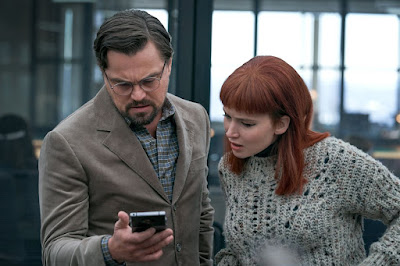
Após uma equipe na Universidade de Michigan descobrir a existência de um enorme cometa que irá colidir com a Terra em um período de 6 meses, resultando em um evento apocalíptico que irá exterminar toda a vida no planeta, o filme acompanha os astrônomos Dr. Randall Mindy (Leonardo DiCaprio) e a doutoranda Kate Dibiasky (Jennifer Lawrence), que embarcam em uma turnê para tentar alertar as autoridades e a sociedade do país sobre a iminente chegada do cometa, através de reuniões com a Presidente dos EUA (Meryl Streep) e seu filho Chefe de Gabinete (Jonah Hill) e de entrevistas em programas de TV. O problema é que ninguém parece dar muita bola.

(After a team at Michigan State University finds out the existence of an enormous comet that will collide with Earth in a period of 6 months, resulting in an apocalyptic event that will exterminate all life on the planet, the film follows astronomers Dr. Randall Mindy (Leonardo DiCaprio) and graduate student Kate Dibiasky (Jennifer Lawrence), who embark on a media tour to try and warn the country's authorities and society on the comet's imminent arrival, through meetings with the President of the United States (Meryl Streep) and her Chief of Staff son (Jonah Hill) and through interviews on gossip TV shows. The problem is nobody seems to give a damn.)


É, eu nem preciso dizer que eu estava bastante animado para assistir “Não Olhe para Cima”. A primeira razão seria a direção do Adam McKay, diretor de filmes de comédia mais conhecido por ter criado a franquia “O Âncora”, protagonizada por Will Ferrell, cujo primeiro filme rendeu sucesso suficiente para ganhar uma sequência, intitulada “Tudo por um Furo”, lançada em 2013. Fora da comédia mais comercial, McKay vem entregando filmes mais dramáticos nos últimos 5 anos, como “A Grande Aposta” (filme que lhe rendeu o Oscar de Melhor Roteiro Adaptado) e “Vice”, biografia de humor negro sobre o ex-vice-presidente dos EUA Dick Cheney. Eu sou enorme fã de “O Âncora” e de “Vice”, embora não tenha apreciado “A Grande Aposta” da maneira que eu esperava apreciar.

A segunda (e mais importante) razão para eu estar animado para assistir ao novo filme de McKay seria o seu elenco. E que elenco, meus amigos! Só de vencedores do Oscar, temos Leonardo DiCaprio, Jennifer Lawrence, Cate Blanchett, Mark Rylance e Meryl “Rainha” Streep. Passando aos indicados ao Oscar, temos Jonah Hill e Timothée Chalamet. E, depois, temos nomes como Rob Morgan, Ron Perlman, Melanie Lynskey, Tyler Perry, Himesh Patel, Ariana Grande e o rapper Kid Cudi, que já são bem frescos na consciência do público em geral. A boa expectativa em relação à um elenco desses é que o espectador terá a chance de ver estrelas como as citadas contracenando juntas. O lado ruim é que nos faz imaginar se o orçamento inteiro fora gasto para escalar a nata de Hollywood, com a equipe e a direção deixando o roteiro em segundo plano.

Mas, em uma daquelas vezes onde alguém fica extremamente grato por estar completamente equivocado, fico muito feliz em dizer que o roteiro não só é o verdadeiro destaque do filme, mas também ajuda o elenco estelar a extrair performances maravilhosas, devido aos paralelos claros e nada indiretos ao período que o mundo inteiro está enfrentando no momento. Esta combinação entre humor negro e ácido e um espelhamento da realidade acaba por fazer do novo filme de Adam McKay uma obra provocante, reflexiva, sagaz e até necessária.

Ok, com isso dito, vamos falar do roteiro. Escrito pelo próprio diretor, baseado em uma história elaborada com David Sirota, o roteiro de “Não Olhe Para Cima” retorna McKay às raízes de seu trabalho em comédias como “O Âncora”, munido de um senso de humor extremamente satírico que, certamente, não cairá aos agrados de todos. Mas, pelo menos para mim, funcionou perfeitamente com a vibe que o filme quis transmitir, resultando em momentos hilários onde a graça é especialmente evidente por estabelecer paralelos com o mundo real.

O tom de “Não Olhe Para Cima” foi uma das maiores surpresas para mim. O trailer me deu a impressão de que seria uma comédia normal, ou talvez um filme que misturaria comédia e drama, como os do Judd Apatow, mas eu amei como o diretor conseguiu inserir alguns momentos mais sérios, que servem de contraste quase perfeito com as várias piadinhas hilárias espalhadas pelo tempo de duração sucinto de 2 horas e 20 minutos do filme. Algo que me agradou bastante foi rever aqui alguns velhos hábitos de McKay utilizados em “O Âncora”, como o uso inventivo dos aspectos técnicos para acentuar o senso de humor do filme e a presença de piadas recorrentes, especialmente aquelas em relação à um personagem em particular.

Falando nos personagens, o diretor faz um ótimo trabalho em não desenvolvê-los como personagens em si, e sim como arquétipos de personalidades que se tornaram frequentes no mundo real, especialmente durante a pandemia de COVID-19, e é aqui onde o roteiro de McKay brilha: na tentativa pra lá de arriscada de transmitir críticas afiadíssimas, sarcásticas, descaradas e nada indiretas à vários aspectos da sociedade, especificamente durante esse período difícil em que estamos vivendo, sejam estes aspectos a cobertura de veículos midiáticos e a recepção do público em relação à estes conteúdos, o governo ou a divisão ideológica visível entre a população mundial.

Só no aspecto da mídia, há uma incontável série de cenas que tratam de temas que são essencialmente relevantes para os dias de hoje: fake news; a necessidade que a mídia tem de dourar a pílula, quando o assunto for difícil demais para digerir; o foco dos veículos midiáticos em abordar assuntos banais, que não farão a menor diferença no público, ao invés de focar no que importa; a ignorância da própria audiência ao digerir conteúdos midiáticos, minerando estes conteúdos para gerar memes e coisas do tipo; pessoas que ganham fama em detrimento daquelas que realmente a merecem; pessoas inteligentes que não possuem credibilidade por serem nativos de um território com menos autoridade. Há pelo menos duas cenas que o mundo todo precisa ver, sem exceções, pois elas expõem o que há de errado com a mídia durante a pandemia de COVID-19.

A política também é um tema proeminente no roteiro de McKay, e eu gostei bastante de como o diretor conseguiu fazer com que, ao mesmo tempo, as críticas fossem direcionadas à governos específicos (cof, cof, EUA e Brasil, cof, cof), e também assumirem um tom universal e imparcial, como se McKay estivesse apontando o dedo para todo lider político no planeta, não importa o partido. Da ignorância inicial do governo em relação à um iminente evento de extrema importância, à investida em tal evento para esconder algum podre recente ou passado, à meta de obter fama e votos a partir de um posicionamento político sobre esse evento, ao ajuntamento de um exército de pessoas que acreditam cegamente nas ideologias inexatas dessa figura, há também uma amálgama de críticas sociopolíticas em “Não Olhe Para Cima”, e tais críticas acabam por transformar o filme em uma obra provocante, reflexiva e, principalmente, atual.

Para finalizar essa parte do roteiro, gostaria de dizer que, até o presente momento, nenhum filme retratou os comportamentos da sociedade mundial durante a pandemia de COVID-19 de forma tão afiada e coerente do que “Não Olhe Para Cima”. É um dos roteiros mais originais dos últimos tempos, sendo hilário, sério, provocante e realista ao mesmo tempo. Todo mundo, independente do posicionamento que têm sobre a pandemia e a vacinação, precisa assistir à nova sátira de Adam McKay. Se não pelos temas e pelo retrato satírico da realidade, pela vindoura temporada de premiações, onde o filme promete se destacar nas principais categorias de cada cerimônia.

(Yeah, I don't even have to say that I was very excited to watch “Don't Look Up”. The first reason why would be its direction by Adam McKay, a comedy film director best known for creating the “Anchorman” franchise, led by actor Will Ferrell, where its first movie made enough success to spawn a sequel, titled “Anchorman 2: The Legend Continues”, released in 2013. Out of the blockbuster comedy spectrum, McKay has been delivering more dramatic films in the last 5 years, such as “The Big Short” (a film that won him the Oscar for Best Adapted Screenplay) and “Vice”, a black comedy biopic about former Vice-President of the US Dick Cheney. I'm a huge fan of “Anchorman” and “Vice”, despite not appreciating “The Big Short” as I expected to.

The second (and most important) reason why I was excited to watch McKay's new film was its cast. And what a cast, ladies and gentlemen! When it comes to Oscar winners, we have the likes of Leonardo DiCaprio, Jennifer Lawrence, Cate Blanchett, Mark Rylance and Meryl “Queen” Streep. Moving on to Oscar nominees, we have Jonah Hill and Timothée Chalamet. And, then, we have names like Rob Morgan, Ron Perlman, Melanie Lynskey, Tyler Perry, Himesh Patel, Ariana Grande and rapper Kid Cudi, which are already pretty fresh in the general audience's collective consciousness. The good expectations about a cast like this one is that the viewer will finally get to see stars like these sharing the screen together. The bad side is that it makes us wonder if the entire budget was spent to cast Hollywood's cream of the crop, with the crew and direction leaving the screenplay behind.

But, in one of those times where someone feels extremely thankful for being completely mistaken, I'm really glad to say that, not only is the screenplay the film's greatest highlight, but it also helps its stellar cast to extract great performances, due to the clear and not-subtle-at-all parallels to the period that the whole world is going through right now. This combination between dark and acid humor and a mirroring of reality ends up turning McKay's new film into a provocative, thought-provoking, witty, and even necessary piece of filmmaking.

Okay, with that said, let's talk about the screenplay. Written by the director himself, based on a story co-written with David Sirota, the screenplay for “Don't Look Up” returns McKay to his work's roots in comedy films like “Anchorman”, armed with an extremely satirical sense of humor that'll, certainly, not please every person who takes the time to watch the film. But at least for me, it worked perfectly with the vibe the film wished to convey, resulting in some hilarious moments that are particularly funny because of their parallels with the real world.

The tone of “Don't Look Up” was one of its biggest surprises for me. The trailer gave me the impression that it was going to be some run-of-the-mill comedy, or something that blends comedy and drama, much like Judd Apatow's films, but I loved how the director managed to put in some pretty serious moments, which serve as the perfect contrast with the several jokes and puns scattered throughout the film's succint runtime of 2 hours and 20 minutes. One thing that pleased me a lot was to witness, in this film, some of McKay's old habits that were established in “Anchorman”, such as the inventive use of the technical aspects to enhance the film's sense of humor and the presence of recurring jokes and gags, especially in regards to one particular character.

Speaking of characters, the director does a great job in not developing them as characters themselves, but as archetypes of personalities that became frequent in the real world, especially during the COVID-19 pandemic, and this is where McKay's screenplay has its chance to stand out: in its highly risky attempt of conveying razor-sharp, sarcastic, unfiltered and not at all subtle criticism to several aspects of society, whether those aspects are media coverage and the public's reception to those kinds of content, the government or the visible ideological division between the world population.

Only when it comes to media, there is a countless series of scenes that deal with themes that are essentially relevant to today's times: fake news; the need media has to make news a bit easier to swallow, when they can be hard to chew; the focus of media outlets in talking about meaningless subjects, which will not make any difference in the general public's lives, instead of talking about what really matters; the own audience's ignorance when digesting these media content, mining such contents to generate memes and such; people who gain fame and success on top of the people who really deserve it; smart people who don't have any credibility just because they're native of a territory with less authority. There are, at least, two scenes that the entire world needs to see, no exceptions, as they expose exactly what's wrong with media coverage of the COVID-19 pandemic.

Politics is also a proeminent theme in McKay's screenplay, and I really liked how the director managed to make that, at the same time, the criticism is directed towards specific governments (cough, cough, US and Brazil, cough, cough) and it also assumes an universal, impartial tone, as if McKay was pointing the finger to every political leader in the world, regardless of their political party. From the government's initial ignorance in regards to an extremely important imminent event, to their investment in such an event in order to hide past or present things they didn't want people to know, to the goal of obtaining fame and votes through a political position regarding that event, to the gathering of an entire army of people who blindly believe in this figure's inaccurate ideologies, there are also several real political views and thoughts in “Don't Look Up”, and such criticism ends up making the film more provocative, thought-provoking and, mainly, timely.

To cap off this part on the screenplay, I'd like to say that, until this present day, there hasn't been a film that portrayed the attitudes of world society during the COVID-19 pandemic in such a sharp and coherent way than “Don't Look Up”. It's one of the most original screenplays in recent memory, being simultaneously hilarious, serious, provocative and realistic. Everybody, regardless of their political position when it comes to the pandemic and vaccination, has to watch Adam McKay's new satire. If not for the themes and its satirical portrayal of reality, watch it for next year's award season, where the film promises to stand out in the main categories of each ceremony.)


Como dito anteriormente, a quantidade de talento presente no elenco de “Não Olhe Para Cima” é tão impressionante, que o conjunto de atores deve ser considerado como um recordista de “maior número de pessoas talentosas em uma cena”, juntamente com várias cenas dirigidas por Wes Anderson. McKay faz um trabalho estupendo de colocar cada ator em um arquétipo bem específico de comportamentos da sociedade atual, e a melhor maneira de medir a performance de cada um é justamente comparando cada um aos arquétipos correspondentes.

Vamos começar pelo trio principal de atores: Leonardo DiCaprio, Jennifer Lawrence e Rob Morgan. Eles seriam os heróis da história, e é incrível ver as diferenças na abordagem do iminente evento cataclísmico que cada personagem faz, e é mais incrível ainda ver como isso impacta na relação que eles têm com outros personagens. Faz um bom tempo que eu não via a Jennifer Lawrence atuar tão bem, e dá pra sentir a injustiça pela qual sua personagem está passando, através da performance dela. Entre os três personagens principais, ela é certamente a mais preocupada sobre a iminente chegada do cometa, e os descarregos que ela faz ao longo do filme são, ao mesmo tempo, hilários e devastadores.

Eu amei o quão ingênuo o personagem do DiCaprio começa sendo, expondo dados científicos para tentar adiar o pronunciamento das duras verdades. Mas aí, a partir da segunda metade do filme, há uma desconstrução brilhante dessa ingenuidade para uma honestidade crua e agressiva, a qual culmina em uma das melhores, se não a melhor cena de um filme de 2021 (tirando de super-heróis, porque houveram muitas cenas legais... [Risos]). Certamente vale uma indicação ao Oscar de Melhor Ator. O Rob Morgan fica, basicamente, no mesmo barco que a Jennifer Lawrence, com o seu personagem sendo injustiçado pelo governo e pela sociedade em relação ao descobrimento do cometa, algo que fica ainda mais agravante devido à cor de pele do personagem e do ator.

A Meryl Streep e o Jonah Hill são os representantes do governo, e quem teve a ideia de colocar esses dois como mãe e filho merece um prêmio. Considerando o calibre de Streep e Hill, que já foram reconhecidos pela Academia várias vezes com indicações e (no caso de Streep) vitórias, é quase inacreditável ver atores tão consolidados e consagrados interpretando personagens tão ignorantes, mas Streep e Hill dão um verdadeiro show aqui, roubando a cena em literalmente toda vez em que aparecem. As comparações dos personagens de Streep e Hill à figuras políticas tanto dos EUA quanto do mundo afora são descaradamente evidentes, e não irão agradar todo mundo, mas me divertiram bastante. Eu dou um destaque em especial pro Jonah Hill, pois ele faz um ótimo trabalho em ser absolutamente irritante, e eu acho que ele deveria ser indicado ao Oscar de Melhor Ator Coadjuvante, pelas várias pérolas que seu personagem solta ao longo do filme.

Eu gostei bastante da indiferença e do egocentrismo que marcam as performances da Cate Blanchett, do Tyler Perry e do Mark Rylance. É incrível ver como os atores manipulam os eventos noticiados por seus personagens à favor deles, e é incrivelmente triste ver que o que atores estão fazendo em um filme é exatamente o que está acontecendo na vida real, e por isso, vai mais um ponto no placar do roteiro de McKay. As performances dos três atores conseguem expor precisamente o que há de errado na apresentação de programas de notícia e no empreendedorismo tecnológico nos dias de hoje. Creio que essa foi a melhor performance do Mark Rylance desde seu papel vencedor do Oscar por “Ponte de Espiões”.

O personagem do Ron Perlman representa a velha guarda da sociedade, um brutamontes que ainda se vincula aos valores da sua época de glória, e as cenas onde ele aparece são sempre engraçadas. O Timothée Chalamet interpreta um adolescente rebelde que é contra o sistema, e fiquei meio na dúvida em relação à religião do personagem, porque às vezes parece sério, mas em outras, parece que é alívio cômico. E para terminar com chave de ouro, temos Ariana Grande e Scott Mescudi (ou Kid Cudi), cuja coragem é preciso admirar, já que seus personagens abertamente criticam as personas que celebridades do calibre deles assumem. As interações entre os dois são hilárias e tem uma música original cantada pelos seus personagens que merece uma performance no Oscar ano que vem.

(As previously stated, the amount of talent present in the cast of “Don't Look Up” is so impressive, that the ensemble of actors should hold the record of “largest number of talented people in one single scene”, alongside several scenes directed by Wes Anderson. McKay does a stupendous job in putting every actor in a very specific archetype of current society's behaviours, and the best way to evaluate each actor's performance is, in fact, comparing them to the matching archetype.

Let's start with the main trio of actors: Leonardo DiCaprio, Jennifer Lawrence and Rob Morgan. They would be the heroes of the story, and it's amazing to see how different their approaches to the imminent cataclysmic event are, and it's even more amazing to see how those differences impact their relationships with other characters. It's been quite a while since I last saw Jennifer Lawrence play a role this good, and you can feel the injustice her character is going through, through her performance. Between the three main characters, she is surely the one who is most worried about the comet's arrival, and her meltdowns throughout the film are, at the same time, hilarious and devastating.

I loved how naive DiCaprio's character starts off as, exposing scientific data in order to postpone the pronouncing of the cold, hard truth. But then, starting from the film's second half, there is a brilliant deconstruction of this naiveté into a raw, agressive honesty, which culminates in one of the best, if not the best movie scene of 2021 (apart from superhero stuff, because there were a lot of cool ones in those... LOL). It's deservingly worth an Oscar nomination for Best Actor. Rob Morgan stays, basically, on the same boat as Jennifer Lawrence, with his character being the target of injustice by the government and society for his involvement in the comet's discovery, something that becomes even more aggravating considering the actor and character's skin color.

Meryl Streep and Jonah Hill are the film's representatives of the government, and the person who had the idea of casting these two as mother and son deserves an award for it. Considering Streep and Hill's caliber, as both of them were recognized by the Academy with nominations and (in Streep's case) wins, it's almost unbelievable to see such consolidated and celebrated actors playing such ignorant characters, but Streep and Hill put on one hell of a show here, stealing the scene in literally everytime they appear onscreen. The comparisons between Streep and Hill's characters and political figures both from the US and abroad are crystal-clear evident, and they will not be to everyone's pleasure, but they were a lot of fun for me. I give a special highlight to Jonah Hill, as he does a great job in being absolutely annoying, and I think he should be nominated for the Oscar for Best Supporting Actor, for the numerous hilarious moments he's in throughout the film.

I really enjoyed the indifference and the self-centered vibe that was imprinted in Cate Blanchett's, Tyler Perry's and Mark Rylance's performances. It's incredible to see how the actors manipulate the events reported by their characters to their own benefit, and it's incredibly sad to see that what actors are portraying in a film is exactly what's going on in real life, and because of that, that's one more positive point for McKay's screenplay. The three actors' performances manage to precisely expose what's wrong with today's TV show hosting and technological entrepreneurship. I believe that this was Mark Rylance's best performance since his Oscar-winning role in “Bridge of Spies”.

Ron Perlman's character represents the older part of society, an old brute who's still attached to the values of his glory days, and he's funny in every single scene. Timothée Chalamet plays a rebellious teenager on a fight with the system, and I was on the fence when it came to the character's religion, because sometimes it feels like it's serious, but others sound like it's a source of comic relief. And, to cap this part off with a bang, we have Ariana Grande and Scott Mescudi (or Kid Cudi), and you have to admire their courage, as their characters are an open criticism to the personas that celebrities on their level take as their own. The interactions between the two of them are hilarious, and there's an original song sung by their characters that deserves a performance at the Oscars next year.)


Como em “O Âncora”, McKay faz um uso inventivo dos aspectos técnicos a favor da narrativa de “Não Olhe Para Cima”, e tudo aqui funciona por ser essencialmente realista. Não há nenhum filtro na direção de fotografia excelente do Linus Sandgren que retire a temporalidade da história dos dias de hoje. Há até algumas cenas onde há o uso da infame “shaky-cam” (câmera que balança), o que injeta uma crueza necessária para fincar os pés do roteiro de McKay no chão, o que foi muito bem-vindo, na minha opinião. Mas, é claro, para dar origem ao cometa e às tecnologias avançadas presentes no filme, há um uso generoso de CGI, mas isso não polui, ou tira a qualidade do filme de nenhuma forma.

O trabalho de Sandgren na fotografia e a montagem do Hank Corwin trabalham em conjunto para retratar a ansiedade que passa pela cabeça dos protagonistas, a necessidade que eles têm de contar essa notícia para o maior número de pessoas possível. A câmera acompanha as mudanças no comportamento de algum personagem ou corta para focar ainda mais nesse personagem, e funciona. É absolutamente angustiante estar na pele destes dois protagonistas, e Sandgren e Corwin conseguem capturar isso com perfeição. A montagem de Corwin também é essencial para o funcionamento de algumas cenas de alívio cômico, e a proeza técnica dessas cenas, combinadas com a escrita de McKay, resultam em momentos verdadeiramente hilários.

E, por fim, temos a trilha sonora original, composta por Nicholas Britell, compositor dos filmes de Barry Jenkins, como “Moonlight” e “Se A Rua Beale Falasse”. Eu não sei uma maneira melhor de falar isso, então lá vai: a trilha sonora de Britell combina perfeitamente com a vibe “científica” do filme. Há algumas faixas que fazem uso de sintetizadores, que acentuam o teor de ficção-científica da narrativa, mas, por outro lado, há algumas faixas sensacionais no estilo de jazz, que me lembraram muito do trabalho do Justin Hurwitz em “La La Land”. A canção original “Just Look Up”, cantada e composta por Ariana Grande e Kid Cudi, é maravilhosamente satírica, sendo esperançosa e deprimente ao mesmo tempo. Mal posso esperar pela inevitável performance dessa canção no Oscar ano que vem, mesmo que, com Billie Eilish, Beyoncé e Lin-Manuel Miranda na corrida, tenha menos chances de levar a estatueta de Melhor Canção Original.

(Just like in “Anchorman”, McKay makes an inventive use of the technical aspects to the benefit of the narrative of “Don't Look Up”, and everything here works for being essentially realistic. There isn't any filter in Linus Sandgren's excellent cinematography that withdraws the film's temporality from today's times. There are even some scenes where there's the use of the infamous “shaky cam”, which injects a necessary rawness to keep the feet of McKay's screenplay on the ground, which was really welcome, in my opinion. But, of course, in order to create the comet and the advanced technologies present throughout the film, there's a hefty use of CGI, but that doesn't pollute, or take out any of the film's quality in any way.

Sandgren's work in the cinematography and Hank Corwin's editing work in tandem in order to convey the anxiety that's going through the protagonists' heads, the need they have of telling this news to as many people as they can. The camera follows the behavior shifts of some character or cuts to focus even more on that character, and it works. It's absolutely infuriating to be under these characters' skin, and Sandgren and Corwin manage to capture that with perfection. Corwin's editing is also essential for some of the comic relief scenes to work, and the technical prowess displayed on those scenes, combined with McKay's writing, results in truly hilarious moments.

And at last, but not least, we have the original score, composed by Nicholas Britell, composer for most films directed by Barry Jenkins, such as “Moonlight” and “If Beale Street Could Talk”. I can't think of a better way to say this, so here it goes: Britell's original score fits perfectly with the film's “scientific” vibe. There are some scenes that make use of synthesizers, which heighten the narrative's science fiction tone; but, on the other hand, there are some sensational tracks on the style of jazz, which particularly reminded me of Justin Hurwitz's work in “La La Land”. The original song “Just Look Up”, sung and composed by Ariana Grande and Kid Cudi, is wonderfully satirical, being hopeful and depressing at the same time. I can't wait for this song's inevitable performance at the Oscars, even though that, with Billie Eilish, Beyoncé and Lin-Manuel Miranda in the race, it has minor chances of winning the award for Best Original Song.)


Resumindo, “Não Olhe Para Cima” é mais uma prova de que Adam McKay é um mestre da sátira. Munido de um roteiro hilário, atual, afiado, provocativo e realista; atuações incríveis de um elenco absurdamente talentoso e aspectos técnicos que são utilizados de forma inventiva para auxiliar a narrativa, o filme consegue ser o retrato cinematográfico mais coerente, descarado e fiel aos comportamentos da sociedade mundial durante a pandemia de COVID-19. Por tudo isso e mais um pouco, a nova empreitada de McKay é, para mim, um dos melhores filmes de 2021 e merece todo o reconhecimento que certamente receberá nas vindouras premiações. P.S.: Fiquem até depois dos créditos, pois há duas cenas hilárias que valem a pena esperar!!

Nota: 10 de 10!!

É isso, pessoal! Espero que tenham gostado! Até a próxima,

João Pedro

(In a nutshell, “Don't Look Up” is further proof that Adam McKay is a master of satire. Armed with a hilarious, timely, sharp, provocative and realistic screenplay; amazing performances by an absurdly talented cast and technical aspects that are used in an inventive way to help the narrative, the film manages to be the most coherent, unfiltered and faithful cinematic portrayal of society's behaviours during the COVID-19 pandemic. Because of all that and even more, McKay's new endeavour is, to me, one of the best films of 2021 and worthy of every recognition it'll certainly get in the upcoming award shows. P.S.: Stay through until after the credits, because there are two hilarious scenes that are worth waiting for!!

I give it a 10 out of 10!!

That's it, guys! I hope you liked it! See you next time,

João Pedro)